Najaf hosts the funeral of Iran's martyred leader — and Iraq's religious establishment takes its place in the send-off
Iraqis gathered in Najaf Ashraf in the early hours of 8 July 2026 to escort the body of Iran's martyred leader through one of Shia Islam's holiest cities. Iranian state-aligned outlets framed the turnout as a farewell from a neighbour; Western analysts are already reading it as cross-border political signalling.
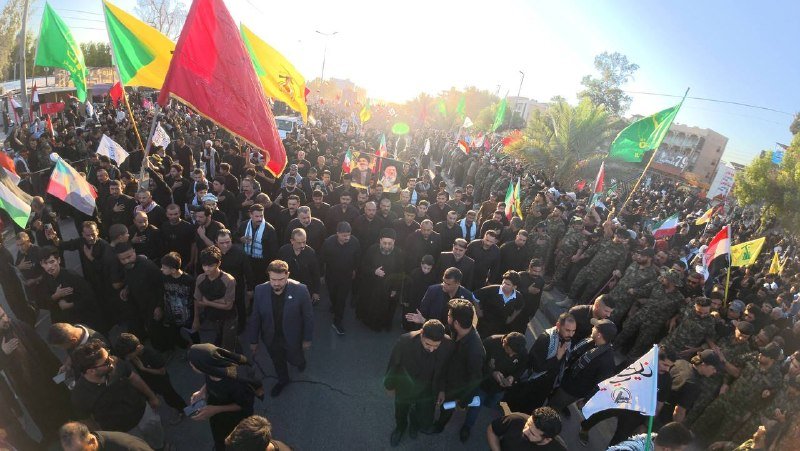
Mourners began arriving in Najaf Ashraf in the small hours of 8 July 2026, clustering around the starting point of a funeral procession for the leader of Iran described in the banners draped across Iraqi streets as the "martyred leader of the nation." Tasnim, the English-language outlet of the Islamic Republic's state-aligned Tasnim News Agency, broadcast the gathering live; its Arabic-language sister channel Jahan Tasnim framed the turnout as "the historic farewell of the Iraqi people." Al Alam Arabic, the Tehran-aligned satellite broadcaster, ran an "urgent" line that mourners were coming "non-stop" from early morning. The body was being prepared for burial at 02:33 UTC, with the procession car in position by 02:54 UTC, according to Jahan Tasnim's rolling coverage.
The scene matters for what it stages rather than only for what it depicts. Funerals conducted in Najaf — home to the Shrine of Imam Ali and a seat of Shia religious learning on roughly equal theological footing with Qom — carry weight that do not transfer to any other Arab city. A senior Iranian figure buried in the Iraqi holy city, after a procession through it, in front of Iraqi crowds, places Iraqi religious and political actors in the role of hosts rather than mourners. That distinction does not depend on a viewer being friendly to Tehran; it is legible from the wording on the banners and from the live, multi-hour coverage on Iranian state outlets alone.
The morning in Najaf
Iranian state-aligned outlets tracked the timetable with the cadence of an official programme. By 02:22 UTC on 8 July, Jahan Tasnim's English desk was already flagging "a large gathering of people to bury the holy body." Forty minutes later, the outlet posted preparation footage of the vehicle that would carry the remains through Najaf's streets. By 03:19 UTC, banners again confirmed the scale of the crowd. By 03:26 UTC, Al Alam Arabic described mourners still arriving. At 04:09 UTC, Jahan Tasnim titled its milestone post "the historic farewell of the Iraqi people" — language that places the Iraqi public as agents of the send-off rather than as bystanders.
Mehr News, the Iranian official news agency, distributed a short video clip from the funeral itself, captioned simply "Iraqi mourning during the funeral of the martyred leader of Iran in Najaf Ashraf." The four sources that carried the day's coverage — Tasnim English, Jahan Tasnim, Al Alam Arabic and Mehr — are all either Iranian state outlets or Iran-aligned satellite networks operating in Arabic. None is an Iraqi wire. The Iraqi press has not yet, in the items reviewed here, put forward an independent count of attendees or a description of the Iraqi security perimeter, which leaves the visible scene functionally Iranian-curated.
What Iraqi framing may add — when it arrives
A second frame is plausible and has not yet been sourced in the items reviewed. Iraqi religious and political actors — Grand Ayatollahs in the hawza, the Sadrist movement, the Coordination Framework parties that run the federal government in Baghdad, tribal networks in Najaf and Karbala — all have their own calculations about what kind of funeral their city hosts. They have, historically, balanced three pressures: fraternity with the Iranian clerical establishment that organises Shia scholarship across the Iran-Iraq border; loyalty to Iraqi sovereignty and distance from networks formally designated as Iraqi militias; and quiet resentment, on the Iraqi street, of being treated as the back yard of a larger neighbour. How heavily each of those pressures registered in the early-morning turnout is not visible from the Iranian outlets alone.
The hard-to-corroborate zone is also evident in the load-bearing word repeated across the banners: "martyred." In Shia clerical and political vocabulary, the term carries a specific doctrinal and political weight — applied to figures killed for the cause of the faith or the resistance, with commemorative duties that follow. Iranian state outlets use it reflexively when describing Iranian security officials, military commanders, allied paramilitary leaders, and senior political figures who die by assassination. Whether Iraqi religious authorities formally accept that framing — and whether the deceased is being commemorated in Najaf under Iranian clerical sponsorship or under Iraqi hawza sponsorship — is a question the day's raw footage cannot answer. The sources reviewed here say only that the body passed through Najaf and was prepared for burial; they do not specify who led the prayers, who issued the burial permit, or which authority sponsored the commemoration.
The cross-border political read
A reading now circulating on Western analysis desks, though not yet sourced from those desks in the materials under review, runs as follows. Iran is in a phase in which the projection of religious and political legitimacy abroad has become a substitute for the projection of hard power; sectarian movements that once articulated themselves through territorial depth inside Iraq, Lebanon and Syria are now articulating themselves through state ritual, sanctuary funerals and historical commemoration. From that vantage point, the choice to bring the body to Najaf — and not bury it at Behesht-e Zahra in southern Tehran, in Qom next to Ayatollah Khomeini and Ayatollah Khamenei, or in a martyrdom-themed cemetery to the north — reads as a deliberate signal that Tehran wants Arab Shia audiences, not just Iranian ones, to define the deceased.
The material facts that the day establishes are more limited than that frame, but they are also firmer. An Iranian official's body was brought to Najaf; Iraqi citizens were visible in the procession in numbers Iranian state media described as historic; the lead coverage was Iranian rather than Iraqi. From those three facts — all of them traceable to Iranian state outlets and their Arabic channels alone — a careful reader can already place Najaf inside a wider pattern of Iran-led funerals staged in cities outside Iran, in which the host city's role is signalled as a credential of regional Shia communion rather than an act of mourning per se.
Stakes over the coming weeks
What changes next will be set less by the procession than by the aftercare. The short, observable tells will be Iraqi religious authorities' own statements — whether they describe themselves as hosts, mourners or co-celebrants; whether Iraqi security organs publish attendance figures; whether Iraqi state-aligned outlets run parallel or competing coverage; whether televised condolences come from Iraqi Shia clergy at the senior ayatollah level or only from political-class figures. Each of those signals tightens or loosens the read.
For Tehran the stakes are about presence rather than territory. In a year in which the wider regional project of armed Shia mobilisation has thinned and in which ordinary Shia populations in Arab states have shown signs of wanting distance from militias branded as Iranian partners, a Najaf funeral reopens a softer door: religious legitimacy, clerical fraternity, public grief, the architecture of pilgrimage rather than the architecture of rockets. For Baghdad the stakes are sharper still — Najaf is Iraq's holy city, and decisions about its airspace, its security perimeter and its clerical invitations are decisions on which Iraqi sovereignty turns. The sources reviewed do not yet report an Iraqi government statement; they will be the right ones to watch, and the ones that decide what kind of story the 8 July procession turns out to have been.
On the wire: this article is built on Iranian-state and Iran-aligned Arabic-language coverage filed between 02:22 UTC and 04:09 UTC on 8 July 2026. Monexus has not yet received Iraqi wire or Iraqi religious-authority framing; the read will be updated as Iraqi-side sourcing arrives.
Wire provenance
This editorial synthesis draws on the following public wire/social posts:
- https://t.me/JahanTasnim
- https://t.me/JahanTasnim
- https://t.me/JahanTasnim
- https://t.me/JahanTasnim
- https://t.me/tasnimnews_en
- https://t.me/alalamarabic
- https://t.me/mehrnews