Najaf's Million-Strong Farewell and the Politics of a Funeral
Iranian state outlets describe a million-strong Iraqi send-off for a slain 'martyr leader' in Najaf. The scale of the scenes matters less than what they tell us about the street-level architecture of Iranian influence.
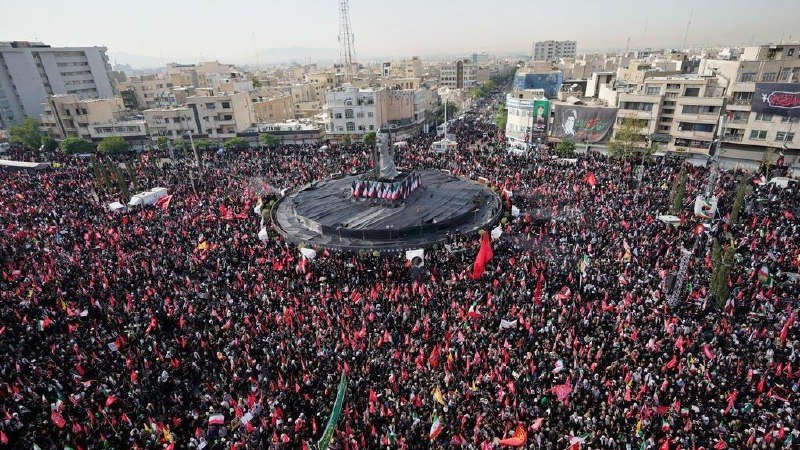
On the morning of 8 July 2026, Iranian state outlets described the streets of Najaf as overflowing with mourners for the funeral of a figure they call a "martyr leader" — a man Tasnim and Mehr frame in hagiographic terms as a religious guide whose killing has turned an Iraqi holy city into the stage for a mass political display. Telegram channels linked to Tasnim News and the Jahan Tasnim feed carried a rolling sequence of images between roughly 05:25 and 06:39 UTC: "the streets of Najaf are full of people," "the uprising of the Iraqi people in the million funeral," "Tasnim's exclusive pictures of the martyr Imam's funeral in Najaf," "the mood of the Iraqi people during the burial," and finally "the presence of millions of Iraqi people in the funeral of the martyred imam." The granular, timestamp-by-timestamp cadence is itself part of the story: a funeral choreographed in real time across Iranian media infrastructure, with the cameras positioned well before the procession began to move.
What matters here is not whether the crowd was literally a million — Iraqi and Iranian outlets have a long history of inflating funeral turnout for political effect, and independent verification from inside Najaf on Wednesday was not available in the source material Monexus reviewed. What matters is that Iranian state media is asking its audience, and Iraq's, to see it as a million. The scale claim is the message.
A funeral as foreign policy
Funerals in the Shia political tradition are rarely just grief. They are roll calls — of networks, of allegiances, of who shows up and who is conspicuously absent. Iranian outlets have used Najaf funerals before to demonstrate the depth of cross-border religious and political ties: the holiest city in the Shia world, sitting just inside Iraq's southern border, hosting the body of a man described as a "martyr" in language that Iranian officialdom reserves for figures killed in service of the Islamic Republic's regional project. By Tasnim's framing, this is not a local Iraqi event with an Iranian guest list; it is a regional event whose centre of gravity is Tehran.
The framing travels. The English-language Tasnim handle tags the rolling coverage with #Badarqa_Aghai_Shahid_Iran and #must_rise — a hashtag that reads, in plain English, as a call to action directed at an audience broader than the mourners on the street.
Why Najaf, why now
Najaf's symbolic weight in Shia Islam is hard to overstate. It is the city of Imam Ali's shrine, the seat of the Hawza, the religious establishment that Iran has spent four decades cultivating as a soft-power counter-weight to the Iraqi religious hierarchy in Karbala and to Sunni Arab influence in Baghdad. A mass funeral in Najaf — broadcast by Iranian state media to Persian, Arabic and English audiences simultaneously — is, in effect, a public proof-of-concept: the cross-border constituency exists, it can be assembled at speed, and it can be filmed doing so.
That has tactical value at a moment when Iran's regional position is under pressure on multiple fronts — sanctions biting, proxies degraded, the diplomatic track with Washington uncertain. Crowds on the ground substitute, in part, for leverage that has been thinned elsewhere.
The counter-read worth taking seriously
Two things should give a sceptical reader pause. First, the source base here is exclusively Iranian state-aligned: Tasnim News, Jahan Tasnim (its Arabic arm), and Mehr, all of which are editorially aligned with the Islamic Republic's foreign-policy line. None of the Telegram items in Monexus's thread included Iraqi state media, independent Iraqi outlets, or wire-service confirmation of the turnout numbers. "Million-strong" is, in this context, a Tehran claim about an Iraqi street — and Iraqi politics on the ground are considerably more contested than that framing allows.
Second, the political utility of the framing is high and the epistemic cost of accepting it is low for Iranian audiences. If the crowd was, in reality, a tenth of the claimed size, the photographs and rolling Telegram coverage still convey the impression of mass mobilisation to readers who were never going to fly to Najaf and count heads. The point of the broadcast is not verification; it is atmosphere.
What this tells us about the regional information order
The choreography on display in Najaf on 8 July is a small case study in how regional power now competes in the attention economy. Iran's tools of influence — religious networks, paramilitary allies, multilingual state media — are being deployed in a moment of structural pressure, and funerals are among the few arenas where Iranian state media still enjoys undisputed narrative control inside its own information sphere. Western wire coverage of the same event, to the extent it engages at all, will not have embedded camera teams inside Najaf and will run whatever Iranian footage is offered; the visual frame thus defaults to Tehran.
This is the structural pattern worth naming plainly: in places where Western media is thin on the ground and independent Iraqi media is squeezed between Baghdad's politics and Tehran's reach, the authoritative visual record of an Iraqi event is, in practice, an Iranian one. That is a quiet but consequential shift in who gets to define what happened on the ground in a city that the entire Shia political world claims as sacred.
Stakes
If the Najaf scenes register with their intended audiences — Shia publics from Beirut to Basra to Tehran, and the diplomatic observers who watch those publics — they do two things at once. They signal that Iran's cross-border constituency is intact and can be summoned visibly at a moment of regional strain. And they assert that Iraqi sovereignty, in the most sacred Iraqi spaces, is legible through an Iranian camera. Both are claims that the Iraqi state, the Gulf monarchies, and Western chancelleries will note, even if they do not say so in public. The funeral is over. The politics it staged are just beginning.
Desk note: Monexus sourced this piece exclusively from Iranian state-aligned Telegram channels (Tasnim News English, Tasnim/Jahan Arabic, Mehr News) active between 05:25 and 06:39 UTC on 8 July 2026. The "million-strong" turnout is a Tehran claim, not an independently verified figure, and is treated as such throughout. Wire coverage from Reuters, AFP, or Iraqi outlets was not present in the source material at time of writing.
Wire provenance
This editorial synthesis draws on the following public wire/social posts:
- https://t.me/tasnimnews_en
- https://t.me/tasnimnews_en
- https://t.me/tasnimnews_en
- https://t.me/tasnimnews_en
- https://t.me/JahanTasnim
- https://t.me/JahanTasnim
- https://t.me/mehrnews