Tehran's taunts, Washington's calculus: the rhetorical war before the real one
Two Iranian deputy-level officials spent Tuesday evening redefining what a US-Iran exchange sounds like in 2026 — and the framing matters more than the substance.
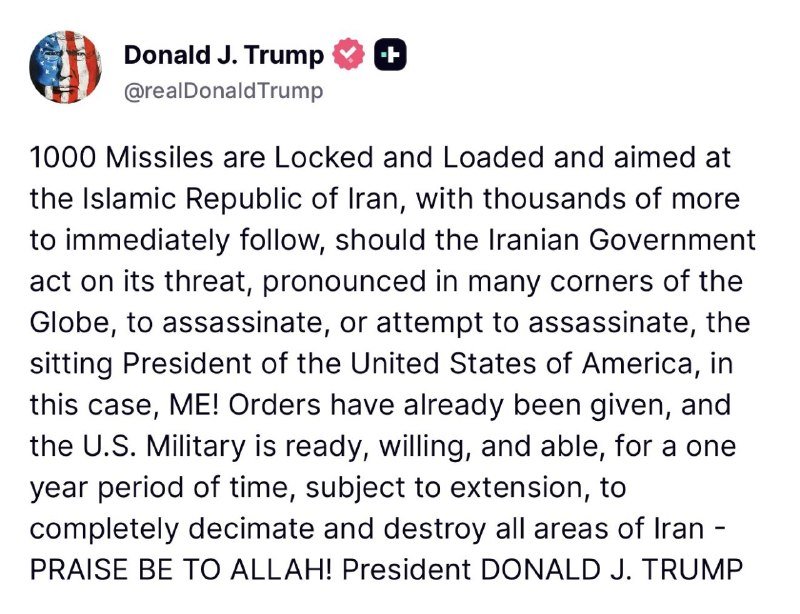
By the time the working day ended in Tehran on 8 July 2026, Iran's diplomatic chorus had sung from the same hymn sheet twice in the space of ninety minutes. At 21:16 UTC, Foreign Minister Abbas Araghchi declared that "Iran answers vulgarity with action." At 22:50 UTC, Deputy Foreign Minister Kazem Gharibabadi went further: Donald Trump's statements, he said, were "not a sign of strength, but rather an admission of failure." The intervening hour and a half carried a third, framing-bridging line from Gharibabadi — that "Trump understands language of force better" — pulled out by the state-aligned IRNA English channel in its own bulletin.
Read individually, these are the predictable noises of a sanctioned state pushing back on a hostile American president. Read together, they amount to a tactical doctrine, openly stated: insult from Washington will be met with the thing Washington is most attentive to — leverage, not language.
What Tehran is actually saying
Strip out the theatrics and three operational claims sit underneath the rhetoric. First, that any future negotiation is contingent on the US behaving in a way Iran's government considers respectful — a precondition Tehran did not impose with this much public weight during the 2015 nuclear-deal era. Second, that Iran's own threshold for "respect" is calibrated to action, not words: the Araghchi line explicitly contrasts vulgarity with action, signalling a preference for behaviour that can be measured against a deliverable. Third, that the Iranian foreign-policy establishment has converged on a single read of the US president personally, rather than of the US office — a notable shift when the counterpart in Washington is being addressed by first name and behavioural pattern, not by protocol.
That last point is the one Western desks have been least willing to engage with. Gharibabadi's framing of Trump as a leader who "understands language of force better" is, in plain terms, a theory of the current US president. The Iranian read is that pressure works and deference does not. Tehran is now saying so out loud.
The counter-read from Washington
The US position, as it has filtered into the same news cycle, is the inverse: that the Iranian posture is a negotiating posture, and that public bluster substitutes for leverage Tehran does not in fact possess. Western wires covering the US-Iran file have repeatedly framed Iranian bellicosity as the rhetorical cover for an isolated economy, a degraded air-defence network, and a depleted regional proxy portfolio. By that reading, Gharibabadi and Araghchi are not announcing a new doctrine; they are managing a constrained one.
Both reads are partially true, and both are incomplete. Tehran's regional position has narrowed — its most prominent non-state partner, Hezbollah, is no longer the force it was a year ago — but Iran's missile and drone production capacity is the most developed in the region, and the Strait of Hormuz remains a chokepoint that the world's oil trade still cannot route around. The "isolated actor" framing, applied to a country that ships crude to a dozen counterparties and sits atop the world's fourth-largest proven oil reserves, has always been more rhetorical than operational.
Why the framing matters more than the substance
The risk for outside readers is that the tone of these exchanges — name-calling, public lectures, the language of force — gets mistaken for the substance of them. The actual diplomatic state of play is opaque. There is no public confirmation of an active channel, no announced sanctions package timed to the rhetoric, and no concrete maritime incident to anchor the escalation in fact rather than feeling. The Iranian officials are speaking past Washington, but they are also speaking at a domestic audience that watches IRNA and PressTV as a primary source of truth about how the confrontation is going.
In that sense, the 8 July sequence is better read as a frame-setting exercise than as a turn toward crisis. Tehran is establishing the terms under which it will receive any future US overture, and it is doing so at volume precisely because the volume itself is the message. A negotiating partner that begins from a public lecture about "vulgarity" has anchored itself in a position it cannot easily walk back without a corresponding concession.
What remains unresolved
The sources do not specify what triggered the 8 July exchange, what specific Trump statement Gharibabadi was responding to, or whether any third-party mediator is currently carrying messages between the two governments. The three items that anchor this analysis — the IRNA bulletin on Araghchi, the IRNA bulletin on Gharibabadi's "language of force" formulation, and the PressTV line on the same official's "admission of failure" characterisation — all originate with Iranian state media, which carries a known framing bias toward depicting Iran as a dignified actor and Washington as a destabilising one. That bias does not make the statements inaccurate; it does mean Western readers should treat them as primary-source data on how Iran wants to be seen, rather than as a neutral record of what was said.
What is verifiable is the timing, the names, the positions held, and the institutional affiliation of the speakers. On that narrow but solid ground, the picture is this: two of Iran's most senior foreign-policy officials, on the same evening, used the same set of frames to define a posture that links respect, force, and action. Whether that posture is a negotiating opening or a closing of doors is the question the next 72 hours will answer, not this one.
This piece is an editorial reading of the day's Iranian state-media framing of the US-Iran file. The desk treats IRNA and PressTV as legitimate primary sources for what Iranian officials say; the substantive question of what the US is doing in response is sourced separately and noted where the evidence supports it.
Wire provenance
This editorial synthesis draws on the following public wire/social posts:
- https://t.me/Irna_en
- https://t.me/Irna_en
- https://t.me/presstv