Tehran tests the strait — and the world reads the script
Iranian state TV declared the Strait of Hormuz under Tehran's control on 8 July 2026, while Ankara publicly warned against turning the waterway into a "sea of war." The choreography of escalation is the message.
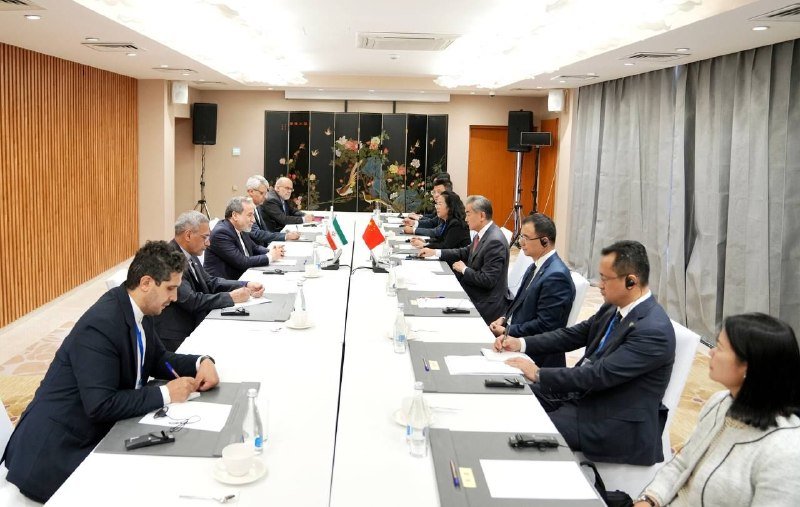
On the evening of 8 July 2026, with European markets already closed, Iranian state television made a claim that the oil benchmarks had been pricing in for months: the Strait of Hormuz, it declared, is under Iran's control, and the situation will not return to the pre-28 February status quo. Within minutes, Iran's deputy foreign ministry told state media that recent American actions "will not stay without response." Mahdi Mohammadi, an adviser to the parliament speaker and a figure closely identified with the negotiating team, framed the standoff in more personal terms: the most painful punishment for a "delusional and narcissistic creature like Trump," he said, is repeated humiliation. The bellicosity is real. Theatrical, too.
None of this is new in form. What is new is the audience. By 20:03 UTC the script was already being rebroadcast in English by open-source channels, with Turkish President Recep Tayyip Erdogan weighing in almost in real time. "We have done and will do everything we can," Erdogan said of the strait. "We will not allow, and do not want, the strait to become a sea of war." The fact that Ankara — a NATO member with a long, prickly history with Tehran — felt obliged to draw a public line is itself the story. The strait has become a stage on which every regional capital is being forced to declare itself.
The chokepoint as a stage
Roughly a fifth of the world's seaborne oil moves through the twenty-one-mile-wide shipping lane between Iran and Oman. That number has anchored a generation of strategic literature and several trillion dollars of naval procurement. It has also, until recently, anchored a quiet assumption: that the strait is too important to weaponise, because everyone loses. The events of early July are a test of that assumption, and the Iranian state-media posture — claim ownership, demand a new baseline, refuse to revert — is the test's first move.
The 28 February reference matters. Whatever arrangement existed before that date — a set of de-escalation understandings, partial sanctions relief, the diplomatic residue of earlier rounds — is now explicitly off the table. That is the operative sentence in the IRIB framing: not the boast, but the refusal to revert.
The Turkish veto
Erdogan's intervention deserves more weight than it has been given in the Western wire. A NATO leader publicly stating that the strait must not become "a sea of war" is, in plain terms, a Turkish veto on any unilateral Iranian closure — and an implicit warning to any third party tempted to escalate through the same waterway. Ankara's own energy import dependence, its reconstruction-cost diplomacy with Gulf states, and its careful balancing act with Tehran give that statement a credibility that a European capital could not easily replicate.
The structural point: the strait is no longer a bilateral US–Iran question. It is a multi-capital problem, and the capitals are starting to act like it.
What Tehran is actually saying
Read across the three Iranian voices — state TV, the deputy foreign minister, Mohammadi — and the message is layered. IRIB asserts control. The foreign ministry promises response. The adviser personalises the confrontation. The combination is a familiar one in Iranian crisis signalling: a maximalist public posture, a diplomatic back-channel implication that escalation is reversible, and a domestic-audience line that frames the standoff as a matter of regime dignity.
The honest reading is that Tehran does not want to close the strait. It wants the option to close it to function as leverage, and it wants that option priced into every conversation between Washington and the Gulf. The risk, of course, is that a leverage posture is indistinguishable from a closure posture until the moment it is not.
Stakes and the weeks ahead
If the framing holds, three things follow over the next quarter. First, insurance and freight rates for Gulf-bound tanker traffic will rise and stay elevated, regardless of whether any vessel is actually harassed. Second, Gulf states will accelerate the bypass corridors — pipelines through the UAE and Saudi Arabia, Iraqi outlets — that have been on drawing boards for a decade. Third, the diplomatic energy of the summer will migrate from Geneva and Vienna to Ankara, Muscat and Doha, the capitals that can talk to Tehran without that conversation being a statement.
The Iranian messaging also narrows Washington's room. The deputy foreign minister's "will not stay without response" is a public commitment, and commitments constrain as much as they threaten. The structural question is whether the US response, when it comes, is calibrated to the rhetorical frame Tehran has set, or to a quieter and more dangerous reality below it. The two are not the same, and the gap between them is where the next mistake will be made.
What we do not yet know
The sources do not specify the precise American action that prompted the Iranian response on 8 July, the naval posture of the US Fifth Fleet on the day in question, or whether the Iranian declaration has been operationalised through IRGCN small-boat deployments or remains, for now, declaratory. The wire is also split, as wire usually is in this theatre, between accounts that treat the posturing as brinkmanship and accounts that treat it as a prelude. Monexus's read is the former, with the latter as a tail risk that should be priced but not yet panicked over.
Desk note: Monexus reads the 8 July messaging as leverage signalling rather than operational closure, and treats Ankara's intervention as the under-reported structural development of the day.
Wire provenance
This editorial synthesis draws on the following public wire/social posts:
- https://t.me/s/osintlive