US weighs Strait of Hormuz blockade as Iran tit-for-tat escalates
Washington has revoked Iran's remaining oil-export license and is openly weighing a renewed naval blockade, as commercial traffic through Hormuz holds steady and Iranian state media reports eight army personnel killed in southern strikes.
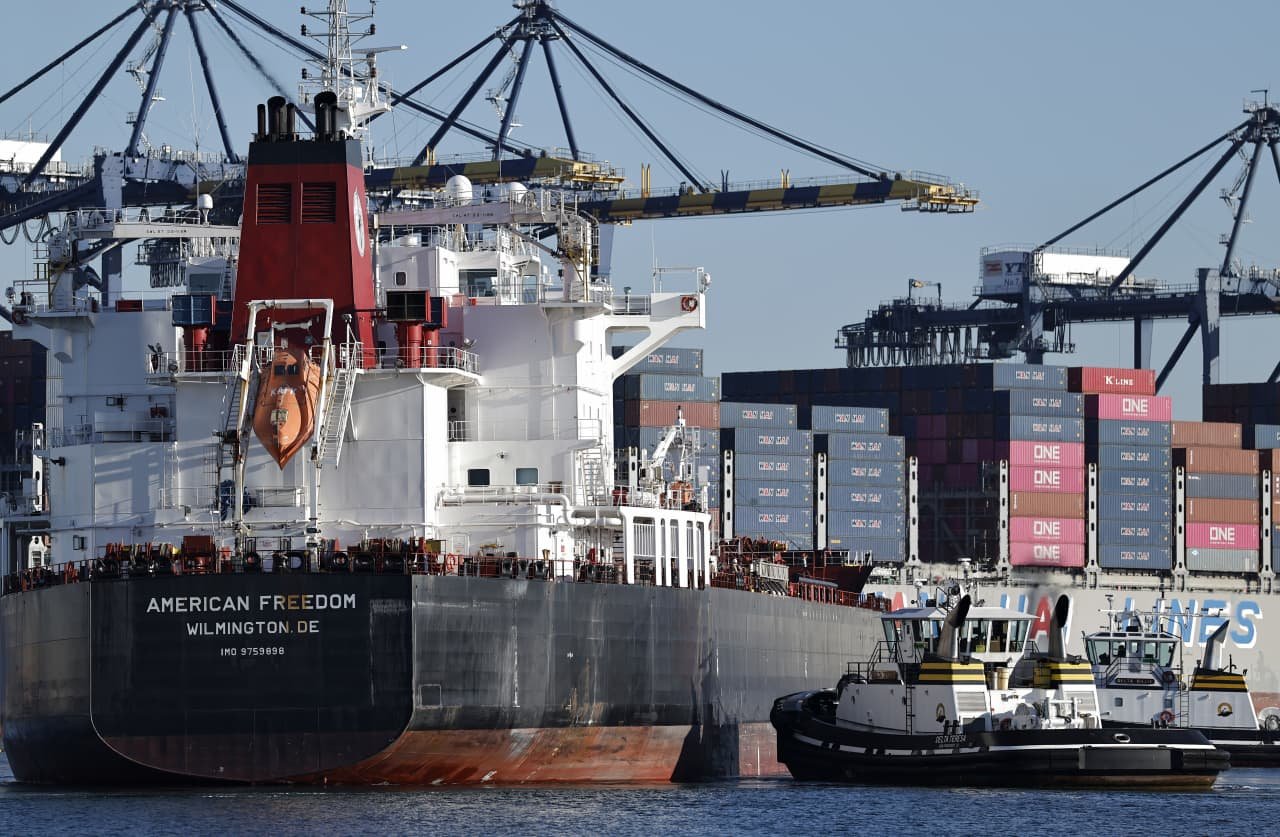
On 8 July 2026, the Trump administration confirmed it is actively weighing a renewed naval blockade of the Strait of Hormuz, days after revoking the license that had permitted Iran's restricted oil exports to reach foreign buyers. The escalation comes against a backdrop of renewed attacks on commercial shipping in the waterway — and a report from Iranian state media that eight members of the Iranian army were killed in US strikes on the country's south.
The two-step escalation — sanctions first, blockade second — is the most concrete signal yet that Washington is willing to weaponise the chokepoint itself rather than just the flows moving through it. The strategic question is no longer whether Iran can sell oil. It is whether the United States will physically seal the corridor through which much of the Gulf's energy still moves.
The sequence
The chain began on 7 July 2026 at 19:11 UTC, when US officials revoked the license authorising limited Iranian crude sales, warning that aggression in the Strait of Hormuz would carry "consequences," according to market coverage. By 19:20 UTC the same day, Axios had confirmed the move as a direct response to Iranian attacks on shipping in the strait, framing the revocation as a punitive measure rather than a routine compliance action.
Less than twenty hours later, at 14:01 UTC on 8 July 2026, President Donald Trump announced that the United States was "considering reimposing a blockade" on the Strait of Hormuz, a position reiterated on prediction markets within the hour. By mid-afternoon, at 15:53 UTC, Iranian state media reported that eight Iranian army members had been killed in US strikes on southern parts of the country — a casualty figure and an attack geography that have not, at the time of writing, been independently corroborated by Western wire services.
The shipping data, and what it is not
The most striking datapoint in the cluster is what is not happening. According to Reuters reporting circulated at 14:37 UTC on 8 July 2026, traffic through the Strait of Hormuz remained steady even as rhetoric from Washington and Tehran sharpened. Commercial vessels continued to transit; insurance rates, where disclosed, were not included in the inputs available to this publication. The disconnect between the volume of threats and the steadiness of the flow is the kind of signal traders and naval planners watch closely: it suggests that shipowners and charterers, for now, do not believe a kinetic blockade is imminent enough to reroute.
That gap — threat versus flow — is the operational space in which escalation can occur without warning. Insurance underwriters typically price a blockade after it is announced, not before; Lloyd's-listed war-risk premiums can move twenty-fold in a weekend once a corridor is declared closed. A "considered" blockade is, in the language of maritime law and the market, not yet a blockade. The administration's framing leaves room to declare one in hours.
The structural frame: chokepoint politics, not just Iran policy
What is unfolding in the Gulf is the standard operating logic of a hegemonic power in late-cycle fiscal stress: control the corridor, not just the commodity. The 2015–2018 sanctions architecture, the 2019–2021 maximum-pressure campaign, and the current revocation-and-blockade sequence share a common assumption — that the price of Iranian oil on world markets is set partly by whether Tehran can physically deliver it. By removing the export license, Washington tightens the legal channel; by threatening the strait itself, it threatens the geographic channel that all Gulf exporters, Iranian and non-Iranian alike, depend on.
The leverage is real but double-edged. Roughly a fifth of the world's seaborne oil moves through Hormuz, including Saudi, Iraqi, Kuwaiti, Qatari, and UAE crude. A declared blockade, even a selective one, would push the Brent benchmark sharply higher and force consuming governments — China, India, Japan, South Korea — into a choice between compliance with US sanctions and the political cost of fuel shocks at home. Beijing's refiners in particular have been the most reliable buyers of Iranian crude under sanctions; a sealed strait would push those barrels back onto discounted Chinese teapot refineries, an outcome that quietly aligns with Chinese strategic interests in keeping Russian and Iranian barrels discounted.
In that sense, the blockade threat is also a test of multipolar plumbing. A 2018-era Iran sanctions regime operated against a backdrop of a unified Western enforcement coalition. The 2026 version runs through a global oil market in which Chinese state-owned traders, Indian private refiners, and a growing shadow fleet of ageing tankers have built workarounds to the dollar settlement system. Whether those workarounds can absorb a fully sealed strait is an open question — and one the markets are, for the moment, refusing to answer in advance.
The counter-narrative: restraint, or déjà vu?
The case for reading this as escalation is straightforward. A blockade is an act of war under any reading of the UN Charter; a revocation of a license that had been negotiated, however grudgingly, signals the collapse of the diplomatic track. The eight Iranian army deaths reported by Iranian state media, if confirmed by independent sources, would mark the first acknowledged Iranian military fatalities from US action since the June strikes and would push the exchange into a retaliation cycle.
The case for restraint is thinner but not empty. "Considering" a blockade is not declaring one. The Reuters data point on steady traffic suggests shipowners — usually the most risk-sensitive actors in the system — do not yet see a kinetic closure as likely. The administration's prior posture, including the careful calibration of the June strikes, has been to raise the cost to Iran without producing the kind of open-ended ground engagement that would force a tanker-driven oil shock at a politically inconvenient moment in a US election cycle. A blockade announced and then walked back, or a blockade announced as a negotiating posture, is consistent with that pattern.
What is harder to dismiss is the asymmetric risk. Hormuz is not a sanctions problem; it is a geography problem. The US Fifth Fleet, forward-based in Bahrain, can interdict Iranian-flagged and Iran-bound tonnage; it cannot, without an enormous and politically costly operation, physically seal a fifty-mile-wide strait against the traffic of every other littoral state. The threat works because everyone in the region believes the US is willing to escalate. It works less well if it is tested.
Stakes and the next forty-eight hours
The two figures to watch are oil and traffic. If Brent moves through $95 a barrel on the back of these announcements, the market is pricing in a real closure; if it settles in the mid-$80s, traders are still reading the blockade threat as a bargaining tool. If Lloyd's-listed war-risk premiums for Hormuz transits are republished sharply higher, underwriters are reading it the same way.
For Tehran, the calculation is whether to test the threat now, with the diplomatic track in tatters, or to hold and wait for a US administration that may be more amenable. For Gulf monarchies, the calculation is whether a sealed strait is worse than an unconstrained Iranian nuclear program. For Beijing, New Delhi, and Tokyo, the calculation is whether the political cost of a fuel shock outweighs the cost of compliance with a sanctions regime that no longer enjoys the consensus it had a decade ago. Each of those judgments is being made in real time, in capitals that the Western wire is reporting on only obliquely.
What remains uncertain is the operational substance of the threat. The sources reviewed for this piece do not specify the scale, geography, or timing of a possible blockade; they confirm only that it is under active consideration. The Iranian casualty report is, for now, sourced to Iranian state media, which has its own framing incentives. Reuters' steady-traffic datapoint is the single most important counter-signal in the cluster, and it is worth weighting accordingly: a chokepoint is only closed when vessels stop moving. By that measure, the strait remains open.
This publication framed the blockade threat as the primary structural story and the sanctions revocation as the immediate trigger, in line with the wire sequence; Iranian state-media casualty figures were treated as reported, not confirmed, pending independent corroboration.
Wire provenance
This editorial synthesis draws on the following public wire/social posts:
- https://t.me/insiderpaper/
- https://x.com/unusual_whales/status/
- https://x.com/unusual_whales/status/
- https://x.com/polymarket/status/
- https://x.com/unusual_whales/status/
- https://x.com/polymarket/status/