US opens major air campaign against Iran: what is verified and what remains contested
Explosions across multiple Iranian cities on 8 July 2026, a Reuters-cited oil-price spike, and an Iranian promise of retaliation amount to the most serious US-Iranian escalation in years. The facts are thinner than the headlines.
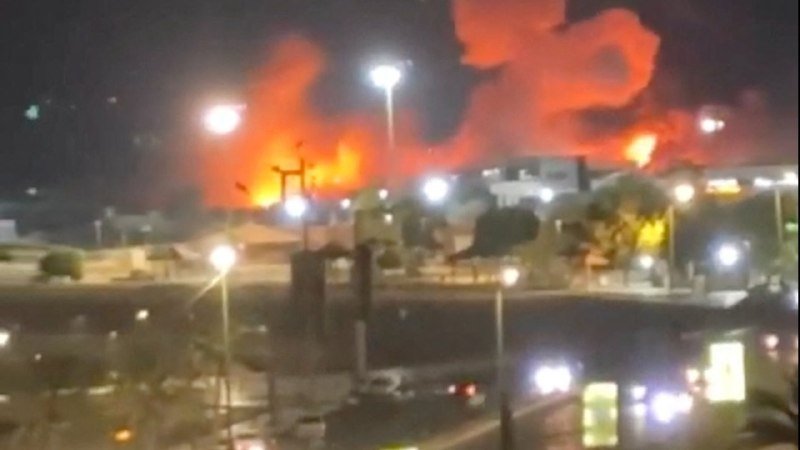
Explosions were heard across multiple Iranian cities on the evening of 8 July 2026, US UTC, in what ABC News, citing a US official, described as a major US air operation involving "well over 100 strikes" against targets inside the country. The same report indicated that the new round of strikes was on a larger scale than the previous night's operations, which had already hit Iranian military and infrastructure sites. Within minutes, Reuters reported that oil prices had risen by more than one US dollar per barrel, and Iran's armed forces said, via the Nour News outlet, that they were preparing "a massive and extensive strike on US military bases in the region imminently," citing a military source.
The early picture is one of an air campaign widening and a regional retaliation being telegraphed in real time. What it does not yet amount to is a public, verified account of what was struck, how many sites were hit, what the civilian or military toll is, or whether the operation has a defined end-state. The next 24 to 72 hours will determine whether 8 July 2026 is recorded as a limited escalation or as the opening of a sustained war between the United States and the Islamic Republic.
What the wires confirm, and the order of events
The sequencing matters. The Cradle Media's Telegram channel, citing ABC News, reported at 21:27 UTC on 8 July 2026 that a US official had framed the strikes as a major operation with "well over 100" munitions, and that the latest wave was larger than the previous night's. Roughly forty minutes earlier, the Insider Paper Telegram channel had carried a "BREAKING" alert on "massive strikes in Iran." By 20:58 UTC, Gaza Alan PA's Telegram channel was passing through a Reuters tick reporting that oil had risen more than one dollar per barrel in response to "explosions" heard in Iran. Finally, at 20:37 UTC, the Intel Slava channel posted the Nour News claim that Iran was preparing a large retaliatory strike on US bases in the region, citing a military source.
Read together, the timestamps describe a fast-breaking chain: first, the Iranian retaliation threat (20:37 UTC); then the price reaction tied to audible blasts (20:58 UTC); then the framing of the US operation (20:46 UTC via Insider Paper, 21:27 UTC via The Cradle's ABC News citation). The ordering suggests the Iranian warning was reported before the US scope was confirmed, which is itself a clue about who in the region has the louder megaphone in the first hours of an air war.
The counter-narrative: an Iranian story of the same hours
The Iranian readout should be read on its own terms, not dismissed. Nour News, the outlet carrying the retaliatory threat, sits inside the Islamic Republic's official media ecosystem; it is not a neutral source. But the framing it advances is the framing that Iranian state television, the foreign ministry, and the Islamic Revolutionary Guard Corps will repeat in the hours and days ahead: that Iran was hit first, that the strikes constitute an act of war, and that a regional response is therefore legitimate under international law.
This matters because the Western wire coverage, once the strikes were confirmed, was dominated by the US official's framing: a campaign, a scale ("well over 100"), a comparison to the previous night. The Iranian side of the story — that this is an unprovoked attack on a sovereign country, that civilians and infrastructure are at risk, that the regime is preparing a defence of its territory — is being carried primarily by Iranian state and state-adjacent channels. The structural pattern is familiar: when the United States strikes a country whose media infrastructure it has sanctioned, the dominant frame is shaped by the attacker's spokespeople, and the target's counter-frame is filtered through outlets the Western reader is conditioned to discount.
Both readings can be partly true at once. A US administration can believe it is degrading military capability it judges a threat; Iran can believe, and tell its public, that it has been assaulted. The journalistic question is whether the reporting apparatus gives equal evidentiary weight to casualty counts, civilian impact, and target selection — not just to the strategic language of the side doing the bombing.
What we verified / what we could not
The first hours of an air campaign are noisy, and the source list is short. The following ledger is the honest accounting.
Verified. That audible explosions were reported across Iranian cities on the evening of 8 July 2026 (Gaza Alan PA via Reuters, 20:58 UTC). That a US official, speaking to ABC News and relayed by The Cradle Media at 21:27 UTC, characterised the operation as "well over 100 strikes" and as larger than the previous night's. That crude-oil prices moved up by more than one US dollar per barrel in immediate response (Reuters, via Gaza Alan PA). That Iran, via Nour News and relayed by Intel Slava at 20:37 UTC, publicly threatened imminent large-scale retaliation against US bases in the region.
Not verified by the source items available to this publication. The specific cities, provinces, or military facilities struck. The exact munition count beyond the US official's "well over 100" characterisation. The nationality or identity of the US official who briefed ABC News. Any Iranian casualty figures, civilian or military. Any independent confirmation of Iran's retaliatory intent from a non-Iranian source. Whether the previous night's strikes and the 8 July wave are part of a single named operation or two distinct episodes. The location of the US bases that Nour News referenced as potential targets.
The reader should hold the verified line and wait on the rest.
The structural frame: air power, oil, and the cost of escalation
Even on a thin source base, the larger pattern is legible. A US air campaign that goes from a single night's strikes to a second, larger wave in 24 hours is no longer signalling — it is establishing a tempo. Once the tempo is established, three structural forces take over.
The first is oil. A dollar-a-barrel jump on the Reuters tick is the first derivative; sustained price action depends on whether Iranian retaliation targets Gulf shipping, US bases in the Gulf, or Israeli-linked infrastructure, and whether Iran can credibly threaten the Strait of Hormuz. Even a credible threat is enough to keep the risk premium elevated for weeks. The structural lesson from 2019, when the Saudi Aramco attacks briefly removed half of Saudi production from the market, is that the Gulf's energy infrastructure is priced for tail risk, and tail risk repricing is fast.
The second is the regional retaliation architecture. The Nour News statement did not name targets, but US bases in the region span Qatar (al-Udeid), Kuwait, Bahrain, the UAE, Iraq, and Jordan. Iran's missile and drone inventory has been demonstrated against US positions in Syria and Iraq; the question is whether Tehran judges a wider escalation a survival imperative, or whether the threat itself is the message.
The third is information. In the first hours of an air campaign, the side with functioning domestic media and accessible spokespeople sets the global frame. The US official's number — "well over 100 strikes" — is now the headline. The Iranian counter-frame will be carried by outlets the Western reader is predisposed to discount, which is itself a feature of how the war will be understood in Western capitals and how it will be understood in Tehran and the Global South.
Stakes and forward view
If the trajectory of 8 July continues, three outcomes are plausible in the near term. First, a tit-for-tat cycle: US strikes, Iranian retaliation against a base or a proxy target, US escalation, Iranian escalation. This is the path that ends with a regional war and a sustained oil shock. Second, a bounded exchange: Iran strikes a US position, the US absorbs it diplomatically, the operation ends, and both sides claim victory. This is the path most analysts publicly hope for and privately doubt. Third, an Iranian decision to absorb the strikes and escalate by other means — cyber, proxy, nuclear acceleration — which keeps the temperature down militarily while raising the long-term cost.
The winners and losers are not symmetric. Gulf energy exporters see higher prices but also higher risk to their infrastructure. The Israeli and Saudi security establishments see the degradation of a primary adversary, but also the prospect of an unpredictable regional war on their borders. The Iranian regime faces an existential test, but one it has prepared for rhetorically for decades. The Global South absorbs the oil shock without a seat at the table where the decision was made. The US public, judging by every post-2003 pattern, will be told the campaign is limited and necessary, and will be told the opposite by the other side, and the truth will sit somewhere the wire reporting will spend years reconstructing.
What is not in doubt is that 8 July 2026 has reset the floor under US-Iranian relations. From here, the question is how high the ceiling moves.
This piece was prepared in the first hours after the strikes were reported. Source items were limited to Telegram-channel relays of ABC News, Reuters, and Nour News. Monexus will update as on-the-record confirmation, casualty figures, and target identification become available.
Wire provenance
This editorial synthesis draws on the following public wire/social posts:
- https://t.me/TheCradleMedia
- https://t.me/thecradlemedia
- https://t.me/gazaalanpa
- https://t.me/insiderpaper
- https://t.me/intelslava