US launches sixth straight night of strikes on Iran as targets shift to infrastructure
CENTCOM confirms a new wave of strikes at 2 p.m. ET on 16 July 2026, the sixth consecutive night of bombardment, as Iranian state media says bridges and an airport were hit.
At 14:00 ET on 16 July 2026, US Central Command began a fresh wave of airstrikes against Iran, the sixth consecutive night of bombardment, with explosions reported across multiple western Iranian cities within the hour. By 19:30 UTC, the open-source channel OSINTtechnicalAmerica reported renewed strikes, and by 21:13 UTC Iranian state media was claiming that bridges and an airport had been hit. The BBC, citing the US statement, framed the operation as designed to "further degrade Iranian military capabilities"; the framing on Iranian state television was that civilian infrastructure had become the target.
Six nights in, the character of the campaign is shifting. The first wave read as a pointed strike on military and nuclear-linked facilities. The latest reporting describes bridges and at least one airport, and an audio-visual record from western cities that suggests an expanding target set. The escalation is no longer just vertical, deeper into Iranian defence assets, but lateral, into the connective tissue that allows a country to function under bombardment.
What CENTCOM has said, and what it has not
CENTCOM's public line is that US forces are conducting a new wave of strikes for the sixth consecutive night "to further degrade Iranian military capabilities," a formulation repeated in the Live Universal Awareness Map wire at 19:32 UTC on 16 July 2026. The command has not, in the materials available at the time of writing, published a target list, a battle-damage assessment, or a civilian-casualty figure. That silence is itself the message: degradation campaigns are deliberately opaque, and the absence of a public target list is a feature, not a bug, of the operational design.
What can be said from the open-source record is that strikes are recurring nightly on a metronomic schedule, that they span western Iranian cities rather than a single site, and that Iranian state media is now describing infrastructure, not just military, among the targets. That progression is consistent with a doctrine of cumulative pressure rather than a single decapitating blow.
The Iranian counter-narrative
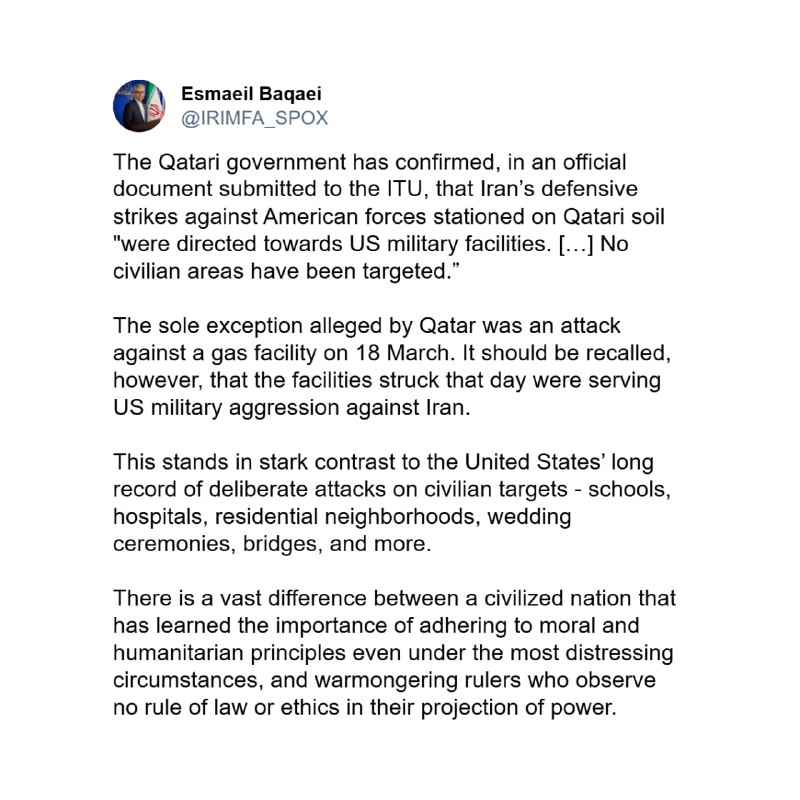
Iranian state media, carried in the Insider Paper wire at 21:13 UTC, reported that bridges and an airport were struck. State outlets in Tehran have an obvious incentive to inflate damage and to recast military targets as civilian ones, and their reporting should be read with that caveat in mind. The structural fact, however, is that an airport and bridges are dual-use, and that destroying them has military effect even if their primary civilian function is what Iranian cameras record.
Iran's larger counter-frame, articulated across the week on state-aligned outlets, is that the strikes are an unprovoked act of war by a foreign power against Iranian sovereignty, and that the campaign will unify domestic opinion behind the government rather than weaken it. That framing is not unique to Tehran; it is the standard response of a state under bombardment, and it tends to be partially correct, at least in the short term. The historical record of repeated Israeli strikes on Iranian assets in Syria, and of US operations in Iraq, suggests that domestic rallying effects rarely last longer than the salience of the campaign itself.
A campaign without a public theory of victory
What is notable about the sixth night is the absence, in the materials available, of any articulated end-state. The CENTCOM statement names a method, "further degrade," not a destination. There is no public Iranian offer on the table, no negotiation track disclosed, no allied readout from Gulf partners laying out the political shape of the post-strike order. Strikes without a publicly stated end-state tend to produce one of three outcomes: a negotiated settlement that the strikes made possible, a protracted low-intensity campaign that becomes the new normal, or a wider war triggered by miscalculation.
The structural read is that Washington is running a pressure campaign calibrated to produce Iranian movement on a set of demands, most likely the nuclear file, ballistic missile inventories, and proxy networks, that have not yet been made public in a single document. That is a defensible strategy if the demands are real, the timeline is short, and the off-ramp is signalled to Tehran. It is a destabilising one if any of those three conditions fail, because cumulative pressure without a destination tends to harden the target rather than soften it.
What remains uncertain
Three things are genuinely unknown at the time of writing. First, the target list: the BBC and CENTCOM describe strikes against military capability, while Iranian state media describes infrastructure; the truth is almost certainly a mix of both, but the ratio is not in the public record. Second, civilian casualties: neither US nor Iranian figures can be relied upon, and no independent verification from UN agencies or international observers appears in the available reporting. Third, the political off-ramp: whether there is a diplomatic channel open in parallel to the bombing, and which capital is hosting it, is not disclosed in any of the source items.
The sixth night of a campaign is usually the moment when the question stops being whether the strikes will continue, and starts being what they are for. The sources reviewed here do not yet answer that question.
Desk note: Monexus framed this as a pressure campaign whose end-state is undisclosed, leaning on the CENTCOM and BBC wires for the operational record and on Iranian state media for the counter-narrative on targets. Where the sources disagree about what was hit, the article names the disagreement rather than picking a side.
Wire provenance
This editorial synthesis draws on the following public wire/social posts:
- https://twitter.com/Osinttechnical/status/207
- https://t.me/insiderpaper
Follow the event.
These dated source records provide context. They do not retrospectively verify this archive article.
Separate what the nuclear watchdog reported from what it could not determine after the June 2025 strikes.