Kyiv hits a Roscosmos supplier at 900 km, and the political geometry shifts
Zelensky confirms Flamingo cruise missiles struck the Progress electronics centre in Samara, around 900 km from the border, against a Roscosmos supplier rather than a battlefield target.
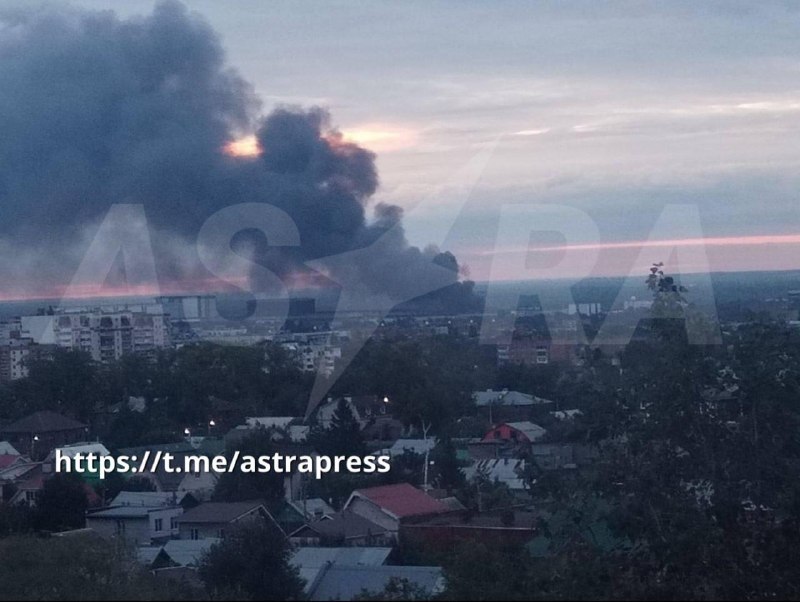
At a televised address on 15 August 2026, President Volodymyr Zelensky said Ukrainian forces had used Flamingo cruise missiles to strike the Progress centre in Russia's Samara region, a facility associated with the state space corporation Roscosmos and the production of electronics used in Russian space and missile programmes. Reporting on Telegram, including Kyiv Post's official channel, Andriy Tsaplienko, noel_reports and Clash Report, put the distance from the Ukrainian border at roughly 900 kilometres. Zelensky called the hit "a good achievement." The same wave also targeted the Savasleyka airbase, according to Kyiv Post's feed. Progress is not a battlefield target. It is a node in Russia's strategic-industrial supply chain, and wounding it from a cruise missile fired by the invaded party is a different kind of statement than the war's daily artillery arithmetic.
Monexus analysis: the political signal is sharper than the physical damage. For two years, the loudest argument inside Western capitals against giving Ukraine long-range systems was that Kyiv lacked the means to use them at operational depth. If the 900 km figure holds up, Flamingo exists to retire that argument. The hardware is now the easy variable. The harder question is whether Western donors will treat a Ukrainian-fired strike on a Russian aerospace supplier as the same category of event as a strike on a Russian troop concentration.
What the sources actually establish
The thread evidence is narrow and worth stating plainly. Four Telegram channels, all Ukrainian or Ukrainian-aligned in framing, carry the same core report: Zelensky confirmed Flamingo missiles hit Progress, the centre is linked to Roscosmos and to electronics production, and the round-trip distance is about 900 km. Three of the four sources name Zelensky directly; one, Clash Report, paraphrases his statement. The 900 km figure appears only on noel_reports within the cited set. The cluster is internally consistent, but it is a cluster, and the reading here treats it as such.
The available source items do not specify a Russian Ministry of Defence damage assessment. They also do not specify how Russian state media framed the strikes on the morning of 15 August. Monexus has not independently established those points on the open wire within this thread.
The 900-kilometre lesson
Read the figure as analysis, not as audited fact. If a Ukrainian-launched cruise missile can reach a Roscosmos electronics line near the Volga, the assumption that donated Western long-range systems would somehow be uniquely escalatory loses force. The hardware is now the easy variable. The political cost of each round is also lower if the rounds are not coming out of a donor country's stockpile and therefore not subject to a donor parliament's vote. Monexus analysis: that is the real story under the photo-op, and it is the story Western defence lobbies will be reading this weekend.
There is a quieter counter-read, surfacing in commentary from analysts who have spent two years arguing Ukraine should conserve missile inventory for battlefield targets. By that reading, a 900 km round trip against a Roscosmos facility is a strategic-communications luxury in a war whose daily casualty ledger is still being written in Donbas. It is a fair critique, and it draws the right line: every Flamingo spent on a strategic target is a Flamingo not aimed at a Russian command post or logistics hub. The counter is that morale, donor confidence and the perception of Ukrainian agency inside the war are also finite resources, and strikes like this one buy them at scale.
The supply chain that does not vote in Berlin or Washington
The deeper frame is industrial base. The war has bifurcated into two parallel contests: the front line, where small-unit tactics and artillery still decide ground, and the supply chain, where the side that can replace missiles, electronics and propellant faster wins the next quarter. Russia's edge in the second contest has been the depth of its Soviet legacy and the willingness of its defence industry to run on three shifts. A Ukrainian production line that can put a cruise missile on a Roscosmos supplier is the answer to that asymmetry from Kyiv's side. The same logic that pushed Western governments to underwrite Polish and South Korean artillery production is now operating inside Ukraine's own missile pipeline.
So long as Ukraine's long-range strike capability depends on donated ATACMS, the political cost of each round is high and the trajectory is constrained by Washington's stockpile. The moment that constraint relaxes, by way of domestic or licensed production, the politics of escalation management shift. The escalation ladder runs in both directions, and Kyiv has just installed a new rung. That is the structural read; the operational read will be settled by what flies, or does not, in the next 72 hours.
What to watch over the next 72 hours
Three things will tell us whether 15 August was a one-off or the opening of a campaign. First, the Russian response. A symmetric escalation inside Ukraine would suggest Moscow has accepted the new range band and is recalibrating; a strike on a Western logistics hub supplying Ukraine would be a different kind of message entirely. Second, the second wave. If another long-range strike lands within the week, on a Russian radar station or a Shahed-136 production line, the message is that 15 August was a demonstration, not a maximum. Third, the production attribution. Whether Western wire reporting in the days ahead confirms Flamingo's production origin will determine whether this article's analytical frame holds or has to be redrawn.
The sources for this article are four Telegram channels within a single Ukrainian-aligned cluster, three of which carry Zelensky's confirmation directly and one of which paraphrases it. Monexus has treated the cluster as the primary record for the strike itself while flagging that the 900 km range is sourced to a single channel in the set and that Monexus has not independently established a Russian Ministry of Defence damage assessment or Russian state media framing within this thread.
Wire provenance
This editorial synthesis draws on the following public wire/social posts:
- https://t.me/Kyivpost_official/38647
- https://t.me/Tsaplienko/97401
- https://t.me/noel_reports/51162
- https://t.me/ClashReport/92611