Kyiv reaches deep into Rostov: Kombinat Kamensky, a quiet propellant for Russia's rockets, is on fire
A solid-fuel plant in Kamensk-Shakhtinsky that feeds Uragan, Smerch and Tornado-S rockets was hit overnight. The strategic logic is harder to argue with than the optics.
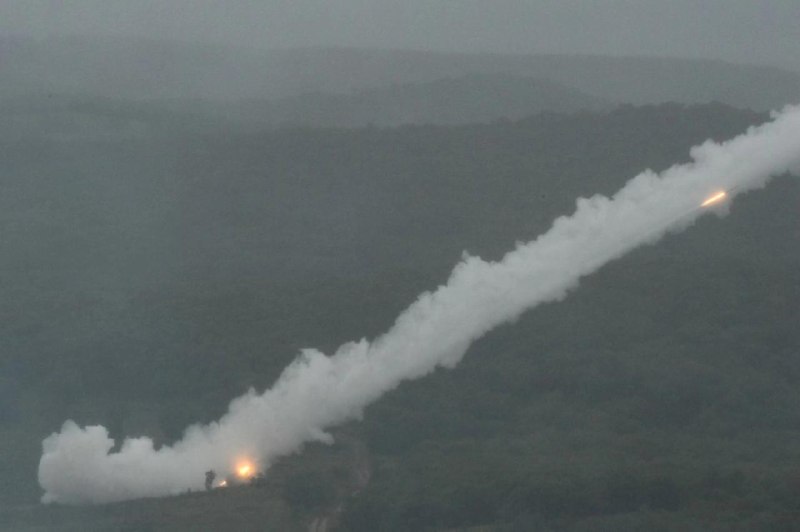
Overnight strikes by Ukrainian forces on the Kombinat Kamensky enterprise in Kamensk-Shakhtinsky, Rostov Oblast, set a Russian solid-rocket-fuel plant on fire on the morning of 16 August 2026, according to a Kyiv Post Telegram post timestamped 10:55 UTC. The General Staff of Ukraine's Armed Forces named the facility directly in its own post: a producer of solid propellant for Russian multiple-launch rocket systems, including Uragan, Smerch and Tornado-S variants. Satellite-derived heat signatures and on-the-ground footage circulated through mapping and conflict-monitoring channels within hours.
Monexus assessment: the strike matters less for the crater it leaves than for the supply chain it interrupts. Solid-fuel MLRS rounds are not artillery shells. They cannot be produced in a converted garage; the chemistry, the inert mixing, the grain-casting all require a small, specialised industrial base. Kyiv has spent two years identifying which nodes of that base sit inside Russian territorial airspace it can reach, and Kamensk-Shakhtinsky is now on that list.
What was actually hit
According to the General Staff of Ukraine's Armed Forces, writing on its official channel on 16 August 2026, the target was the Kombinat Kamensky plant in Kamensk-Shakhtinsky, Rostov Region of the Russian Federation, struck overnight. The post specified the plant's role in the Russian military-industrial complex and identified the propellant it produces for Uragan, Smerch and Tornado-S rocket systems. The Kyiv Post report on the same day characterised the facility as a "strategic plant" producing solid rocket fuel for Russian MLRS, and the AMK Mapping channel's overnight analysis referenced NASA FIRMS thermal data to corroborate ignition at the site. Noel Reports distributed footage purporting to show the aftermath of a drone and missile attack on the combine.
Four Telegram threads from the morning of 16 August 2026, all pointing at the same address. The corroboration across channels is real, even if the visual material is partial and the Russian-language side of the record has not yet surfaced in the items available to Monexus.
Why solid fuel, why now
The temptation in Western commentary is to read every Ukrainian deep strike as a symbolic gesture, a morale play, an attempt to embarrass the Kremlin in front of its own people. That reading is patronising, and it is wrong. Solid-fuel MLRS rounds are the kind of ammunition that a country running low on does not visibly run low on. Front-line soldiers do not post shortage notices for propellant; they post them for 152-millimetre shells. A Russian gunner firing Uragan at a Ukrainian position does not know, and does not need to know, whether the round was made last month or last year. The shortage shows up in the factory's order book and, eventually, in the tempo of barrages. It is a slow, structural pressure rather than a dramatic one.
That is the logic of this campaign. Kyiv's long-range drone and missile force has, over the past twelve months, worked its way down a list: oil refineries, aviation-fuel depots, electronics plants, now solid-propellant facilities. Each category requires different expertise, different warheads, different approach corridors. The Kombinat Kamensky strike is not a one-off. It is a node on a longer industrial map.
The Russian counter-frame, taken seriously
Moscow's framing, when it appears, will be predictable. A strike on Russian soil is an escalation, an attack on a civilian-industrial facility, a provocation designed to drag NATO deeper into the war. Russian state-aligned channels will emphasise any worker casualties, will dwell on the residential blocks of Kamensk-Shakhtinsky, will note that the plant employs thousands of civilians and produces inputs that have civilian aerospace applications. There is a sincere version of that argument worth taking seriously: solid-fuel chemistry is dual-use, and a missile hitting a chemical plant carries genuine local risk. Monexus finds that this counter-frame is strongest on humanitarian grounds and weakest on the question of agency. A defence plant feeding rocket systems that are used against Ukrainian cities does not acquire civilian immunity by employing civilians. The dual-use objection applies equally to every missile factory Russia has hit in Ukraine since 2022, and it has not stopped Russian strikes.
Stakes, and what to watch
If the Kombinat Kamensky strike lands cleanly on production lines rather than merely on a roof, the consequences will not show up in tomorrow's casualty count. They will show up in three to six months, in the volume of Russian MLRS fire along the front, in the price Russia pays for replacement propellant from alternative suppliers, and in the Kremlin's calculation of whether its remaining solid-fuel capacity can be dispersed quickly enough to survive the next round of Ukrainian targeting. The honest expectation: this is one node in a campaign, not a knockout blow. Watch for follow-on strikes at other points on the Russian propellant supply chain, and for any Russian attempt to bring the facility back online at scale under shelter.
One thing the available source items do not specify: the operational status of specific production lines inside the plant, the size of its pre-strike stockpile, whether the damage is concentrated on the propellant-mixing halls or on adjacent support infrastructure, and any first-party Russian statement responding to the strike. The next forty-eight hours will tell which of those questions get answered by open-source investigators, which by Russian officials, and which are left to inference.
Monexus framed this strike as a structural pressure campaign rather than a one-off spectacle, and gave Moscow's dual-use counter-argument its strongest form before dismissing it on agency grounds, a framing most Western wires skipped in favour of damage-assessment footage.
Wire provenance
This editorial synthesis draws on the following public wire/social posts:
- https://t.me/Kyivpost_official/38669
- https://t.me/operativnoZSU/218477
- https://t.me/AMK_Mapping/35912
- https://t.me/noel_reports/51209