Trump rules out interim renewal, Iran holds the Hormuz clock
A Reuters report on Trump's dismissal of any deal with Iran landed within hours of Tehran's Hormuz-flavoured MoU deadline, while Iranian state media amplified a 33 percent approval print and Oman-mediated shipping talks continued in parallel.
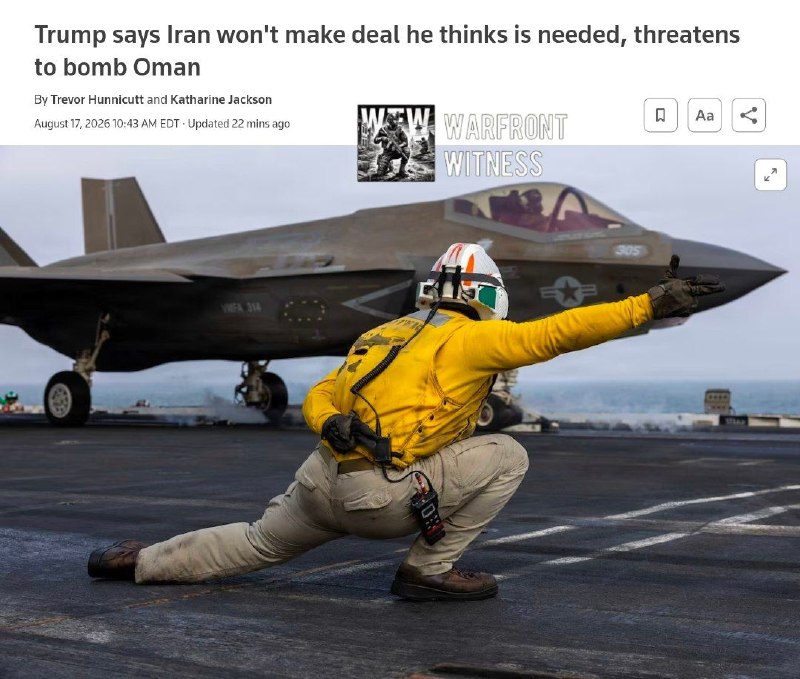
At 06:22 UTC on 18 August 2026, a Reuters report carried via the wfwitness Telegram channel delivered two pieces of news in one wire: US President Donald Trump said Iran would not agree to the type of deal he believes is necessary to end the war with the United States, and he ruled out extending the interim agreement reached in June. The same wire flagged that Oman and Iran continued efforts to restore commercial shipping through the Strait of Hormuz, with Trump warning Oman against that track. Reuters paraphrased the president as insisting Tehran must come to terms.
The morning then layered three more inputs on top of that wire. Iranian state-aligned Tasnim and a Jahan Tasnim relay both amplified a Reuters/Ipsos poll showing satisfaction with Trump's performance at 33 percent, framing the figure as the lowest of his current term. Hindustan Times, in a separate report at 04:31 UTC, said Iran had set a deadline for US implementation of a bilateral memorandum of understanding and warned of escalation in the Strait of Hormuz and wider West Asia if diplomacy failed. Read as relays rather than as first-party primaries, the polling number is a Tehran-circulated frame, not a primary polling release. Read together, however, the morning's inputs describe a diplomatic track that is not so much closed as crowded with contradictory signals.
What Trump actually said, and what Reuters actually reported
The Reuters dispatch as carried on wfwitness is structured as a verdict, not an opening gambit, and the June interim agreement is the load-bearing detail. By ruling out an extension of that interim arrangement, the president removed the cheapest available off-ramp: a quietly renewed status quo that buys time without requiring either side to declare victory. The same dispatch notes an Oman-Iran track on commercial shipping through Hormuz, with Trump publicly warning Oman. That detail sits awkwardly with the headline posture. If the president has genuinely written off a deal with Tehran, why single out an Omani mediation effort on a narrow shipping file? The most natural read is that the administration is not closing every channel; it is closing the framework channel while reserving room for sector-by-sector management of the strait.
That reading is Monexus analysis, not a wire claim. The alternative read is that the Omani shipping effort is being treated as Iranian cover for de facto sanctions evasion, and that the warning to Muscat is part of the same pressure campaign Tehran is being told to absorb. Either way, the Oman strand is the part of the picture that does not fit the clean narrative of a closed diplomatic track, and the Reuters dispatch on which the morning rests treats both strands as live.
The MoU deadline and the shipping-track divergence
The Hindustan Times report is more textured than the Telegram relay headline suggests. It describes an Iranian MoU-based framework whose non-implementation would trigger escalation in the Strait of Hormuz and the wider West Asia region, and it pairs that posture with a separate strand: Iran has reiterated that it had not resumed talks with the US, while continuing to work with Oman on a joint statement to manage Hormuz shipping. The two strands pull in different directions. The MoU track is bilateral and conditional on US behaviour; the Oman track is multilateral and focused on a specific commercial file. Iran is therefore not negotiating with Washington while preserving a managed shipping conversation through Muscat.
That distinction matters for the price tag attached to escalation. An MoU-based framework offers Tehran a managed bilateral relationship without requiring concessions on its nuclear architecture or regional posture, which is consistent with the framing on Hindustan Times that implementation, not maximalism, is the trigger. The Oman track sits alongside it rather than underneath it. Treating the two as the same channel flattens a picture in which Iran appears to be holding open a narrow commercial file while closing the broader political one.
Monexus assessment: the 33 percent number, in relays
The Reuters/Ipsos figure of 33 percent satisfaction is doing political-economy work in the morning's coverage, but its provenance is worth handling carefully. The number arrived into this article's source set through Tasnim's English wire and a Jahan Tasnim relay, both of which framed it as a domestic-US political liability for the administration. Iranian state media have a structural interest in presenting the cost of the war as borne by the American political system rather than by Iran, and the framing in both relays is consistent with that interest. The figure itself is a Reuters/Ipsos product, not a Tasnim product; the relays are amplifiers, not authors.
The number, on its face, narrows the political band inside which an administration can absorb a fresh escalation in the Gulf. That is the framing Tasnim and Jahan Tasnim are selling to their audiences, and the framing also fits the political incentives of an administration that has publicly ruled out an interim renewal. Monexus finds the framing plausible rather than proven: the cited relays establish that the figure is being circulated in a particular way by a particular set of outlets, and that the political logic of the framing tracks the diplomatic posture of the same morning. The figure's standing as the lowest of Trump's tenure, current term, or presidency is not independently established by the source items; the relays use the language of "lowest" without specifying which comparison class they have in mind. That distinction is left as a quoted characterisation of the relays, not asserted as an observed fact.
What is documented, and what is not
What the morning's source items document is narrow and specific: a Reuters dispatch reporting Trump has ruled out extending the June interim agreement and has warned Oman against its Hormuz shipping track with Iran; a Hindustan Times report describing an Iranian MoU-based framework with a stated deadline, paired with a denial that Iran has resumed bilateral talks with Washington and a confirmation of an Oman-mediated shipping-track effort; and two Iranian state-aligned relays carrying a 33 percent approval figure as a Reuters/Ipsos product.
What the sources do not specify is the substance of the June interim agreement beyond its existence, the text of the MoU whose implementation Iran has demanded, the size or composition of any shipping arrangement Oman and Iran are trying to restore, or whether backchannel contact between Washington and Tehran is currently active. This article has not independently established any of those details, and any of them could change the read of the same wire inputs. The diplomatic language of both governments on 18 August 2026 described a closing window on the framework track, not on every channel, and the Omani shipping strand is the part of that picture most likely to be misread if it is treated as a synonym for the bilateral file.
Desk note
Monexus framed this story around the Reuters dispatch as carried on wfwitness, the Hindustan Times report on Tehran's MoU framework and shipping-track denial, and the two Iranian state-media relays of the Reuters/Ipsos figure, treating the Oman shipping track as a separate strand rather than as part of a closed diplomatic picture. The wfwitness wire itself contains the Oman detail, which the previous draft on this story elided; restoring it changes the read of Trump's posture from a clean closure to a sector-specific pressure campaign. The 33 percent number is treated as a relay-amplified frame rather than as a first-party polling release, and the "lowest" characterisation is attributed to the relays rather than asserted as an observed fact.
Wire provenance
This editorial synthesis draws on the following public wire/social posts:
- https://t.me/wfwitness/107385
- https://t.me/tasnimnews_en/31536
- https://t.me/JahanTasnim/230490
- https://t.me/hindustantimes/39804
- https://www.hindustantimes.com/world-news/iran-sets-mou-deadline-for-us-warns-of-escalation-in-hormuz-west-asia-if-diplomacy-fails-top-points-101786971503287.html