UAE claims it intercepted two Iranian ballistic missiles; Tehran denies launch and frames the moment as a 1953 anniversary
Abu Dhabi says it engaged two ballistic missiles launched from Iran on the evening of 18 August 2026, with at least one intercepted, and is reportedly suspending commercial and financial exchanges with Tehran; Iran's foreign ministry rejects the claim as baseless and a deputy minister invokes the 28 August coup anniversary to reframe the confrontation.
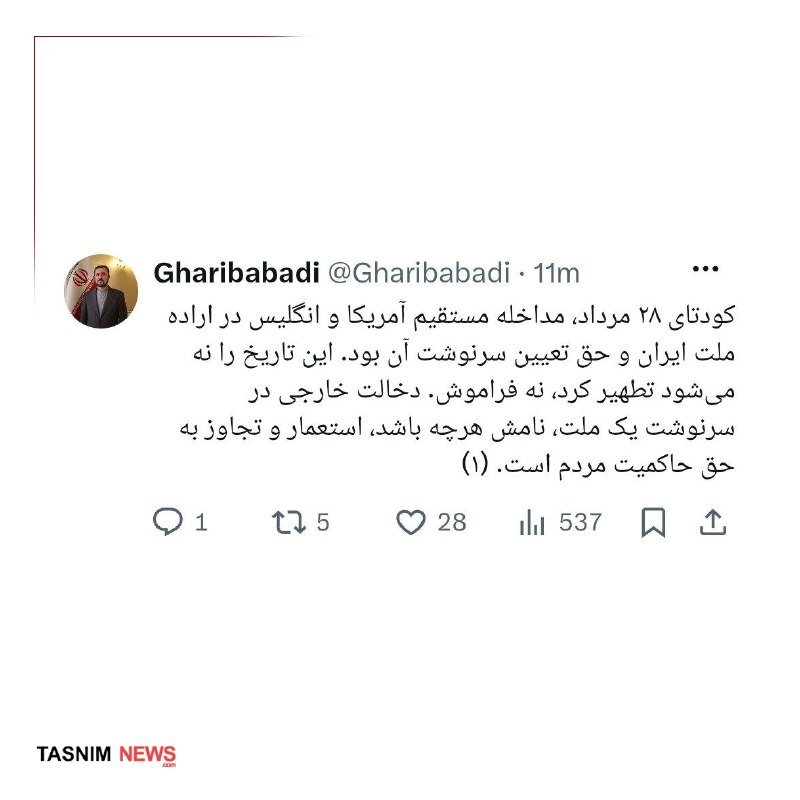
Two ballistic missiles launched from Iran toward the United Arab Emirates on the evening of 18 August 2026 were countered by UAE air defences, with the UAE Ministry of Defense also announcing a suspension of commercial and financial exchanges with Iran, according to Iranian state-linked outlets paraphrasing the Emirati statement late on Monday. Tehran rejected the accusation within hours. Foreign Ministry spokesman Ismail Baqaei called the UAE's claim baseless, and deputy minister Kazem Gharibabadi used the moment to invoke the 28 August coup anniversary and the foreign intervention that anniversary commemorates. The exchange ran along two tracks in parallel: a denial of the launch and a historical reframing of the accusation.
The episode is small in visible military terms and large in rhetorical ones. The UAE, as paraphrased by Fars News International, said it had countered two ballistic missiles fired by Iran that evening; Iran denied the launch took place at all, and Gharibabadi then folded the accusation into a longer story about external pressure on the Islamic Republic. The two accounts leave a factual vacuum at the centre of the story, and both sides are using that vacuum to say something else about power, history and the room for manoeuvre in the Gulf.
What Abu Dhabi said
The UAE Ministry of Defense went public first. According to a Fars News International paraphrase at 21:34 UTC on 18 August 2026, the ministry said in a statement that it had "countered two ballistic missiles fired by Iran this evening," that one projectile fell into regional waters and the other fell outside the country's waters. The same Fars paraphrase noted that the UAE announced a suspension of commercial and financial exchanges with Iran as part of the same response package, a measure that converts the operational claim into a tangible economic signal. The statement, as relayed through Fars, did not specify launch areas, missile types, intended targets or interception locations, and the original UAE statement did not appear directly in the source chain this article is built on.
The economic move is the part most worth weighing. A missile interception claim from a Gulf ministry of defense is an extraordinary statement to issue without supporting debris imagery, telemetry or photography. A simultaneous suspension of commercial and financial exchanges with Iran is a discrete, observable policy action that other governments, banks and shipping registries can confirm or deny in the coming days. Both moves are intelligible as an attempt to lock the UAE's account of the incident into the public record before the Iranian counter-narrative solidifies. The available source items do not specify which of these motivations is in play, and they do not specify which exchanges (banking, trade, transit) the UAE's suspension covers.
How Tehran answered
Iran's response moved along two tracks in parallel, both within roughly an hour of the UAE statement surfacing. The first was denial. Foreign Ministry spokesman Ismail Baqaei, relayed via Tasnim News English at 20:54 UTC on 18 August 2026, "completely rejected" the UAE claim that Iran had launched a missile toward the country. The same rejection was carried by the Jahan Tasnim channel at 20:45 UTC, a touch earlier in the evening. The Baqaei statements and the Jahan Tasnim relay reached the Iranian audience before the UAE statement, as paraphrased through Fars, surfaced in the channel at 21:34 UTC.
The second track was historical. At 22:38 UTC on 18 August 2026, Al-Alam television quoted Gharibabadi, the deputy for legal and international affairs at the Ministry of Foreign Affairs, saying the Iranian nation "does not back down against pressure and stands firmer in the face of imposition and threats," and tying that posture to the 28 August coup. Tasnim News English carried the same Gharibabadi line at 22:43 UTC; Fars News International carried it at 23:06 UTC. The three Iranian state-linked channels reproduced near-identical versions of the Gharibabadi statement, with light editorial variation but no substantive disagreement on the anniversary framing.
The choreography is the story. Denial of the launch is one move; a coup-anniversary frame is another, and the reference is not incidental. The 28 August anniversary marks the 1953 overthrow of Prime Minister Mohammad Mosaddegh, the founding grievance the Islamic Republic's foreign policy doctrine routinely invokes against external pressure on Iran. By tying the present missile accusation to that anniversary, Gharibabadi recasts the UAE statement as a continuation of a familiar pattern of outside intervention, rather than as a discrete security incident. The UAE's claim, in this telling, is not the news; the assumption that Iran is the aggressor is the news.
What we verified / what we could not
This article's sourcing comes entirely from Iranian state-linked Telegram channels: Fars News International, Tasnim News English, Tasnim Jahan, and Al-Alam. The UAE Ministry of Defense statement is paraphrased through Fars News International rather than read directly; the original UAE text did not appear in the source chain this article is built on. The Baqaei rejection is reported in two Iranian channels with consistent wording. The Gharibabadi anniversary remarks are reproduced in three near-identical versions across the Iranian channels, with light editorial variation but no substantive disagreement.
What can be verified from the source chain: that the UAE claimed, on the evening of 18 August 2026, to have countered two ballistic missiles originating from Iran, with one projectile falling into regional waters and the other falling outside the country's waters, and that the same UAE statement, as paraphrased by Fars, announced a suspension of commercial and financial exchanges with Iran; that Iranian Foreign Ministry spokesman Ismail Baqaei publicly rejected the claim the same evening, relayed via Jahan Tasnim at 20:45 UTC and Tasnim News English at 20:54 UTC; that Deputy Minister of Foreign Affairs Kazem Gharibabadi used the 28 August coup anniversary to assert Iranian resolve against what he called imposition and threats, as carried by Al-Alam at 22:38 UTC, Tasnim News English at 22:43 UTC and Fars News International at 23:06 UTC; that the denials and anniversary remarks were sequenced across Jahan Tasnim, Tasnim News English, Al-Alam and Fars News International between 20:45 UTC and 23:06 UTC on 18 August 2026.
What this article cannot verify from the available items: whether the UAE statement reflected an actual launch, a test, or a posture signal; whether the missiles' trajectory, range, type or intended target was disclosed by UAE authorities; whether the UAE's suspension of commercial and financial exchanges covers banking, trade, transit, or all three, and whether it is unilateral or coordinated with other Gulf states; whether any third-party government outside the Iranian state-linked channels has endorsed, contested, or commented on the UAE interception claim; whether the Iranian anniversary remarks were a pre-planned statement or a rapid response to the UAE announcement; whether the spellings "Gharibabadi" and "Baqa'i" reflect distinct persons or transliteration variants of the same office. The source items do not specify these details. Independent corroboration of the UAE interception claim, and of any third-party diplomatic reaction, will require sourcing this article does not have access to and is not citing.
The structural frame, in plain language
Reread the sequence and the power logic snaps into focus. A Gulf state publicly attributes a missile launch to Iran, pairs the attribution with a suspension of commercial and financial exchanges, and Iran does two things at once: deny the launch, and reach back to the 1953 coup to assert that the burden of proof in any Iran-related accusation is on the accuser. Both Iranian moves are intelligible only against a backdrop of accumulated suspicion. The UAE is signalling that its airspace is defended and that escalation has a cost, in operational and in economic currency. Tehran is signalling that even the framing of an incident is contested terrain, and that it will not accept the language of accusation on its opponents' terms.
This is what happens when there is no shared evidentiary authority in a region. Two states are running parallel reality operations on the same evening. The UAE wants its interception claim and its economic measures to be remembered; Iran wants the accusation itself to be remembered as a historically familiar pattern. Neither side is obliged to the other, and neither side has agreed on a place where the disagreement can be adjudicated. In that gap, the event that may or may not have happened is doing less rhetorical work than the economic measure that can be observed in any case, and the historical reference that Tehran definitely did invoke. Monexus analysis: the more durable record from this episode is not the contested interception but the demonstrable UAE suspension of commercial and financial exchanges, which third parties can confirm or refute on the same evidence everyone else is reading.
Stakes and what to watch
The immediate stakes calibrate to how the rest of the Gulf and the wider region reads the UAE statement. If Saudi Arabia, Bahrain, Kuwait, or Qatar endorses the UAE attribution or mirrors the financial suspension, the accusation hardens into a regional diplomatic question and an economic cordon. If Washington, Moscow, or Beijing calls for technical evidence, the contest shifts to the seam between operational disclosure and intelligence protection. If Oman or Iraq, the two neighbours with the most direct exposure to both Iranian and Gulf airspace, remains publicly silent, the silence becomes its own signal. The source items do not specify any of these reactions; independent reporting on third-party positions falls outside this article's sourcing and is not asserted here.
The next dated marker is the anniversary itself. 28 August 2026 will surface official Iranian commemorations by name, and the language used that day will tell whether the UAE exchange has been folded into a broader messaging line about encirclement and external pressure, or whether it is filed as an isolated incident. Whether Iran issues a detailed technical denial, or contents itself with Baqaei's one-line rejection, will signal how much diplomatic room Tehran believes it has on this file. Whether the UAE's suspension of commercial and financial exchanges is confirmed by counterparties in the days ahead will be the single hardest piece of the story to dispute, on either side. The August 18 episode is, for the moment, two competing accounts and one observable economic move; the next 72 hours will determine whether the competing accounts resolve into a single diplomatic line or harden into parallel ones.
Desk note: Monexus has run the UAE claim and the Iranian denial side by side, with explicit sourcing caveats on the Iranian state-linked channels. The 1953-coup framing is reported as a framing, not as historical argument. The UAE's suspension of commercial and financial exchanges with Iran is reported as entailed by the Fars paraphrase of the UAE statement, not as an independently corroborated fact.
Wire provenance
This editorial synthesis draws on the following public wire/social posts:
- https://t.me/FarsNewsInt/259305
- https://t.me/tasnimnews_en/31757
- https://t.me/JahanTasnim/230634
- https://t.me/alalamfa/350054
- https://t.me/tasnimnews_en/31763
- https://t.me/FarsNewsInt/259312