China's industrial stack pulls in two directions: a record year for electric trucks and buses, a yuan bond push offshore
Global sales of electric trucks and buses cleared 500,000 in 2025, with China driving the bulk of the volume, while Beijing separately pushed to widen international use of the yuan through offshore bond futures.
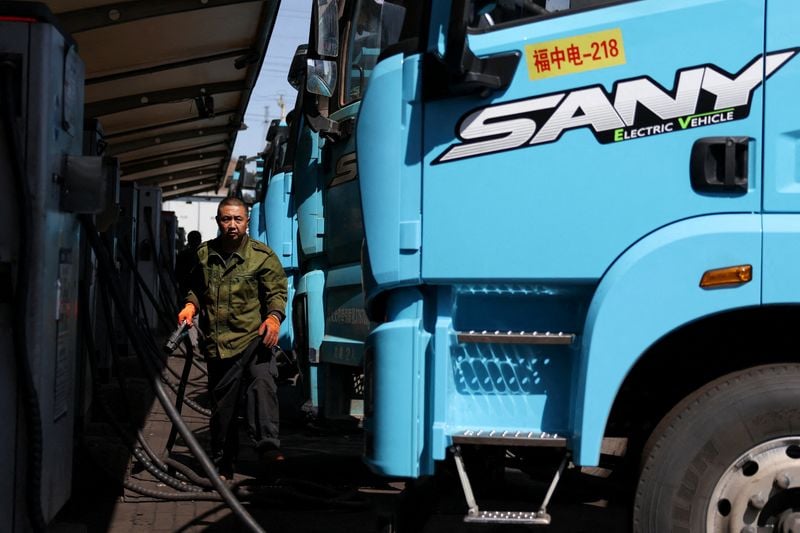
Global sales of electric trucks and buses cleared the 500,000 mark for the first time in 2025, with China driving the bulk of the volume, according to data published on 19 August 2026. The same day, Nikkei Asia reported that China has opened up offshore trading in government bond futures, the latest in a sequence of moves aimed at encouraging international use of the yuan. Separately, Chinese robot makers were out in force at the World Robot Conference in Beijing, pitching humanoids for warehouse and factory work rather than spectacle.
Read together, the three threads sketch a familiar picture: Chinese industry producing at scale in categories where the rest of the world still subsidises and pilots, the financial plumbing to settle and hedge that production in yuan, and the next product cycle already in marketing mode. None of the moves is new in isolation. The volume and the simultaneity are.
Half a million, mostly Chinese
The headline number is the truck-and-bus figure. Electric sales of medium- and heavy-duty trucks and buses worldwide passed 500,000 units in 2025, with China again the dominant market, according to a research round-up published by Investing.com on 19 August 2026 citing industry trackers. The source material does not specify which buyer segments absorbed the volume or what share of supply came from Chinese OEMs, but the China-domination headline is the load-bearing claim and it is in the public record.
That matters because the passenger-EV conversation has long been framed as a Tesla-versus-the-rest contest. The commercial-vehicle market is more politically mundane and more economically consequential. A diesel city bus replaced by an electric one locks in a decade of operating savings, a domestic grid load, and a service relationship with the local OEM. The pattern resembles what Chinese solar and battery makers did earlier in the decade: build scale at home first, then export the cost curve.
The Western framing of the EV story tends to dwell on subsidies, dumping allegations and overcapacity. Monexus assessment: the structural reading is closer to the opposite. Chinese OEMs and provincial governments spent a decade building a complete domestic stack, from cells to chassis to charging networks, and the result is now visible in commercial-vehicle volumes that the rest of the world is not close to matching. The same pattern is visible in adjacent categories, including the humanoid robotics push covered below.
A yuan bond market, with foreigners at the table
The second thread is financial. Nikkei Asia reported on 19 August 2026 that China has opened offshore trading in government bond futures, its latest move to encourage international use of the yuan. The available source items do not specify the exact launch date, the listing venue, or the settlement details. Whether the 19 August post marks the launch itself or follow-up coverage of an earlier-debut contract is a question the article cannot resolve from the cited material alone. Monexus analysis: the report fits a recognised pattern in which Beijing incrementally widens the channels through which foreign investors can hold, hedge and clear Chinese government bonds.
The pitch is straightforward: foreign holders of Chinese government bonds gain an exchange-listed instrument to hedge interest-rate and currency risk, rather than relying on the onshore market or opaque OTC arrangements. The Western line on this tends to treat every yuan-internationalisation step as either a marketing exercise or a threat to dollar dominance. The structural reading is less dramatic: Beijing is reducing a specific friction that has kept foreign investors underweight Chinese government bonds relative to the size of the Chinese economy. Whether that adds up to a real shift in reserve composition is a question the next round of IMF COFER data will help answer.
Robots after EVs
The third thread is industrial-strategic. Chinese humanoid robot makers used the World Robot Conference in Beijing to position their machines for factory and warehouse work, Reuters reported, rather than the dance-and-martial-arts demonstrations that have dominated marketing videos to date. The shift is small in commercial terms but large in signalling: the category is moving from spectacle to use case.
The Reuters piece does not, in the cited excerpt, establish the founding window of the relevant startups or the specific cost-curve mechanism by which Chinese makers undercut Western peers on price. Monexus analysis: the general commercial logic is familiar. A wave of Chinese startups has used cheap domestic supply chains for motors, reducers and batteries to compete in adjacent categories, and the bet is that the same cost-curve strategy that worked in EVs and batteries will work in humanoids, with China again capturing the volume and the iteration speed. The risk, on the Chinese side, is the same one BYD and CATL have had to manage: thin margins, price wars, and the danger that the category gets commoditised before any one firm consolidates around a durable moat.
The Western framing of the robotics push often leans on the national-security angle: chips, export controls, the usual perimeter. The industrial framing is closer to the truth. Chinese humanoids are, for the moment, a demand problem dressed up as a technology story. The buyers, both inside and outside China, are still scarce, and the unit economics of a humanoid that works a warehouse shift for less than a human are not yet proven at scale.
What the three threads share
Read together, the EV volume, the yuan-bond futures push and the humanoid pivot describe a single strategy with three moving parts: produce at a scale no one else can match, build the financial plumbing so the production can be settled and financed in domestic currency, and queue up the next product cycle before the current one peaks. The pieces reinforce each other. EV and battery exports generate the trade surpluses that support the currency. The currency, once it is easier to hedge and clear, lowers the cost of capital for the next industrial cycle. The next cycle, if it lands, buys Beijing another decade of relevance in a category the rest of the world is still approaching.
The risks are internal as well as external. Property-sector deleveraging is still working through Chinese bank balance sheets. Local government finances remain strained. Demographic decline has moved from forecast to fact. And the export-led growth model is running into the tariffs and subsidy probes that always follow a country that dominates a category. None of those risks is resolved by a record year for electric buses or a new bond futures contract. The two steps are necessary, not sufficient.
Monexus assessment: the most natural read of the data is that Beijing is buying optionality. The yuan-bond futures move is a small reduction in a friction that has kept foreign money underweight China. The EV volume is a reminder that the cost-curve lead in commercial vehicles is already wide. The humanoid pivot is an attempt to make sure the next product cycle starts in China even if the current one slows. The harder question, and the one the wire services have not yet answered, is whether the buyers outside China will follow at the same pace they did with EVs.
Desk note: Monexus framed the truck-and-bus, yuan-bond and humanoid threads as one strategy with three moving parts, rather than as three separate stories. The Western wire line tends to treat each as a standalone event; the structural reading treats them as a sequence. The reported date of the bond-futures launch has not been independently confirmed against the Nikkei Asia post, and the article above flags the ambiguity rather than asserting a specific launch date.
Wire provenance
This editorial synthesis draws on the following public wire/social posts:
- https://www.investing.com/news/economic-indicators/china-drove-global-electric-truck-bus-sales-above-half-a-million-in-2025-4868388
- https://t.me/nikkeiasia/21391
- https://t.me/NikkeiAsia/21391
- https://reut.rs/4g8Ddj1
- https://x.com/Reuters/status/2090189651294163270