US-run Hormuz oil corridor moves millions of barrels a day, Axios reports; Polymarket prices 35% chance of normal traffic by year-end
Axios reports a US military-run shipping corridor is moving millions of barrels of oil a day through the Strait of Hormuz. Prediction markets are pricing only a 35% chance that normal traffic returns by 31 December.
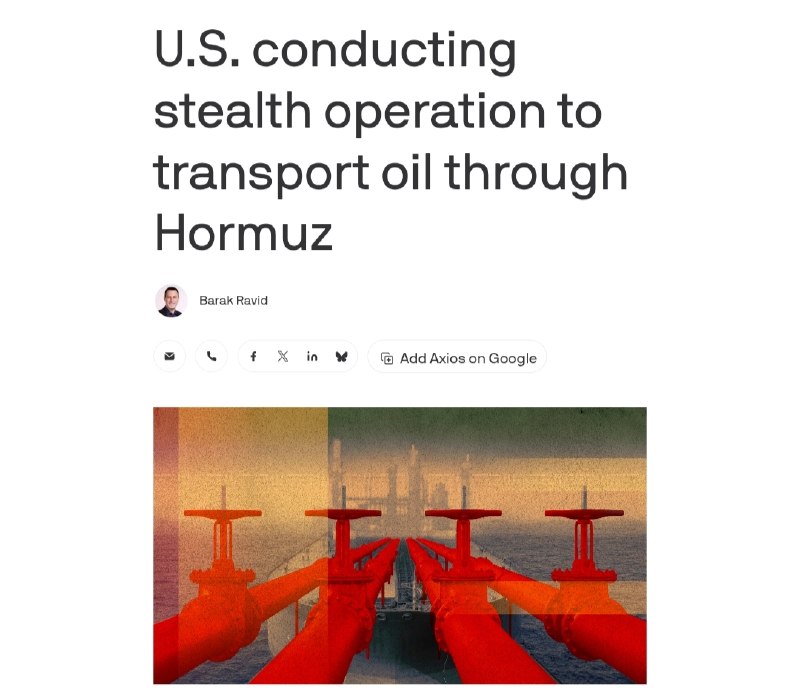
At roughly 19:37 UTC on 19 August 2026, the financial-markets account Unusual Whales flagged an Axios scoop: the United States has been running what it described as a stealth operation to keep oil moving through the Strait of Hormuz. Within minutes, Telegram channels including BellumActaNews (19:46 UTC) and Insider Paper (19:39 UTC) were carrying the same line, that the US military has quietly established a shipping corridor able to move millions of barrels a day through the choke point, framed by those outlets as a success even as the wider war continues. On Polymarket, traders priced the odds of Hormuz traffic returning to normal by year-end at 35%, an implicit judgement that a militarised lane and a normalised lane are not the same thing.
The picture now on traders' desks is structurally simple. The corridor exists, oil is moving through it, and it is being disclosed to US audiences through Axios rather than through a Pentagon press conference. Whether such a wartime channel can substitute for a reopened waterway over a five-month horizon is a different question, one the market is pricing heavily downward.
What the Axios-led reporting actually says
The thread evidence on the corridor is consistent across three relays. Unusual Whales, citing Axios, characterised the operation as a "stealth operation to transport oil through Hormuz". BellumActaNews and Insider Paper, both carrying the same Axios material, described a US-military-run shipping corridor "in and out of the Strait of Hormuz to transport millions of barrels of oil each day" and called it "a notable success even as the broader war" continues. Polymarket's X account, posting at 20:09 UTC on 19 August, attached a 35% probability to the proposition that Hormuz traffic returns to normal by 31 December 2026.
That is the full evidentiary record this article rests on, and the attribution chain runs from Axios to two Telegram relays and a prediction market, rather than to a single on-record Pentagon or US Central Command (CENTCOM) briefing. The published source items do not specify a legal frame for the corridor, the flag-state consent regime for participating tankers, the relationship between the corridor and any Iranian naval posture, or whether throughput is being disclosed on a regular cadence. Any reading of those details, this article's included, has to be flagged as analysis rather than as a direct restatement of the reporting chain.
The Polymarket read: 35% by 31 December
The cleanest measure of trader conviction is the Polymarket contract at 20:09 UTC on 19 August, which priced Hormuz normalisation by year-end at 35%. Three things follow from that single print. First, traders do not believe a normalised strait is the base case; a 65% majority is pricing for a world where the corridor, or something like it, is still required deep into the autumn. Second, 35% is not zero, so a non-trivial chunk of the market believes diplomacy, de-escalation, or a visible concession could reopen transit on conventional terms. Third, because the contract is binary and short-dated, every week that passes without resolution will mechanically shrink the residual 35% as the deadline approaches, and pricing should be expected to drift rather than whipsaw.
The market's read sits awkwardly with the corridor's promotional framing. BellumActaNews and Insider Paper both call the operation a "notable success". Polymarket puts the probability of the war-defining transport problem being solved by 31 December at roughly one-in-three. Both can be true: the corridor can be working while a normal waterway does not return.
What "success" buys, and what it does not (Monexus analysis)
The next interpretive question is what kind of success the corridor is, and what it is not. Reads as analysis: a US-military-run corridor buys throughput, not normalisation. It does not by itself return war-risk insurance premia to pre-war levels, reopen the route to independent commercial traffic without a US escort relationship, or settle the underlying dispute over transit rights in the strait. It is a workaround, and the available reporting does not establish how durable the workaround is supposed to be.
The rivalry between the two framings is the central tension of the story. The Axios-relayed material presents the corridor as a working military solution; the Polymarket print presents it as a temporary substitute rather than a resolution. The most natural reading of the combined evidence is that both are right at once, and that the gap between them, "millions of barrels a day now" versus "65% probability of not being normal by year-end", is the actual story.
A plausible counter-read is that the corridor is itself a form of escalation management. By publicly demonstrating that oil can move without a conventional ceasefire, the operation reduces the pressure on Washington to negotiate under the gun, and on Tehran to escalate to deny the corridor. That is a reading the source items do not state, and it is offered here as analysis, not as a restatement of the reporting.
The autumn watch list
Three dates and one number will tell us whether the corridor is degrading, holding, or transitioning into something more permanent. First, any US Navy or CENTCOM statement that names the corridor in daylight would represent an inflection point, the moment Washington decides the workaround is worth owning in public. Second, the next fortnight of Polymarket prints on the 35% contract will show whether traders are revising up toward diplomatic normalisation or down toward a long-militarised year. Third, Omani and Emirati reporting on insurance premia for Hormuz calls will show whether commercial operators are willing to transit without US cover, which is the true test of normalisation. The number is the million-barrels-a-day figure itself: any drop in throughput would convert a working workaround into an under-supply shock almost immediately.
The supplied source items do not specify whether the corridor's volume is being disclosed consistently week to week, so the published million-barrels-a-day framing should be treated as a snapshot, not a trend. They also do not specify whether the Axios report drew on a single named official or an aggregate of background briefings, which means the attribution chain runs from Axios to two Telegram relays rather than to a single verbatim on-record comment. The Iranian side's framing of the same sea-lanes has not appeared in the supplied source items, and this article has not independently established Tehran's public posture on the corridor in this article.
Read together, the picture is straightforward: a working oil channel exists, the broader conflict around it does not, and traders are pricing the gap between the two at roughly two-to-one against a normal year.
How Monexus framed this: the US-led corridor is reported here as a wartime workaround whose existence is supported by the Axios-led source chain, with the Polymarket contract treated as a trader's read on a binary outcome rather than as a forecast of any individual event. The Iranian side's framing of the same sea-lanes has not appeared in the supplied source items, and this publication has not independently established Tehran's public posture on the corridor in this article.
Wire provenance
This editorial synthesis draws on the following public wire/social posts:
- https://x.com/unusual_whales/status/2090161308599779823
- https://t.me/BellumActaNews/176533
- https://t.me/insiderpaper/44024
- https://poly.market/Lf9guLf
- https://x.com/Polymarket/status/2090169184692928517