The Southern Lebanon File Is Filling Up With One Type Of Footage
Israeli strikes on Qanatra, Hadatha and Ali Al Taher Hill were logged across the evening of 18 August 2026. The follow-up questions about what the footage is doing to the picture are not.
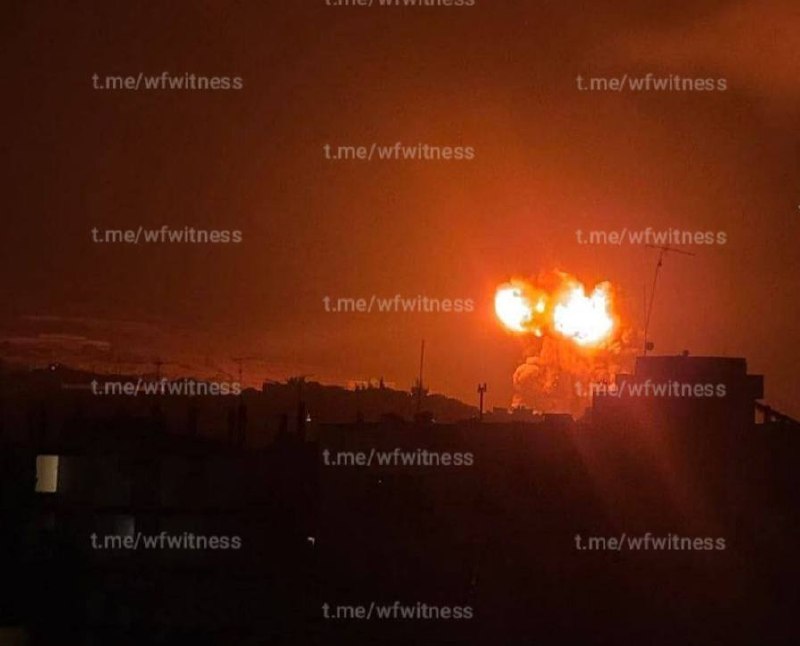
At 21:51 UTC on 18 August 2026 the open-source channel wfwitness logged Israeli jets entering southern Lebanese airspace. At 22:23 UTC the same channel logged Israeli jets over the western Bekaa. In between those two timestamps, the channel's record lists airstrike imagery on Ali Al Taher Hill at 21:57 UTC, an Israeli airstrike on Qanatra at 21:52 UTC, and an explosion in Hadatha at 22:18 UTC attributed to Israeli demolition activity. A fourth entry, Israeli artillery shelling of Qanatra, was logged at 01:19 UTC on 19 August 2026. Read as a sequence, the slice of the record has the cadence of an inventory: a strike, then another, then footage, then a flyover note, then another strike. The narrative that ties them together is the part the thread does not contain.
Israeli operations in southern Lebanon have, in prior rounds, been framed by Israeli spokespeople as targeted action against Hezbollah infrastructure and rocket-launch sites north of the border. That framing is not present in the cited Telegram record for this slice of the evening. What is present is location, time, and a camera angle. The question worth asking is what the steady drip of that one kind of evidence is doing to the way the picture gets read downstream.
The footage did the work the briefing did not
The cited Telegram record names three locations struck across roughly half an hour on 18 August 2026 and a fourth log entry for Qanatra artillery on 19 August at 01:19 UTC. It does not specify which units were hit, what the targets were, or whether the IDF Spokesperson's unit had issued a corresponding readout at the time these messages were posted. To be precise about the limits of the available record: these posts say what was struck and roughly when, and they carry imagery. They do not carry named-party verification of the target classification.
The gap between strike and readout is not unique to this round of southern Lebanon operations. What is worth noticing is the order in which the two feeds are landing. A reader who wants imagery of what hit Qanatra at 21:52 UTC finds it within minutes on channels of this kind. A reader who wants a named-party account of what was being targeted at Qanatra at 21:52 UTC has, at the moment of this filing, the slower feed. The faster feed wins by default, and on a long enough timeline the default becomes the frame.
The Hezbollah question the wire will not ask
In past rounds of southern Lebanon operations, Hezbollah's media arm has asserted that strikes hit civilian infrastructure rather than its positions, and Israeli sources have asserted the opposite. Neither assertion appears in the cited Telegram record for the slice of 18 August 2026 covered here. The honest reading is that the operational geography of southern Lebanon is contested ground in real time: the location labels are stable across the thread, and the site classifications are not given.
The media-flow point is that coverage routinely defers to whichever side produces the cleanest package first. When imagery lands on Telegram within minutes of an overflight of the western Bekaa, the visual establishes the frame: something happened here, look at it. When a competing account arrives hours later, the frame has already settled. Reversing a settled frame costs more column-inches than the original frame required. This is not an argument about who is right in any specific strike. It is an argument about which kind of evidence travels first in a market that rewards speed.
The political economy of the border camera
Southern Lebanon is unusually well-covered for a frontline that produces no declared operations in the thread record. The reason is structural, and worth naming plainly. Open-source channels and dedicated monitors can geolocate strikes from a distance using crater analysis, building outlines, and prior imagery of the same hilltops. The equipment is cheap, the operators are transnational, and demand from foreign-policy desks for verified geolocation has stayed high across the past two years of regional operations. The result is a market in which a single hillside can be photographed from multiple angles within ninety minutes of impact. Israeli military spokespeople and Hezbollah's information arm are competing, in effect, against a third party that neither controls.
That third party has its own incentives. Channels such as wfwitness trade credibility for reach, and reach for speed, in a market where verification costs time. The reader is the loser in that exchange only when downstream labels do not arrive at all. The wires that relay the footage later, the broadcasters that air it, and the analysts who cite it all do better work when they state plainly that the imagery is sourced from an open-source channel and is unverified by named parties on the ground. The 18 August record does not carry such caveats attached to its own entries. That absence inside the cited posts is the story.
What the next 72 hours will and will not settle
The reasonable expectation, on past patterns, is that within 48 to 72 hours Israeli military spokespeople will name the targets at the struck locations if the operation follows prior practice, and that statements from Hezbollah-affiliated media will follow on a similar horizon. A second wave of footage from Lebanese domestic outlets, likely carrying civilian-casualty context, is also reasonable to expect. The available record does not specify any of that as of this filing. None of it will retroactively label the imagery already in circulation. The frame, in this kind of media environment, is set by the first upload, not by the verified briefing.
The structural question the southern Lebanon file keeps returning to is whether democratic publics can run a security conversation on material that arrives without sourcing labels attached. The 18 August record is one evening in a much larger answer. It is the kind of data point that, accumulated across months of similar evenings, makes the answer easier to read.
This piece frames the southern Lebanon strike record logged by wfwitness across the evening of 18 August 2026 as a media-flow question, not an operations question. Where the cited posts do not specify a detail (Israeli readout, Hezbollah response, civilian-casualty count, target classification), this article has not independently established it, and the gap is named rather than filled.
Wire provenance
This editorial synthesis draws on the following public wire/social posts:
- https://t.me/wfwitness/107521
- https://t.me/wfwitness/107525
- https://t.me/wfwitness/107530
- https://t.me/wfwitness/107532
- https://t.me/wfwitness/107537
- https://t.me/wfwitness/107538
- https://t.me/wfwitness/107546