Kyiv wakes to another missile night: what the AMK Mapping tracker tells us before the morning brief
Between 01:17 and 02:28 UTC on 20 August 2026, an open-source tracker logged seven groups of cruise missiles threading across three oblasts. The pattern is familiar. The arithmetic is not.
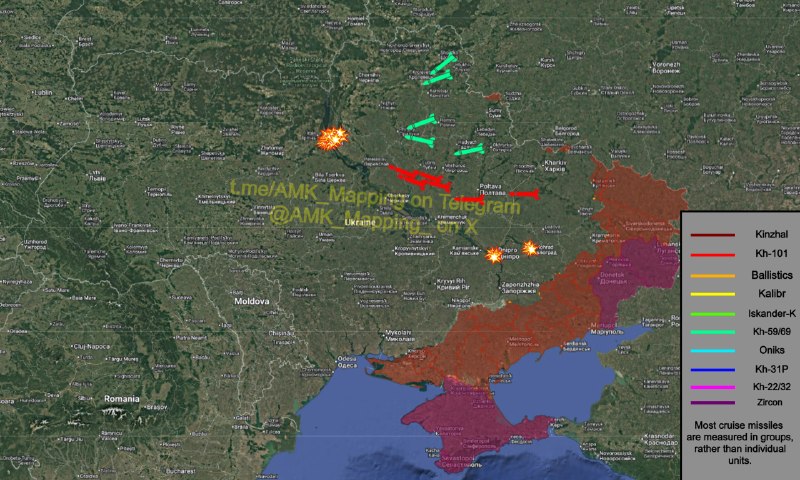
At 01:17 UTC on 20 August 2026, the open-source aviation monitor AMK Mapping logged seven distinct groups of Kh-101 cruise missiles in Ukrainian airspace: six crossing Kharkiv Oblast, one already over Poltava. By 01:53 UTC, a fresh salvo of Kh-101s was entering Kharkiv from the north-east. By 02:00 UTC the Poltava-bound group had changed course to the west. By 02:03 UTC that westward track had held. By 02:20 UTC, a new formation of Kh-59 and Kh-69 air-launched cruise missiles had pushed into Sumy Oblast, with the next wave vectoring toward Kyiv. By 02:28 UTC, the first interceptions were being recorded: Kh-59/69s over Kyiv Oblast, Kh-101s over Poltava.
Read in isolation, that is one hour and eleven minutes of a Telegram channel refreshing. Read against the rhythm of the past four years, it is the operational signature of a war Moscow has decided not to de-escalate, and a Western audience that has been taught to look away.
The pattern is the news
Kh-101s are the long-range, air-launched cruise missile Russia fires from Tu-95 and Tu-160 strategic bombers. Each warhead reaches roughly 2,500 kilometres; each salvo requires multiple aircraft, in-flight refuelling, and a layered intelligence, surveillance and reconnaissance stack behind it. Kh-59 and Kh-69 family missiles are shorter-range, tactical, often paired with the heavier stand-off launchers. The combination is not accidental. A mixed salvo forces Ukrainian air defence to spend interceptors on the cheap tickets first, then run dry before the higher-value Kh-101s arrive on target. The arithmetic is the message.
What the AMK Mapping log captures is the inputs to that arithmetic. It is not an official Ukrainian Air Force statement. It is the work of a volunteer open-source tracker that monitors flight paths, radio emissions, and post-strike imagery, and that has become a primary read of the front of the air war for journalists and embassies who do not have their own overhead view.
The information gap is the story
The morning-after coverage will follow a familiar choreography. The Russian Ministry of Defence will report a successful strike against a designated military target. The Ukrainian Air Force will report intercepts, with a percentage figure and a count of inbound missiles. Western wires will reconcile the two with a hedged formulation of the form "Russia launched, Ukraine said it shot down" and move on to the politics of the day. None of that will report what the AMK Mapping log actually shows: the sequential decisions of a Russian air campaign, the way missiles bunch into groups, the way groups change course, the way the air-defence envelope is being probed in real time.
The Western wire frame has become structurally incapable of reporting that picture. It is built to quote official spokespeople, not to read the open-source evidence they ignore. The volunteer channel does what the press apparatus no longer treats as its job: it watches the sky, and it tells the public what is coming over the horizon.
Counting what gets counted
Monexus assessment: there is a reason this kind of granular tracking is now performed by Telegram channels and not by the major wires. The cost of putting a journalist on the air-war beat in Ukraine is high; the cost of an ADS-B receiver and a trained eye is low. The information asymmetry that was once the state's monopoly has been redistributed, and the redistribution is now granular enough to embarrass the institutions that used to own it. The tracker is not a substitute for the Ukrainian Air Force report; it is a parallel source that occasionally contradicts it, and that is the point.
The seven groups of Kh-101s at 01:17 UTC, the Sumy-bound Kh-59/69s at 02:20 UTC, the Poltava intercepts at 02:28 UTC, are not a forecast. They are a record. What the record supports is a single, unfashionable conclusion: the missile war is not winding down. The trajectory that Western publics are told to expect, the gradual ratchet toward negotiation, is not visible in the data. The data shows a state spending cruise missiles it cannot easily replace, on a tempo it is not visibly willing to reduce.
What the ledger does not tell us
The available source items specify missile types, oblasts, and timing. The source items do not specify launch platforms, aim points, the number of warheads per missile, or the outcome of the Kyiv and Poltava intercepts beyond the fact that interceptions occurred. The Ukrainian Air Force had not, as of the latest source item, published a consolidated strike tally for the night. The Russian Ministry of Defence had not, in the sourced material, commented on the salvo. The next twelve hours will fill in some of the gaps. The pattern will not.
The next time the seven-group metric is logged, the next time Sumy and Kharkiv and Poltava are threaded together in the same hour, the same cycle of wire coverage will follow. The question for Western readers is not whether the next salvo is coming. The AMK Mapping log has already answered that. The question is whether the press apparatus that covers it will learn to read the open-source record with the same seriousness it gives to the official communiqué.
Desk note: Monexus sourced this piece exclusively from the AMK Mapping Telegram thread for 20 August 2026 (six posts, 01:17 UTC to 02:28 UTC). Ukrainian and Russian official statements are absent from the cited material and have not been inferred. The article reads the open-source record against the structural pattern of the air war as reported elsewhere; it does not claim, on the cited evidence alone, that any specific target was hit.
Wire provenance
This editorial synthesis draws on the following public wire/social posts:
- https://t.me/AMK_Mapping/36196
- https://t.me/AMK_Mapping/36224
- https://t.me/AMK_Mapping/36227
- https://t.me/AMK_Mapping/36229
- https://t.me/AMK_Mapping/36234
- https://t.me/AMK_Mapping/36239