Trump's 'Economic D-Day' framing draws Araghchi rebuke and Gharibabadi's 'economic war' critique
On 20 August 2026, Telegram channels carried Trump's 'Economic D-Day' declaration and a two-pronged Iranian response: Foreign Minister Araghchi's pointed rebuke and Deputy Foreign Minister Gharibabadi's framing of US pressure as a fallback after military means failed.
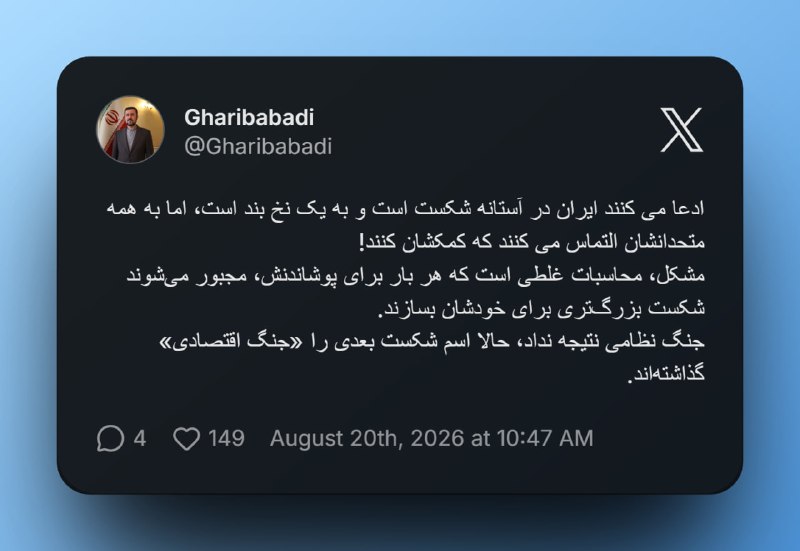
On 20 August 2026, a near-simultaneous exchange between Washington and Tehran compressed a longer standoff into a single rhetorical duel. At 06:42 UTC, War Footage Witness relayed a Donald Trump statement on X in which the US president announced what he termed "Economic D-Day" against Iran, declared further economic pressure on the Islamic Republic, and argued that "no one has given the Islamic Republic of Iran a greater opportunity to make a Deal" than his administration. The same relayed item carried an immediate response from Iranian Foreign Minister Abbas Araghchi criticising the announcement. Within the next ninety-seven minutes, four Telegram channels carried remarks from a second Iranian official, Deputy Foreign Minister Kazem Gharibabadi, who read the US escalation as a fallback after a military track that did not deliver.
What is unfolding is a coordinated messaging clash between two governments that have been moving in and out of crisis for the better part of a year. The underlying file is the same as it has been: enrichment, missiles, regional proxies and the question of whether US leverage can be exercised short of war. What has shifted is the packaging, and now the names attached to it. Tehran is no longer arguing only that sanctions are illegal; it is arguing, through both its foreign minister and its deputy, that sanctions are a confession of failure, a fallback by a power that has tried other means and not prevailed.
What the wfwitness item actually contained
The single Telegram item that anchors the day is the War Footage Witness post at 06:42 UTC. It does two things in one frame. First, it relays Trump's X announcement: "Economic D-Day" against Iran, further economic pressure, no deal yet, and the line that no one has given Iran a better opportunity to make a deal than his administration. Second, it carries Araghchi's response to that announcement. Monexus analysis: putting the US declaration and the Iranian foreign minister's reply in the same relay converts what could have been two separate news cycles into one. The phrase "Economic D-Day" travels as a US-declared label, not as an Iranian invention, and Araghchi's reply lands inside the same information cycle rather than as a delayed follow-on. That sequencing matters because it fixes the contested vocabulary in place before any subsequent reporting can reframe it.
What Gharibabadi added between 07:23 and 08:19 UTC
Once Araghchi had replied, a second Iranian voice entered the same information cycle. Gharibabadi's remarks, as carried by the cited Telegram channels between 07:23 and 08:19 UTC, run on a single argumentative track with two distinct phrasings. PressTV's version, timestamped 08:19 UTC, rendered the line as: the US has "named its next defeat 'Economic D-Day'" after its military campaign "failed to achieve its goals." Tasnim, at 07:23 UTC, rendered the same idea as: "America has called its next failure 'Economic War.'" Clash Report, at 07:45 UTC, foregrounded a related line, that Tehran's adversaries "claim Iran is on the brink of collapse and hanging by a thread, yet they beg all their allies to help them", followed by a charge of "the wrong calculation." A second War Footage Witness post, at 07:41 UTC, summarised the remarks as a criticism of Trump's "economic war" announcement on X.
Monexus analysis: the two phrasings do related but non-identical work. "Economic D-Day" reads as a claim that the escalation was pre-scripted to fail; "economic war" reads as a complaint about the instrument itself. Both rest on the same premise, that military means did not deliver, and both are designed to shift the burden of definition onto Washington. The PressTV version is the sharper of the two, recasting US policy as a defeat Washington itself has named in advance. Read together with Araghchi's earlier response, the picture is of a two-track Iranian push: the foreign minister meets the US phrase directly, while the deputy broadens the argument into a critique of the instrument itself.
What Trump said, and what both Iranian replies addressed
Trump's X post, as relayed at 06:42 UTC by War Footage Witness, sets the counter-frame. A deal has not yet been reached. The United States is now turning to economic pressure and has named the move "Economic D-Day." No one, in the president's words, has given Iran a better opening to negotiate. The post is short, declarative, and built around leverage: a public offer on terms that Washington controls, paired with a warning that the alternative is more pain, and a label that frames economic escalation as a decisive event rather than a continuing process.
The available source items do not specify whether Trump's X post extended to specific sanctions designations, secondary sanctions on countries trading with Iran, or measures targeting particular sectors; the cited post excerpt covers the "Economic D-Day" label, further economic pressure, and the negotiating-window line. Monexus reads the framing contest as follows. The most natural reading of the three statements together is that diplomacy has not collapsed into open conflict, that economic statecraft is the chosen instrument of escalation, and that Washington is investing rhetorical weight in that instrument by naming it. Araghchi's response treats the naming as illegitimate; Gharibabadi's response treats the instrument as a fallback. Trump's framing only works if the diplomatic track is read as still salvageable; the Iranian framings only work if the military track is read as a failure and the economic track as a confession of that failure. The question is which frame takes hold in the middle ground: third-country capitals and energy traders pricing the outcome.
The structural read, in plain language
What the exchanges really show is the slow attrition of the older US playbook. The standard model is military threat plus sanctions plus diplomatic isolation; the expectation is that the target folds within months. Iran's response across recent rounds of this cycle has been to stretch the timeline, keep the nuclear file technically inside the non-proliferation framework, and trade oil through channels the sanctions cannot fully reach. Read on its own terms, that strategy has worked so far. Iran is not collapsed. Iran is not in negotiations on Washington's preferred timetable. Iran is still able to put out the kind of coordinated, multi-voice messaging captured in these Telegram posts, with both a foreign-ministerial and a deputy-ministerial track visible inside a two-hour window.
The dollar-centred financial order remains the principal instrument of US power, and the Iranian counter-messaging is not challenging that order directly. It is challenging the political legitimacy of using that instrument as a substitute for war. The implicit argument, sharpened by Araghchi's direct reply and broadened by Gharibabadi's framework, is that the United States, having failed to deliver a decisive result through force, is now attempting to deliver it through finance, and that doing so is itself an admission that the earlier track did not work. That is a real argument, not a slogan; it is also a partial one, because the economic track is not a concession but the move the United States makes when it chooses not to use force. Naming it "Economic D-Day" does not change that; it only makes the substitution more visible.
Stakes and what to watch next
The practical stakes for the rest of 2026 are concentrated in three places. First, the energy market. Any further escalation in economic measures feeds into shipping insurance, tanker routing and refining margins, with the Strait of Hormuz as the swing variable; the cited sources do not specify any current moves on tanker routing or insurance. Second, third-country capitals. The diplomatic game is now being played in Beijing, Moscow, Ankara and the Gulf monarchies, where Iran's ability to keep an export route open matters more than any single bilateral statement. Third, the negotiating track itself. Trump's framing, that a deal is available if Iran chooses it, and Tehran's two-track framing, that the US has run out of moves, are all postures. The market signal will come from which posture survives contact with the next sanctions designation or the next round of IAEA reporting.
The remaining uncertainty is whether either side has a credible off-ramp that does not look like a climbdown. The US framing demands movement on enrichment and missile activity. The Iranian framing demands recognition that sanctions have not produced collapse and a return to the diplomatic track the US now labels "Economic D-Day." Both demands can in principle be met, but not by the other side announcing it as a victory. The Telegram exchanges on 20 August suggest that neither government is yet willing to give the other the framing it needs. The cited posts contain no indication of a back-channel movement on either side, and this article has not independently established whether direct US-Iran talks are scheduled beyond what the public posts disclose.
Desk note: Monexus frames the Iranian messaging as state communication to be reported with the same weight as the US side, not dismissed. Of the four Telegram channels carrying Gharibabadi's remarks, PressTV and Tasnim are Iranian state outlets; Clash Report and War Footage Witness are cited by name without further attribution beyond what the source items specify. The sourcing mix is acknowledged in-line rather than concealed. The article's anchor item, wfwitness/107692, carries both Trump's declaration and Araghchi's response in the same relay; that sequencing is reported as the source records it rather than separated into two news cycles.
Wire provenance
This editorial synthesis draws on the following public wire/social posts:
- https://t.me/wfwitness/107692
- https://t.me/presstv/203494
- https://t.me/ClashReport/93050
- https://t.me/wfwitness/107694
- https://t.me/JahanTasnim/230821