The Nuseirat strike opens a quieter fight: naming who is accountable for the hostage files
The IDF says Sabahi Sami Mahmoud Shahata, identified as a Hamas platoon commander who held hostages, was killed in Nuseirat on Wednesday 19 August. The strike closes one entry in a ledger that is being kept as much at home as on the ground.
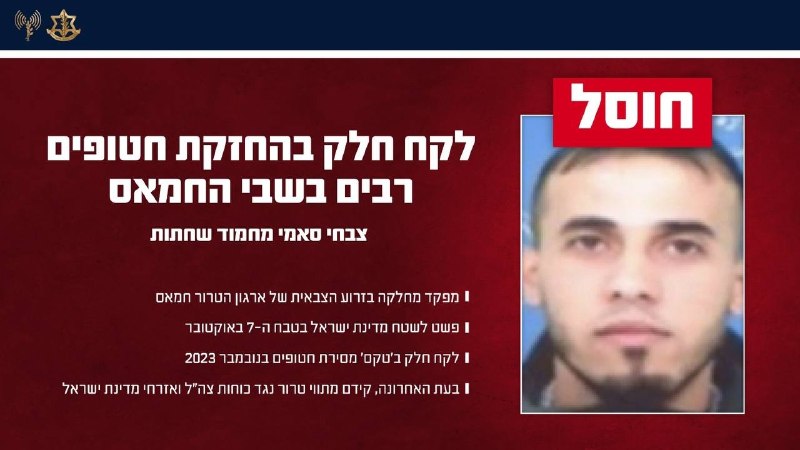
The IDF struck Sabahi Sami Mahmoud Shahata in the Nuseirat area of central Gaza on Wednesday, according to the IDF Spokesperson's official Telegram channel. The IDF's post, timestamped 21 August 2026 at 07:03 UTC, frames the strike as having taken place "two days ago (Wednesday)" and identifies Shahata as a Hamas platoon commander who "took part in holding numerous hostages in Hamas captivity" and who "infiltrated Israel during the October 7 massacre." The same channel adds a further specification: that in November 2023, as part of a hostage release agreement, Sabahi participated in the handover ceremony of the returnees and their transfer to the Red Cross.
The strike is not a battlefield update. It is the public closing of one entry in the ledger Israel is keeping of 7 October, and it shows how that ledger is being built, and contested, name by name.
Three tellings of the same man
Three Telegram channels have put a name and a frame around Wednesday's strike. The IDF Spokesperson channel presents Shahata as a Hamas platoon commander with two distinct roles layered together: the battlefield infiltration on 7 October, and the longer, quieter work of guarding captives afterwards, including his role in a November 2023 handover ceremony under a release agreement.
A second channel, tracking open-source intelligence, repeats the identification and adds operational context. It says Shahata was killed in the Nuseirat area on Wednesday, was a Hamas platoon commander, and that he "later helped" hold hostages. That account is consistent with the IDF's, though it does not reproduce the handover-ceremony detail.
A third channel, focused on Gaza witness reports, identifies the man killed in a separate drone strike on a motorcycle west of the Nuseirat camp as "Sami Mahmoud," roughly an hour before the IDF's post. It does not name a Hamas role or a hostage file. The first name and the geography match; the institutional label does not.
The three accounts do not contradict each other. They sit at different layers of the same event. What they illustrate is how thin the public membrane is between a strike, a name, and a designation.
The hostage custody ledger, and one named file inside it
Israel's wartime case at home rests on a chain of names: the hostages, their families, the militants identified as their captors. Closing that chain is political work the war does alongside the fighting. Every announcement that ties a named militant to a hostage file is a piece of evidence in that ledger, whether or not the underlying militants ever face a courtroom.
The IDF's framing of Shahata fits that pattern, and goes further than the language of typical targeted-killing notices. "Took part in holding numerous hostages" places the strike inside an accountability frame. So does the more specific claim that in November 2023 Sabahi participated in the handover ceremony of released hostages and their transfer to the Red Cross. That second line is the unusual one. It does not just assert a guard role; it ties the named militant to a specific moment in the hostage file, when captives came out under an agreement and were handed to the International Committee of the Red Cross. For Israeli audiences, that is the kind of detail that turns a strike into a closing entry rather than a battlefield score.
Monexus analysis: the announcement is best read as a closing-of-account, not a battlefield milestone. Its audience is partly domestic, partly the families still waiting, partly the mediators who track who is and is not still in the chain. The November 2023 handover detail is the load-bearing line, because it makes the hostage connection verifiable rather than abstract.
What the sources do, and do not, specify
The IDF post names Shahata's alleged role in the November 2023 handover ceremony, but the available posts do not specify which individual hostages he is alleged to have guarded in that ceremony, the duration of his broader involvement in holding captives, or the unit he served in. The open-source channel adds operational context but does not reproduce the handover-ceremony detail. The Gaza witness channel does not assign a Hamas role at all, and does not specify whether the motorcycle strike it reported refers to the same event the IDF attributed to its own operations.
This is the standard shape of targeted-killing announcements: a name, a designation, a list of alleged acts, with operational specifics withheld. The ledger is built to be legible to families and the public, not to be cross-checked against an underlying court file.
What the announcement actually changes
In the short term, very little operationally. Nuseirat has been a recurring strike zone throughout the war; one named killing does not shift the ground map. Politically, the strike removes one name from the alive-and-unaccounted-for list and adds it to the killed-and-identified list, with the specific attachment to a November 2023 hostage-handover ceremony. For the hostage question, that is a meaningful move, because the political pressure inside Israel is now distributed across fewer unresolved files.
The honest reading is that this is bookkeeping as statecraft. The names attached to hostage holding are the units by which the war is being measured at home. Each closing entry shrinks the set of files the government has to defend, and changes which families the next round of negotiations will be organised around.
The harder question is whether the ledger, as it closes, tracks the hostages themselves, or only the captors. On the evidence available here, the announcements name the captors with more precision than the captives, even where, as in this case, a specific moment in the hostage file is invoked.
Desk note: Monexus led with the IDF Spokesperson's identification of Shahata and reproduced its specific claim about his participation in the November 2023 hostage handover ceremony, corroborated against a second open-source channel for role and location, while flagging the gap between the IDF's institutional framing and the local witness account. Coverage of hostage-custody strikes tends to read these announcements as battlefield news; this piece treats them primarily as ledger news, where the political weight sits in who is named and in what capacity.
Wire provenance
This editorial synthesis draws on the following public wire/social posts:
- https://t.me/idfofficial/19087
- https://t.me/osintlive/565669
- https://t.me/wfwitness/107818