Panama Canal to cut daily transits to 34 from 3 September, then to 32 from 15 September, as El Niño tightens the world's shipping maths
The Panama Canal Authority will cut daily transits to 34 from 3 September and then to 32 from 15 September as an El Niño drought bites, with carriers already passing through $1,000-per-container surcharges and a Polymarket contract pricing any US seizure of the waterway by year-end at 4%.
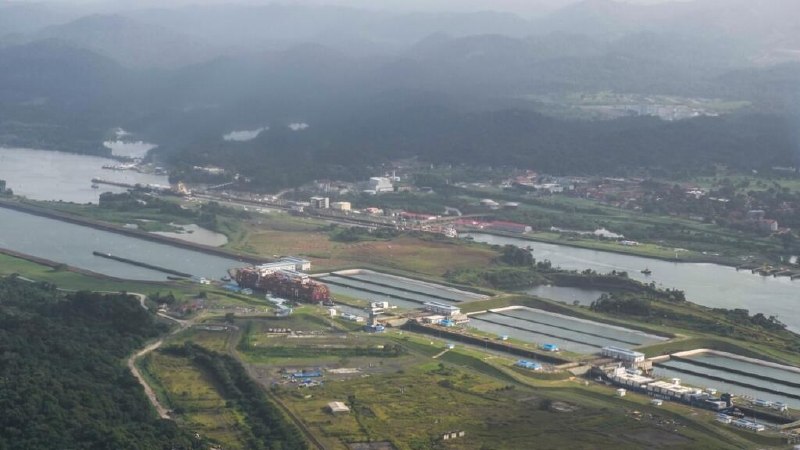
The Panama Canal Authority will cut the daily ship ceiling in two steps in September 2026, according to the France 24 English wire published on 20 August: first to 34 transits per day from 3 September, and then to 32 transits per day from 15 September. The France 24 reporting, picked up at 22:58 UTC on 20 August on the English-language site and relayed six minutes earlier on the French service at 22:39 UTC, attributed both steps to a drop in precipitation linked to El Niño. A separate relay channel, GeoPWatch, posted the headline numbers shortly after, summarising the authority's guidance.
Two minutes before France 24, a Polymarket post at 22:23 UTC on 20 August flagged the canal news, and two minutes after that, at 22:25 UTC the same day, Polymarket pointed to a separate market pricing the chance of a US seizure of the waterway before 31 December 2026 at 4%, a number that captures how traders are still weighing the geopolitical tail even as the climate tail dominates the shipping pages. Disclose.tv reported the same evening, at 22:20 UTC, that two further draft cuts were being imposed over the coming weeks, which would force vessels to leave tonnage onshore before crossing, and that carriers are already hiking surcharges to $1,000 per container as less freight moves per vessel. The available source items do not specify whether the draft cuts Disclose.tv describes are the same operational levers as the two-step transit cap reported by France 24, or separate measures.
An Al Jazeera English breaking-news wire at 01:12 UTC on 21 August sharpened the climate frame, restating the El Niño attribution and adding that the phenomenon is expected to raise the odds of drought and excess heat across the wider region through the months ahead. The Al Jazeera item does not name a new transit cap; it confirms that the meteorological premise behind the France 24 reporting is the consensus view across mainstream wire desks, and it pushes the climate-risk horizon beyond the immediate September cuts.
What is, on its face, a hydrology story is also a freight story, and freight stories move quickly into price stories. Panama's Gatún and Alajuela lakes are the canal's operating reserve; when their levels fall, the locks have to use less water per transit, which means either fewer ships per day or shallower ships per ship. Either lever tightens effective capacity on a route that handles a substantial share of US container traffic, and the timing lands in a market that has spent two years relearning that "just in time" was always a confidence trick wearing a logistics lanyard.
The water, and the queue
The proximate cause is meteorological, not commercial. France 24's 20 August dispatch stated plainly that the reduction from September stems from a drop in precipitation linked to El Niño, and the Al Jazeera English wire at 01:12 UTC on 21 August reiterates that the same El Niño pattern is forecast to lift drought and heat risk across the region in the period ahead. France 24 gave the sequence of numbers: from 36 transits currently permitted, the daily ceiling will fall to 34 from 3 September, and then to 32 from 15 September. Disclose.tv reported two specific draft restrictions scheduled over the coming weeks, which would force carriers to offload cargo onto land or accept deeper draft penalties before reaching the locks.
That is a familiar script. The shape of the policy follows the same playbook the authority has used in prior dry cycles: protect the freshwater system, accept lower throughput, and let the market re-price. The structural difference this cycle is the starting point for container shipping: Asia–US East Coast routings were already operating under elevated pressure, and the available source items do not specify the current status of alternative routings. There is less slack to give back.
The freight, and the surcharge
When the canal lightens a ship, the cargo does not disappear; it relocates. Disclose.tv reported on 20 August that, with less freight moving per vessel, carriers are hiking surcharges to $1,000 per container and reshaping routings. The mechanism is standard: a low-water transit restriction pushes the marginal Asia–US East Coast container either onto rail across the Isthmus or onto a longer alternative sea route, and the cost of either option lands on the freight invoice, eventually on the shelf price.
Monexus assessment: the $1,000-per-container figure is the part to watch. A draft limit is a physical constraint; a named surcharge is a market signal that the constraint has been priced. Once a major liner publishes a Panama Canal low-water surcharge at that order of magnitude, secondary carriers historically follow, and spot rates on the trade lane reprice within days. Investors with exposure to integrated liner groups, trans-isthmian rail operators and US East Coast port authorities should expect that repricing to land in the third-quarter earnings cycle, on the desk's expectation based on the cited reporting.
The Polymarket contract running alongside this news adds a useful, if grim, second data point. The 4% probability of a US seizure before year-end, posted on 20 August 2026, sits against a backdrop in which US political rhetoric about "reclaiming" the canal has not gone away. The market is saying, in effect, that climate, not geopolitics, is the binding constraint on the canal's near-term operating story, and that any force majeure plays out through surcharges rather than flag-raisers. That is the consensus read among the bettors pricing that contract.
A canal as contested infrastructure
The Panama Canal is the most legible piece of trade infrastructure in the world, and the contest over who sets its terms has been continuous for more than a century. The water in the locks is newer and older than the politics; the politics does not stop when the rain does.
Two structural points sit underneath the September restrictions. First, climate exposure: an El Niño cycle that reliably reduces rainfall across Central America turns a transoceanic shortcut into a rationed resource on a recurring cadence, a point the Al Jazeera English wire at 01:12 UTC on 21 August reinforces by extending the drought-and-heat risk to the wider region. The Panama Canal Authority has invested in deeper reservoirs and water-recycling basins since 2023, but the buffer is partial and the demand side of the equation keeps growing. Second, corridor politics: any disruption to the canal tilts cargo toward US West Coast ports and intermodal rail, toward the Suez route when Red Sea risk recedes, and toward overland corridors through Mexico and the US South. Each tilt is a small subsidy to the corridor that absorbs it and a small penalty to the canal's own customer base.
Monexus analysis: read together, the four threads now on the wire, the two-step operational cap (34 transits from 3 September, then 32 from 15 September), the $1,000-per-container surcharge signal, the 4% seizure market, and the broader El Niño drought-and-heat risk flagged by Al Jazeera, describe a canal that is simultaneously under physical stress, commercial repricing and political speculation, with none of the strands yet at a breaking point. The operational cap will compress margins for liner operators and lift them for rail and alternative-port operators; the surcharge will move through spot rates within days; the speculation market will keep a bid under Panama sovereign risk until the contract expires at year-end. The dominant story is that a piece of infrastructure the global economy treats as a default is, for the second time in three years, asking the global economy to plan around it, and that the climate driver behind the asking is, on this evidence, intensifying rather than easing.
What to watch into September
Three near-term data points will clarify the picture, on this publication's expectation. First, the Panama Canal Authority's formal advisory in the days before 3 September, which will state the first-step daily maximum in detail and any auction-style reservation rules. Second, the first major liner's revised tariff sheet, which will translate the cap into a dollar figure per TEU beyond the $1,000-per-container number already in circulation and is the cleanest read on whether the market is treating this as a 2023-style event or a softer one. Third, the September rainfall totals over the Gatún watershed, which will determine whether the caps hold, deepen or ease.
The honest uncertainty is hydrological: an El Niño signal is a forecast, not a measurement, and the canal's worst-case is a forecast that proves mild. The available source items do not specify whether the authority has signalled a further tightening beyond the 32-transit ceiling already announced for 15 September; the Al Jazeera wire flags elevated regional drought-and-heat risk without quantifying canal-specific rainfall deficits for the weeks ahead. The honest structural read is that the canal's operators have learned, since 2023, to cut early and cut visibly, because a public cap is cheaper than a private crisis. The honest political read is that a 4% market on a US seizure is not zero, and the canal sits inside a hemisphere in which "infrastructure security" has become a category of policy on its own.
For shippers, the operational message is to assume the first cap lands on 3 September and the second on 15 September, and to plan routings and inventory accordingly. For investors, the structural message is that maritime chokepoints, physical, climate and political, are no longer tail risks; they are the baseline case for trade-route pricing through the rest of this decade. The water decides how many ships pass; the politics decides who decides that. On 20 August 2026, both variables were moving in the same direction at once, and the mainstream wire at 01:12 UTC on 21 August confirms the climate variable is not easing anytime soon.
Desk note: This update integrates the Al Jazeera English breaking-news wire at 01:12 UTC on 21 August, which restates the El Niño drought-and-heat attribution and extends the regional climate-risk horizon; the lead has been corrected to reflect France 24's two-step sequence (34 transits from 3 September, then 32 from 15 September) rather than a single 36-to-32 cut, and the chronology of the Polymarket, Disclose.tv and France 24 posts has been aligned with the available timestamps. Wire provenance remains anchored in the France 24 cluster for the transit-cap numbers, Disclose.tv for the surcharge and draft-cut detail, and Polymarket for the geopolitical tail.
Wire provenance
This editorial synthesis draws on the following public wire/social posts:
- https://www.aljazeera.com/news/2026/8/21/panama-canal-to-limit-shipping-ahead-of-extreme-weather-during-el-nino?traffic_source=rss
- https://f24.my/C7D5.g
- https://t.me/france24_fr/22717
- https://t.me/GeoPWatch/38678
- https://t.me/disclosetv/21743
- https://x.com/disclosetv/status/2090564470674182567
- https://x.com/Polymarket/status/2090565497875988543
- https://poly.market/kawzgvN
- https://x.com/Polymarket/status/2090565822188032099
- https://t.me/osintlive/565647
- https://www.aljazeera.com/news/2026/8/21/panama-canal-to-limit-shipping-ahead-of-extreme-weather-during-el-nino?traffic_source=rss
- https://f24.my/C7D5.g
- https://t.me/france24_fr/22717
- https://t.me/GeoPWatch/38678
- https://t.me/disclosetv/21743
- https://x.com/disclosetv/status/2090564470674182567
- https://x.com/Polymarket/status/2090565497875988543
- https://poly.market/kawzgvN
- https://x.com/Polymarket/status/2090565822188032099
- https://t.me/osintlive/565647