Canada to retaliate dollar for dollar as US tariffs take effect at midnight
US tariffs on Canadian goods took effect at midnight UTC on 22 August 2026 after trade talks collapsed. Prime Minister Mark Carney says Ottawa will respond with dollar-for-dollar retaliation across a range of US sectors, with the Canadian measures to come into force on 8 September.
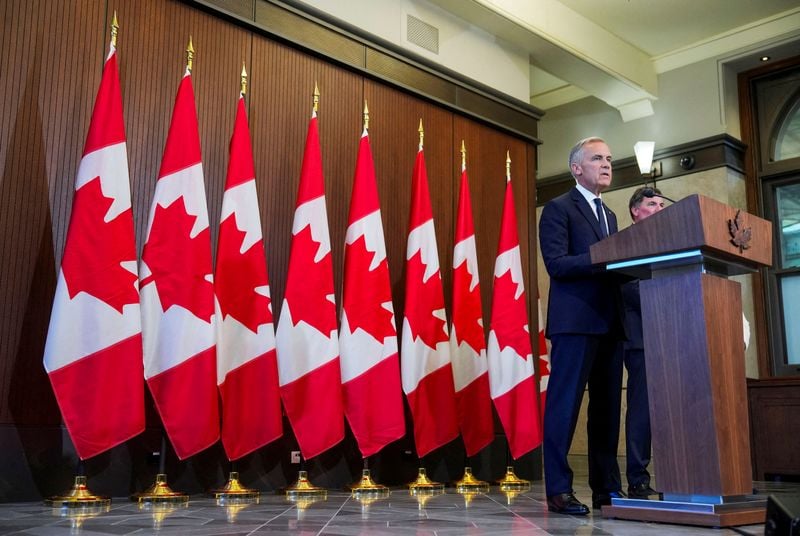
US tariffs on Canadian goods took effect at midnight UTC on 22 August 2026, after trade negotiators in Washington and Ottawa failed to reach a deal ahead of the deadline. Within hours, Prime Minister Mark Carney announced that Canada would impose retaliatory tariffs on a broad slate of US sectors, matched "dollar for dollar" to the US measures now in force, according to a Reuters dispatch timestamped 17:30 UTC on the same day. Carney's announcement, as carried by the Reuters wire and relayed by other outlets, specified that the Canadian response will come into effect on 8 September, giving both sides roughly a fortnight to resume talks before Ottawa's measures bite.
The episode lands inside an already strained North American trade relationship. Canadian steel and aluminium exports have been subject to duties since the first Trump-era metals tariffs, and the continental supply chain has been adjusting to that regime for years. What the cited reporting establishes for 22 August 2026 is the start of a new round, the headline US rate at issue, a Canadian announcement that the response will be calibrated in dollar terms rather than negotiated down, and an explicit Canadian effective date of 8 September that converts the announcement from a threat into a scheduled action.
What took effect at midnight
CTV's breaking-news alert, surfaced via Unusual Whales at 04:06 UTC on 22 August 2026, described the new US tariffs as having gone into force early Saturday morning after the two governments failed to reach a deal before the midnight deadline. Polymarket's trader-briefing account placed the trade affected at roughly $20 billion of Canadian goods, with a 50% headline US duty cited in the same wave of reporting.
The New York Times account, surfaced via Unusual Whales at 04:50 UTC, attributed to the US side the framing that Canada had declined a deal that would have "staved off" the 50% tariffs. The available reporting does not include a Canadian-government characterisation of the negotiating position in those terms; Carney's public line, as relayed by Reuters, has been a sector-by-sector response calibrated to the US measures, with the timing fixed for 8 September rather than immediate.
Carney's dollar-for-dollar posture
Reuters, in the report timestamped at 17:30 UTC, quoted Carney as saying Canada will impose retaliatory tariffs "across a raft of US sectors," with the size of the Canadian response calibrated to match the US measures dollar for dollar. A CNN report, relayed by Unusual Whales at 05:04 UTC, used the same "dollar for dollar" framing for the Canadian response.
Monexus analysis: the choice of "dollar for dollar" ties the Canadian action to a transparent formula rather than a discretionary list, and the 8 September effective date converts that formula into a clock. The two moves together, proportional calibration and a deferred implementation, are the diplomatic equivalent of a written warning: the cost to the US is set out in tariff arithmetic, but the hit is staged so both governments retain the option of an off-ramp in the interim. The Reuters wire presents both elements as part of the same announcement; the cited reporting carries the dollar-for-dollar formulation through Reuters and CNN, and the 8 September effective date through the broader Reuters-sourced coverage of Carney's statement on 22 August 2026.
Reading the structural frame
Monexus analysis: the structural reading of the cited reporting is that this is a political confrontation in which tariffs are leverage, not a trade-remedy dispute in the technical sense. Carney's reference to "a raft of US sectors," rather than a narrow product list, points in that direction: the response is calibrated to the political weight of the US measures, not to a particular injury to a particular Canadian industry.
A second structural point is the sequencing of the public framing. The US side went public, via the NYT line, with the claim that Canada had declined a deal. Monexus assessment: that framing serves a domestic US audience more than a negotiating counterpart; it tells the Canadian side that, whatever else changes in the coming days, the optics around who walked away have already been written. Canada's dollar-for-dollar response, with the 8 September start date, is the predictable countermove: refuse the narrative, demonstrate that the cost to the US is real in tariff arithmetic, and keep the door technically open for a face-saving off-ramp before the Canadian measures bite.
What the cited reporting does not specify
The available source items do not enumerate the full sectoral scope of either the US measures or the Canadian retaliation. Carney's announcement referred to "a raft of US sectors" without, in the cited reporting, listing them; the Polymarket briefing placed the scale of Canadian goods affected by the US measures at roughly $20 billion, but the symmetric Canadian retaliation value is not stated in the source material itself. The 50% headline rate is cited in the reporting, but the precise product coverage of that 50% rate is not laid out in the items Monexus has read.
It is also not clear from the cited posts whether either side has publicly signalled an off-ramp. The cited reporting establishes the tariffs taking effect at midnight UTC, the announced Canadian response, and the 8 September effective date for the Canadian measures, but does not, on the record reviewed here, lay out a named procedural mechanism for talks to resume or for either side to pause.
What to watch next
Monexus expectation: in the days ahead, three things will determine whether the dispute cools or compounds. First, the enumeration of Canadian retaliation sectors, which Reuters's "raft" phrasing leaves undefined and which will set the political temperature on both sides of the border. Second, any face-saving procedural move before 8 September, whether through a USMCA-adjacent channel or through a direct bilateral track, that would let either side step back from the scheduled Canadian measures without owning the climbdown. Third, the first industry-level data on cross-border disruption, which will tell markets whether the tariff arithmetic is biting in the way the headlines imply in the fortnight before Canada's response comes into force.
Desk note: Monexus leads with Carney's official response because the cited reporting makes the Canadian announcement the clearest new fact on the public record. The 8 September effective date is treated as part of that announcement and carried through where the cited reporting supports it. Where the US and Canadian framings diverge on why talks collapsed, both appear, with the available evidence flagged as US-side sourcing for the "Canada declined" line.
Wire provenance
This editorial synthesis draws on the following public wire/social posts:
- http://reut.rs/4zz4Bhu
- https://x.com/Reuters/status/2091216502628237731
- https://www.investing.com/news/world-news/canada-to-impose-retaliatory-tariffs-across-a-raft-of-us-sectors-carney-says-4872377
- https://x.com/unusual_whales/status/2091028641279054053
- https://x.com/unusual_whales/status/2091025111503757416
- https://x.com/unusual_whales/status/2091014143105204630
- https://x.com/Polymarket/status/2091013514638885288
- http://reut.rs/4zz4Bhu
- https://x.com/Reuters/status/2091216502628237731
- https://www.investing.com/news/world-news/canada-to-impose-retaliatory-tariffs-across-a-raft-of-us-sectors-carney-says-4872377
- https://x.com/unusual_whales/status/2091028641279054053
- https://x.com/unusual_whales/status/2091025111503757416
- https://x.com/unusual_whales/status/2091014143105204630
- https://x.com/Polymarket/status/2091013514638885288