Dalio's three-year debt clock puts gold back in the centre of the asset map
Bridgewater's founder told investors the next US debt crisis is roughly three years out, and to hold up to 15% in gold while trimming bonds. Monexus reads the call as a portfolio manual for the end of the rate-cycle.
Ray Dalio's warning landed with the timing of a metronome. On 21 August 2026 the Bridgewater founder told investors that a US debt crisis could arrive within roughly three years, and that the cure for it is the same prescription he has prescribed for most of the last decade: buy gold, cut bonds, and prepare for the currency regime that follows [Crypto Briefing, 21 Aug 2026, 18:18 UTC]. The 15% gold allocation he flagged on social media is not a hedge in the conventional sense; it is the explicit replacement for trust in the long end of the US Treasury curve [Unusual Whales on X, 21 Aug 2026, 21:32 UTC].
The call deserves more weight than a single tweet. Dalio has been warning about a debt-driven fiscal squeeze since Principles for Navigating Big Debt Crises (2018) and his more recent How Countries Go Broke (2025), and he has spent the last three years rotating the conversation from rates to balance-sheet arithmetic. The new element is the calendar: three years is short enough to be actionable, long enough to reshape a retirement plan built around 60/40.
The math he is pointing at
US federal debt held by the public is now well past the level that, in past debt restructurings abroad, triggered currency re-anchoring. Dalio's frame is the historical one: when debt service crowds out everything else, central banks print, the long bond reprices, and the asset that benefits is the one no one else can issue. That asset is gold. The 15% figure is not a trading idea; it is a portfolio insurance policy against a balance-sheet event that, in his telling, has roughly a three-year fuse [Unusual Whales on X, 21 Aug 2026, 21:32 UTC].
Crypto Briefing's relay of the message added the operational instruction: trim bonds first, gold second, the rest of the portfolio only as a residual [Crypto Briefing, 21 Aug 2026, 18:18 UTC]. Read together, the two notes form a manual, not a forecast.
What a debt crisis looks like, on Dalio's clock
Dalio's working definition is closer to a fiscal squeeze than a default. Debt service rises; refinancing becomes harder; the central bank steps in to monetise; the long bond sells off in real terms; a parallel repricing of risk assets follows. The crisis does not start with a missed coupon; it starts with a buyer strike at auction.
The three-year horizon lines up with the maturity wall on US Treasury debt coming due between now and 2029. As that paper rolls at higher coupons, the dollar cost of carrying the debt rises even before any new spending is added. Dalio has argued in How Countries Go Broke that the typical path is not a single default but a gradual erosion of the currency's purchasing power, which is why he reaches for the metal rather than for a short-duration Treasury trade.
What the portfolio actually looks like
For an investor building to the 15% gold target, the maths is unglamorous. With a $1m book, $150,000 sits in physical, an ETF, or a miner basket. The bond book shrinks. The equity sleeve shifts toward quality and dividend coverage that can survive a higher real-rate regime. Cash becomes optional, not strategic.
The interesting question is what the 15% displaces. In the standard 60/40, the 40 in bonds is the seat being vacated. For Kenyan retirees considering a repatriation portfolio from the diaspora, the calculation runs in parallel: a Sh819,000 net monthly income abroad, paired with a Sh72,000 domestic income, against a goal of buying land and building a retirement home in Kenya by age 60 [Nation, 22 Aug 2026, 03:18 UTC]. The optimal mix for that saver depends on whether the shilling holds its recent real-yield gains, and that depends on the same dollar regime Dalio is underwriting with gold.
What the dissenters say
The case against is structural. Bulls on the long bond argue that the US dollar's reserve status is sticky, that Treasury market depth is irreplaceable, and that foreign central banks have nowhere better to park reserves at scale. Bears counter that reserve status is a function of trust, and trust is the variable Dalio is explicitly modelling. The honest read is that both can be right for years at a time, and then wrong in a quarter.
There is also a quieter counter-narrative from the commodities complex itself. Gold's run has historically paused when real yields rise; the next move in the metal depends on the Fed's reaction function, which in turn depends on whether fiscal dominance has already taken hold. Dalio's call is implicitly that it has.
The Kenyan parallel
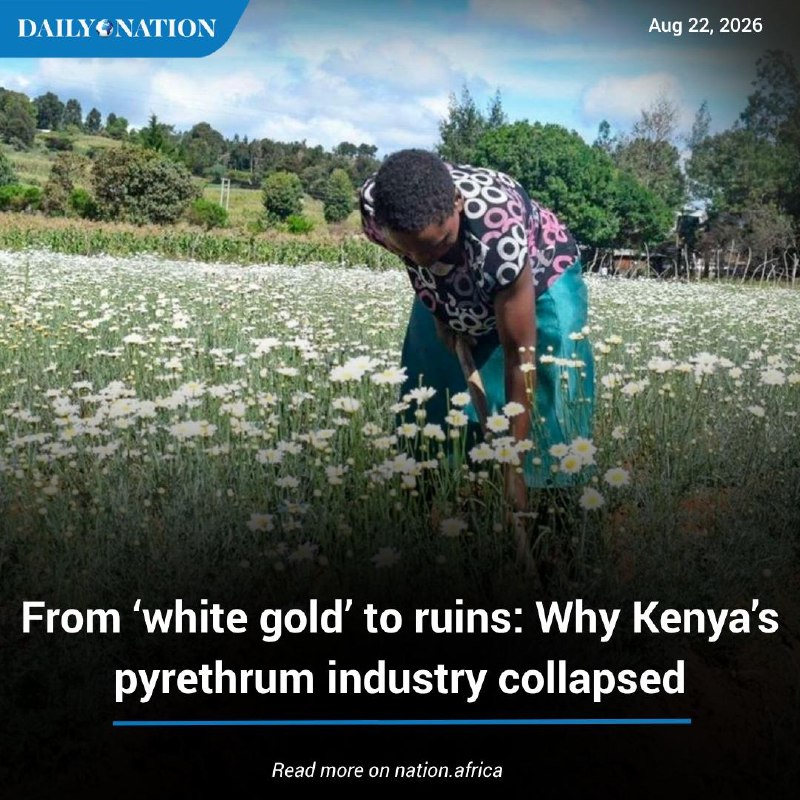
It is striking that the same morning carried a long-form account of how Kenya's pyrethrum industry, once the country's "white gold", collapsed after the liberalisation of the 1990s [Nation, 22 Aug 2026, 03:21 UTC]. The story is about pyrethrin, not bullion, but the structural point is identical: a single-crop export economy built on a price the world was willing to pay, until it wasn't. The lesson the diaspora retiree is reaching for is the same one Dalio is underwriting: don't concentrate the balance sheet on a single source of trust, whether that source is a US Treasury bond or a Kenyan auction floor.
The pyrethrum story ends with a regional policy question: can 19 counties that once earned a living from the flower rebuild the chain now that global demand for natural insecticides is rising again on environmental grounds [Nation, 22 Aug 2026, 05:31 UTC]. Dalio's prescription is, in effect, the same question answered at the household level.
Monexus analysis
Read together, the two posts describe the same hedge from two directions. Dalio is telling investors to insure the household balance sheet against a fiscal event three years out. The Kenyan reader is being told to insure the household balance sheet against a currency event that has already begun. The instrument is different in each case; the discipline is the same.
The structural reading: when a debt crisis this large is being priced on a three-year clock, the asset that benefits is the one with no counterparty. Dalio has spent most of his career arguing that point. The novelty this week is the calendar attached to it.
Desk note: Monexus treated Dalio's two posts as the primary inputs and the Kenyan Nation features as the structural parallel; the wire did not connect the two stories, and we did not invent a link between them beyond the asset-allocation frame.
Wire provenance
This editorial synthesis draws on the following public wire/social posts:
- https://x.com/unusual_whales/status/2090914841825530289
- https://t.me/CryptoBriefing/18812
- https://nation.africa/kenya/news/from-white-gold-to-ruins-why-kenya-s-pyrethrum-industry-collapsed-5566626
- https://nation.africa/kenya/life-and-style/saturday-magazine/can-my-diaspora-income-afford-me-retirement-in-kenya-earning-sh250-000-monthly--5566606
- https://t.me/DailyNation/143705
- https://t.me/DailyNation/143710
- https://t.me/DailyNation/143726
- https://t.me/DailyNation/143730
- https://x.com/unusual_whales/status/2090914841825530289
- https://t.me/CryptoBriefing/18812
- https://nation.africa/kenya/news/from-white-gold-to-ruins-why-kenya-s-pyrethrum-industry-collapsed-5566626
- https://nation.africa/kenya/life-and-style/saturday-magazine/can-my-diaspora-income-afford-me-retirement-in-kenya-earning-sh250-000-monthly--5566606
- https://t.me/DailyNation/143705
- https://t.me/DailyNation/143710
- https://t.me/DailyNation/143726
- https://t.me/DailyNation/143730