Ukrainian drones hit Ozon warehouse in overnight wave, footage shows
Overnight Ukrainian drone strikes hit a warehouse belonging to one of Russia's largest online retailers, with smoke plumes captured on video. The cited posts do not establish casualty figures, the specific city, or the scale of operational damage.
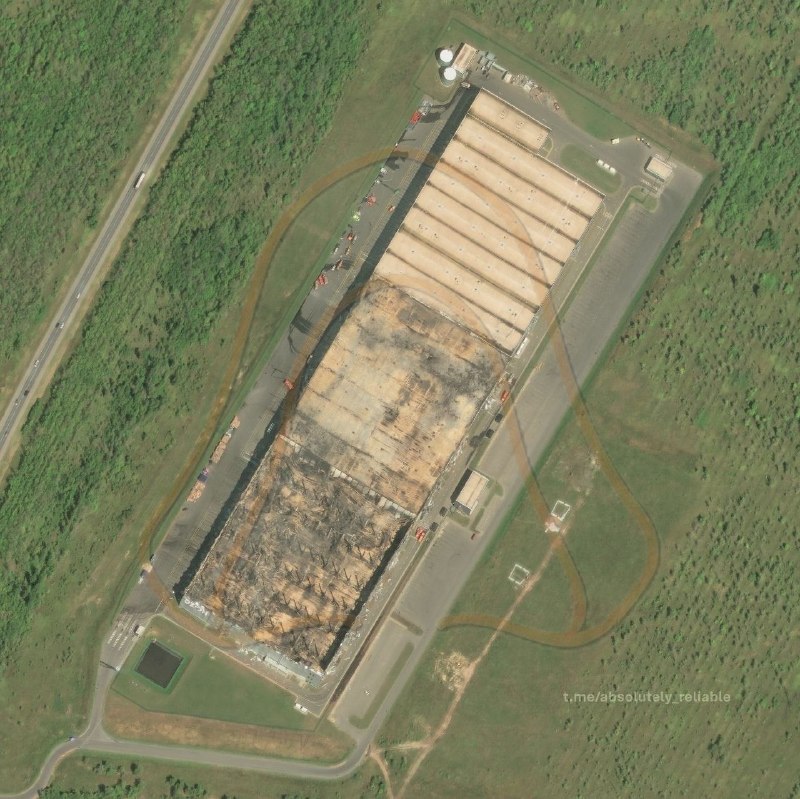
Smoke rose over an Ozon warehouse in the early hours of 22 August 2026 after Ukrainian drones struck the site in an overnight wave, according to wire reporting in the cited posts. Reuters flagged the hit on X at 08:45 UTC; Insider Paper relayed matching imagery of a large black plume at 08:46 UTC; Investing.com's stock-market wire logged the strike at 07:42 UTC.
The four cited items establish what is verifiable on the first morning of reporting: a strike by Ukrainian drones on an Ozon warehouse, captured on video as a substantial smoke plume. They do not specify the city of the warehouse, the operational damage, a casualty toll, any Ozon statement, or any Ukrainian General Staff formal strike tally. Monexus analysis: the choice of target, a consumer-facing retail brand rather than a refinery or military-industrial site, is the analytically interesting move, but the evidentiary floor right now is the strike and the plume, not yet the geography or the bill.
What got hit, and where
Reuters's short identifies the site as an Ozon warehouse without specifying the city in the headline text available in the cited posts. Insider Paper's footage shows a large black plume rising from a low industrial structure; Investing.com's stock-market wire confirms the same fact pattern without adding location, casualty, or damage detail.
The cited four items do not place the warehouse geographically. Reporting beyond these four posts, in outlets such as The Moscow Times, Kyiv Post, LIGA.net and UNN, has identified the strike as occurring in Russia's Samara region and reported a concurrent strike on a Novokuibyshevsk refinery. That geography and co-strike claim sit outside the cited thread, and Monexus notes them here as adjacent first-day reporting only; the cited four items do not, on their own, establish a Samara location or a paired refinery strike.
Ozon runs one of Russia's two dominant online retail platforms, alongside Wildberries. Its fulfilment network stretches across the country, and a single warehouse complex can move tens of thousands of parcels a day. The available source items do not specify the operational impact: whether the warehouse was fully destroyed, partially damaged, or shut down for inspection. Reporting that fills in those specifics had not appeared in the cited posts as of 08:46 UTC.
Why a retailer, not a refinery
The choice of target is the analytically interesting move. Ukrainian officials have argued publicly that the logistics, payment and distribution systems that move Russian goods also move the tax revenue, contracts and morale that keep the war funded. Ozon, listed on the Moscow Exchange and once touted as a homegrown alternative to Amazon, fits that logic. A strike that disables a major fulfilment node does not directly degrade a tank plant, but it inserts friction into the system that delivers goods to Russian households and, by extension, reminds them that the bill for the war is being passed to them.
The economic channel matters here. Ozon's market capitalisation, customer base and vendor network make its warehouses a pressure point where private-sector pain can be converted into political signal. The available source items do not include any Ozon statement, Russian Ministry of Defence response, or Ukrainian official comment beyond the strike itself; whether the company or Russian authorities have publicly characterised the strike as deliberate economic warfare, or as incidental damage from a wider drone wave, had not been established in the cited posts.
The wider overnight picture
The Ozon strike did not arrive alone. Ukrainian long-range drone operations have, over the course of 2026, become a near-nightly feature of the war, with multiple launch-and-hit cycles reported across Russian territory from the border regions to the Urals. The cited posts describe a single overnight wave at Ozon; they do not enumerate the full salvo, the other targets hit, or the intercept data published by the Russian Ministry of Defence. The Ukrainian General Staff, in its morning briefing pattern, typically details strike claims within hours; that briefing was not present in the available source items.
A separate incident surfaced in the same morning's feed from a different direction: in Lviv, a man stabbed a Territorial Recruitment Centre (TCC) employee in the neck and then rushed a policeman, who opened fire, according to a Telegram post by UNIAN at 07:26 UTC. The cited post reports the attacker was wounded by the policeman after staff at the recruitment centre had been checking his data. TCC centres handle Ukraine's wartime mobilisation and have been politically contentious; attacks on them are a recurring, low-volume but high-symbolism feature of the war at home. The two incidents, one outward, one inward, sit on different axes of the same conflict and together illustrate the dual pressure Ukraine is operating under.
What the cited thread establishes, and what it does not
The honest ledger, scoped strictly to the cited four items: they confirm the actor (Ukrainian drones, per Reuters and Investing.com), the target (an Ozon warehouse), and the visible result (smoke, captured on video). They do not specify the city, the operational damage, any casualty toll, Ozon's response, the Russian Defence Ministry's intercept claims, or the Ukrainian General Staff's formal strike tally. Reuters's short is itself a relay of initial reporting rather than a confirmed-damage assessment; the certainty on what exactly burned, and how much of it, sits lower than the certainty that something was hit.
The morning's press cycle will fill in much of that within hours, and adjacent first-day reporting beyond the cited four items has begun to do so, with geography and possible paired-refinery strikes named in outlets not represented in this article's source list. Monexus has chosen not to import those details as confirmed fact because the URL floor for this article is the four cited items, and the cited items are silent on location and damage scope. A casualty figure reported elsewhere in the day's wire, six killed, also sits outside the cited four and is not asserted here.
What is established, and what is not, will matter for the market and the message. If Ozon confirms a major fulfilment node is offline for days, the read shifts from symbolic to operational. If Russian authorities report large intercept numbers and minimal damage, the read shifts the other way. As of the cited posts, neither side has yet said which version of the night is the right one, and the article rightly stops at what the cited thread actually supports.
Monexus framing note: This piece leads with the wire confirmation (Reuters, Investing.com) and the on-the-ground imagery (Insider Paper footage), and treats the Lviv TCC incident as adjacent context rather than the lead, on the grounds that the Lviv event is a domestic-security story with a different news cycle, while the Ozon strike is part of an externally directed pressure campaign that the wire has already named. Geography, casualty and damage specifics from reporting beyond the cited four posts are flagged as adjacent first-day accounts rather than imported as confirmed fact.
Wire provenance
This editorial synthesis draws on the following public wire/social posts:
- http://reut.rs/4gf9YLu
- https://x.com/Reuters/status/2091084253312307392
- https://t.me/insiderpaper/44092
- https://www.investing.com/news/stock-market-news/ukrainian-drones-hit-warehouse-of-russian-online-retailer-ozon-in-overnight-strikes-4872310
- https://t.me/uniannet/199153