Alibaba's $10bn Hong Kong placement reads as a dual-purpose capital action
The headline is "AI." The arithmetic, on the available evidence, is a large equity raise the company has chosen to frame around artificial intelligence infrastructure.
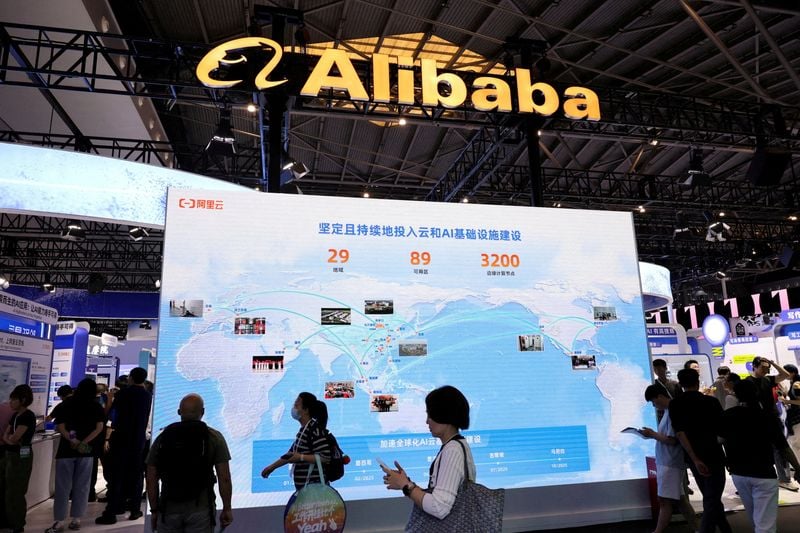
On 23 August 2026, Alibaba Group told the Hong Kong Stock Exchange it would raise HK$80 billion, roughly US$10.2 billion, through a new share placement, with proceeds earmarked for investment in artificial intelligence infrastructure. The figure was carried by Nikkei Asia's wire at 09:01 UTC and by Investing.com's company-news desk at 07:50 UTC the same morning, with Investing.com's headline characterising the deal as a record Hong Kong share sale for the company.
The framing matters. The company has chosen to put "AI" at the centre of the announcement, and the wire has obliged. Read closely, the placement is doing two jobs at once, in this publication's reading: it is funding the capex the cloud and model businesses require to stay credible against domestic rivals, and it is supplying primary equity at a moment when the group has signalled, through the size and venue of the raise, that it prefers capital sourced close to home.
What the wire actually says
The source items are narrow. Nikkei Asia's Telegram post and Investing.com's two companion pieces state the size, the venue, the use of proceeds, and the date. They do not specify how the proceeds will be split between model training, inference infrastructure, and chip procurement; they do not specify the lock-up terms for participating investors; they do not name the cornerstones or the pricing discount. Those details will arrive in the formal placement documents, and until they do, the AI framing should be read as the company's preferred characterisation of a transaction whose underlying motive is, by design, harder to pin down from a press release alone.
What the wire does establish is unambiguous: HK$80 billion, denominated in Hong Kong dollars, raised in Hong Kong, earmarked for AI investment, on 23 August 2026. The superlative is also explicit: Investing.com's headline labels the deal a record Hong Kong share sale.
The dual-purpose read
Monexus assessment: the placement is most naturally read as a capital action that serves two masters at once. On the technology side, the unit economics of frontier AI are unforgiving, and a placement of this size gives the company room to fund compute without quarterly earnings becoming a constraint on the build-out. On the venue side, raising in Hong Kong rather than New York keeps the share register close to the cloud customers, the regulators, and the supply chain that the AI business depends on.
There is also a counter-read worth airing: a primary placement is a cheaper, less dilutive-to-credit way to underwrite a multi-year capex programme than a debt raise at a compressed multiple. The company is paid the compliment of being told what to spend the money on, in the same breath as it is handed the cash, and that combination is itself a signal of how the management wants the next leg of the story told.
What it means for the Hong Kong market
The benchmark effect is the part of the story the source items genuinely support. A record-sized Hong Kong share sale by Alibaba, denominated in Hong Kong dollars and disclosed in a single round, is likely to be cited, repeatedly, in the marketing materials of every other mainland-listed cloud and model company that wants to come to market in the next twelve months. The placement anchors a pricing reference for the cohort.
The other side of that is concentration. Hong Kong's primary liquidity for tech is now meaningfully correlated with the capital plans of a small number of issuers, and the exchange's pitch to global allocators leans heavily on a story that, in practice, depends on the patience of a small group of mainland issuers. The source items do not specify how concentrated that turnover has become; the structural read, that Hong Kong's primary tech market is deeper but more correlated than it was a cycle ago, is this publication's analysis rather than a wire claim.
Stakes, and what to watch
The near-term test is mechanical. The placement needs to clear at a price the market accepts without a disorderly overhang, and the use of proceeds needs to be visible enough in subsequent capex disclosures to justify the multiple expansion the company is implicitly asking for. The medium-term test is competitive: whether the AI infrastructure Alibaba is funding with this round produces revenue density that justifies the rebuild, and whether the group's cloud unit can hold share against state-backed and Huawei-led rivals over the period the raise is designed to fund.
What remains genuinely uncertain is the sequencing. The available reporting does not specify how the proceeds will be split between model training, inference infrastructure, and chip procurement, nor does it specify the lock-up terms for participating investors. Those details will arrive in the formal placement documents, and the AI framing should be read as the company's preferred characterisation of a transaction whose underlying motive is, by the design of the disclosure, harder to pin down than the headline suggests.
Desk note: Monexus framed the placement as a dual-purpose capital action, AI narrative on the surface, balance-sheet recalibration underneath, rather than as a pure technology story, because the source items support both readings and the company has a clear incentive to keep the technology framing dominant.
Wire provenance
This editorial synthesis draws on the following public wire/social posts:
- https://t.me/NikkeiAsia/21437
- https://www.investing.com/news/company-news/alibaba-plans-record-102-billion-hong-kong-share-sale-to-fund-ai-4872426
- https://www.investing.com/news/stock-market-news/alibaba-proposes-hong-kong-share-placement-worth-10-billion-4872416