Tehran hears two pitches on the same weekend
Pezeshkian sells a US track as the best available option for peace while Turkey, Saudi Arabia and Pakistan reportedly offer Iran a seat at an existing defence framework.
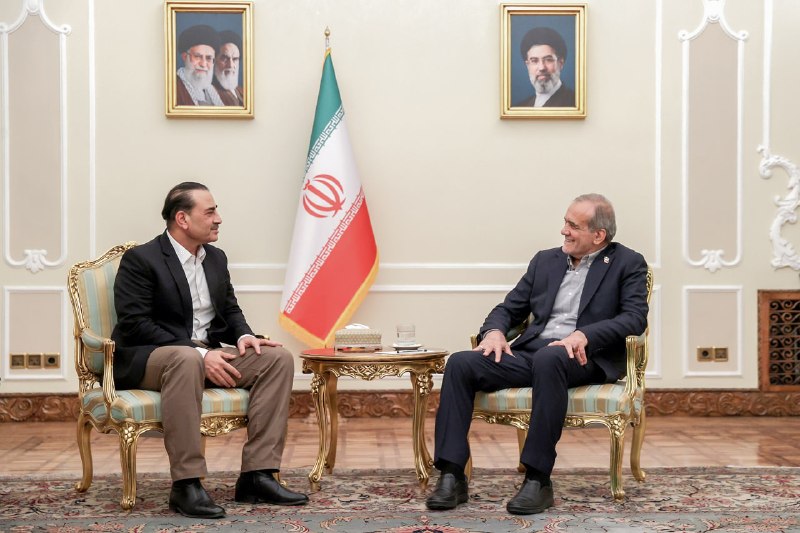
On 23 August 2026, Iran's President Masoud Pezeshkian argued publicly that a deal with the United States was the best available path to peace and to drawing foreign investment back into the country, according to Deutsche Welle's reporting that day. Hours earlier, Pakistan's army chief had been announced for a Monday visit to Tehran, framed by Iranian Foreign Ministry language as a mediation step. And on the same day, a Telegram post attributed to The Jerusalem Post cited regional reporting that Turkey, Saudi Arabia and Pakistan had invited Iran to join a defence pact. The two pitches arrived within hours of each other. The reading worth taking seriously is that Tehran is being courted, not isolated, and that the courtship has at least two distinct suitors.
This piece does not treat either track as settled. The American channel rests on Pezeshkian's public framing. The regional channel rests on a single, unconfirmed Telegram-sourced report. Monexus analysis: the structural story is the simultaneity, not the content of either offer. A Middle East that ships parallel invitations to Tehran inside one news cycle is a Middle East that has stopped pretending Iran is a problem to be managed by one capital.
The American pitch, as Pezeshkian stated it
DW's 23 August story carried Pezeshkian's argument in its narrowest form: peace with Washington is the precondition for the investment Iran cannot otherwise attract, and his government is selling the deal domestically on those terms. The available source items do not specify what trade-offs Pezeshkian attached to that framing, whether he coupled the economic argument to a security one, or how he positioned the file against regional alternatives. Monexus assessment: read the pitch as Pezeshkian stated it. Do not load it with paraphrase the wire copy does not contain.
The regional pitch, reported but not confirmed
The Jerusalem Post's Telegram post on 23 August went further than the official readouts. It reported that Turkey, Saudi Arabia and Pakistan have jointly invited Iran to join a defence pact. The same post added the essential caveat: the invitation had not been publicly confirmed by Iran's Foreign Ministry or by any of the three putative sponsors. The available source items do not specify the terms of any arrangement, the membership class on offer, or the command structure under discussion. Treat the pact as in-play rather than as fait accompli. The reporting does not let a reader say more than that an invitation has been reported by a regional outlet that did not see it confirmed at foreign-ministry level.
A second caveat is structural and matters more than it looks. Earlier August reporting, referenced widely in the regional press and tracked separately by this publication, treats the Turkey-Saudi Arabia-Pakistan arrangement as a framework already in existence, with Iran positioned as a possible accession rather than as a co-author. Monexus assessment: if that prior reporting holds, the 23 August invitation is the opening of an accession conversation, not the drafting of a new treaty. The distinction changes what Iran is being asked to join and how much leverage Tehran has over the terms.
Why the two tracks sit uneasily together
The available source items do not specify how Pezeshkian himself framed the relationship between the American and regional tracks, nor do they specify whether the United States has been consulted about the regional channel or has objected to it. Monexus analysis: a Tehran that argues for a Washington deal in public while a regional defence framework quietly beckons is signalling that it does not intend to be a single-customer foreign policy. Whether that posture is sustainable, or whether one track eventually subordinates the other, is a question the sources do not resolve.
The Pakistani channel
Pakistan is the actor with the most visible footprint in the 23 August reporting. Its army chief's Monday visit, flagged by both Investing.com and DW, is the public end of a mediation track that the sources frame as ongoing. The available source items do not specify what Islamabad is asking Tehran for, what it is offering, or how the visit relates to the reported defence-pact invitation. Monexus assessment: treat Pakistan as the most legible mover in the regional track, and treat the visit as the test of whether the reported invitation moves from Telegram to foreign-ministry readouts within the working week.
What to watch over the next 72 hours
Three signals will indicate which track is gaining ground. First, whether Iran's Foreign Ministry publicly confirms the army chief's visit and whether its readout names the defence pact or restricts itself to bilateral items. Second, whether any of the three putative sponsors confirms the invitation through an on-the-record statement. Third, whether Pezeshkian repeats the peace-deal framing in a domestic forum that tests his coalition's tolerance for it. The available source items do not specify the answers. They specify only the questions worth asking.
What remains genuinely uncertain
The 23 August reporting is unusually thin on specifics. The available source items do not specify the terms of any defence arrangement, the membership class Iran is being offered, or whether nuclear issues fall inside the perimeter of any pact. They also do not specify whether the United States has been consulted about the regional track. The prior August reporting on a Turkey-Saudi Arabia-Pakistan framework, separately tracked by this publication, is not contradicted by the 23 August items but is not corroborated by them either. Treat the gaps as live. They are the points a premature claim of either breakthrough or collapse would damage most.
Desk note: Monexus treated the Telegram-post invitation as a credible but unverified report, kept the American and regional tracks analytically distinct, and flagged the prior August reporting on a Turkey-Saudi Arabia-Pakistan framework as the structural baseline against which the 23 August invitation should be read.
Wire provenance
This editorial synthesis draws on the following public wire/social posts:
- https://www.dw.com/en/iran-president-defends-deal-with-us-as-best-option-for-peace/a-78477486?maca=en-rss-en-all-1573-rdf
- https://t.me/The_Jerusalem_Post/17095
- https://www.investing.com/news/commodities-news/iran-says-pakistans-army-chief-to-visit-tehran-on-monday-4872425