Israeli strikes hit four southern Lebanese villages in pre-dawn barrage
Four posts on the Telegram channel wfwitness between 22:35 UTC on 22 August and 01:05 UTC on 23 August 2026 describe a sequence of low-altitude Israeli flights, artillery fire and airstrikes across southern Lebanon, naming Al Mansouri, Ali Al Taher, Kfar Rumman and Mayfadoun.
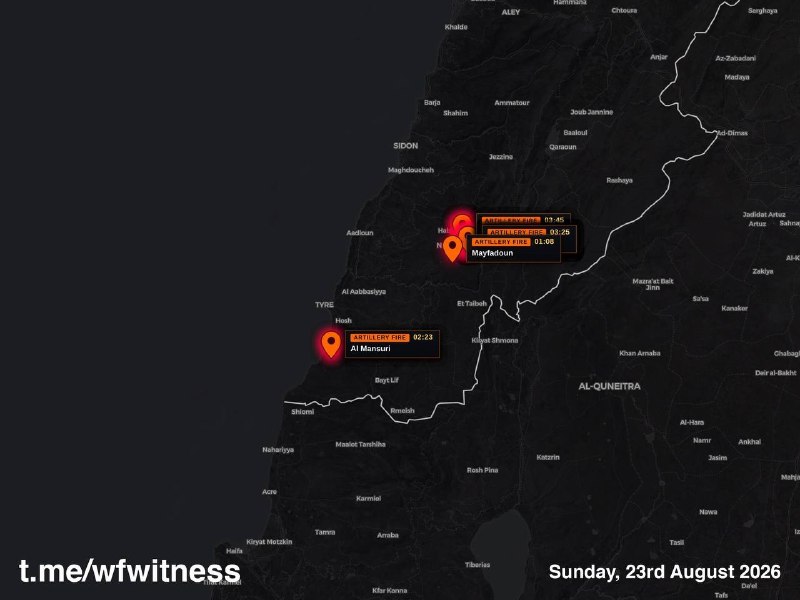
At 22:35 UTC on 22 August 2026, the Telegram channel wfwitness posted a short item: "Israeli jets over southern Lebanon at a very low altitude." A second post followed one minute later, repeating the low-altitude observation and adding a single line: "Israeli airstrike targets Kfar Rumman south." At 22:46 UTC, the same channel switched from air to ground, posting "Non stop Israeli artillery shelling on the town of Al Mansouri and Ali Al Taher hill, southern Lebanon." The first lines of that artillery post are then re-used verbatim at the top of the channel's 01:05 UTC update on 23 August, which broadens the tally to a wider four-village summary.
The four posts, taken in order, are the only public evidence this article relies on. They describe a sequence that begins with low-altitude Israeli aircraft over the south, adds an airstrike on one named village, expands into artillery fire on two named points, and within a few hours widens into a four-village barrage tally. The thread evidence does not, on its own, establish who is firing, what is being struck, or whether the named villages sit on the border ridge or further north. The available source items do not specify those details.
What the four posts actually say
The earliest item, posted at 22:35 UTC on 22 August, records Israeli jets flying at a very low altitude over southern Lebanon. A second post at 22:36 UTC repeats the low-altitude sighting and appends, in the same message, the line that an Israeli airstrike had targeted Kfar Rumman. The third post, at 22:46 UTC, switches from air to ground and describes non-stop Israeli artillery shelling of Al Mansouri and the Ali Al Taher hill area. The fourth and final post, at 01:05 UTC on 23 August, opens with the same Al Mansouri / Ali Al Taher artillery line and extends the account into a wider tally: 28 Israeli strikes across southern Lebanon in the four hours since midnight, 25 by artillery and three by airstrike, across Al Mansuri, Ali Al Taher, Mayfadoun and Kafr Rumman.
Monexus assessment: the textual overlap between the 22:46 UTC post and the 01:05 UTC post (the latter's opening lines repeat the former's artillery phrasing) is consistent with the 01:05 UTC item being either a continuation edit of the 22:46 UTC post or a separate summary that reuses the same phrasing. The thread evidence does not, on its own, decide between those readings. What the four posts jointly establish is narrower and firmer: by 01:05 UTC on 23 August, the channel's own running tally named four villages and 28 strike events, of which 25 were artillery and three were airstrikes.
What the available source items do not specify
The four posts do not name an Israeli unit firing, do not cite an Israeli military spokesperson, and do not record a Hezbollah or Lebanese Armed Forces statement responding to the bombardment. The channel does not give casualty figures on either side, does not specify the calibre of the artillery, does not give coordinates or distances from any border line for any of the four villages named, and does not state whether the airstrike on Kfar Rumman or the artillery fire on Al Mansouri and Ali Al Taher struck residential structures, weapons emplacements, or open ground. Monexus has not independently verified any of these details, and the cited items do not contain them.
The same absence applies to the broader pattern. The cited posts do not specify whether the four-hour, four-village barrage was a single coordinated operation, a sequence of independent engagements, or the continuation of an earlier day's fire, and they do not name any cross-border rocket launch that preceded or followed the Israeli fire. Each of those readings is consistent with the bare text the channel published, and the channel's text alone does not choose between them.
Where the evidence thins
The geographic and institutional context that usually frames southern-Lebanon strike reports (the boundary line drawn after the 2006 conflict, the UNIFIL monitoring presence in the border district, the location of the named villages relative to that line) is not supplied by the four posts. The cited items do not place Al Mansuri, Ali Al Taher, Mayfadoun or Kafr Rumman on a map, do not state which side of any boundary line they sit, do not name the local authority in control, and do not record any statement from the UNIFIL spokesperson or the Lebanese Armed Forces. This article does not back-fill that context from other sources, because the only URLs available for citation are the four wfwitness items themselves, and the policy in force restricts the sources list to URLs that appear in the thread context.
The most natural reading of the four posts, taken jointly, is that the channel is reporting a sequence of Israeli air and artillery action on named villages in the south of Lebanon in the overnight window. That reading is consistent with both the wording and the timing of the posts. It is also consistent with a wider reading in which the 22:35 UTC low-altitude flight, the 22:36 UTC Kfar Rumman airstrike, the 22:46 UTC artillery fire on Al Mansouri and Ali Al Taher, and the 01:05 UTC four-village tally are all parts of a single overnight operation; the cited items do not, however, require that wider reading, and they do not exclude the narrower one in which the four posts are independent bulletins without a single underlying plan.
What to watch next
Three near-term signals would tell us whether the 22 to 23 August barrage is an isolated strike package or the opening of a longer cycle. First, any Israeli military statement identifying the targets struck in Al Mansuri, Ali Al Taher, Mayfadoun and Kfar Rumman, which would clarify whether the operation was framed as a counter-rocket or counter-infrastructure action. Second, any Hezbollah or Lebanese Armed Forces statement, which would tell us whether the barrage is being answered or absorbed. Third, whether wfwitness's posting cadence in the hours after 01:05 UTC extends the village list or shifts to new locations further from the earlier sites, which would indicate the firing zone is widening rather than contracting. Monexus assessment: at the time of publication, the cited items do not contain any of those signals, and this publication has not independently established the answers.
How Monexus framed this: the four cited items are a Telegram feed without an Israeli or Hezbollah statement attached. Monexus reports the channel's own running four-village tally and the verbatim overlap between the 22:46 UTC and 01:05 UTC posts, rather than back-filling it with wire copy or geographic context that the available evidence does not contain. The characterisation of the 01:05 UTC post is left open between "continuation edit" and "separate summary that reuses the same phrasing," because the thread evidence does not decide between the two.
Wire provenance
This editorial synthesis draws on the following public wire/social posts:
- https://t.me/wfwitness/107980
- https://t.me/wfwitness/107981
- https://t.me/wfwitness/107984
- https://t.me/wfwitness/107985