Five wire items, five different weights
On 23 August, a Telegram channel reported a passenger train attack. Around it, four other items landed at equal volume. The shape of that cluster is the story.
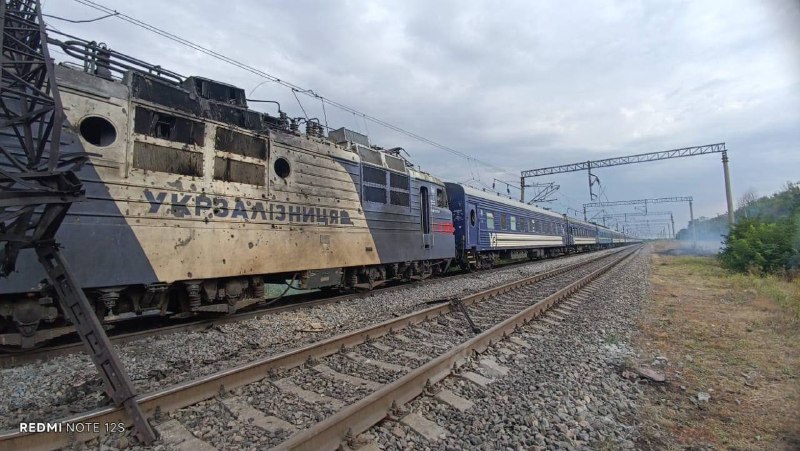
On 23 August 2026, the Noel Reports channel on Telegram posted that a passenger train carrying nearly 600 people, including 15 children, came under attack by Russian jet-powered drones, that the train was deliberately struck, and that it was hit a second time after rescuers and emergency crews arrived. The cited Telegram item does not state the country or region in which the strike took place. Ukrainian outlets reporting on the same day's rail strike have publicly identified the location, according to broader coverage cited below; the Telegram item this column works from does not, and that is the only evidence base for the lead of this piece.
Five items crossed the desk on the 22 and 23 August window. One came from Telegram; the other four came from the Polymarket X account. They share an unkind common thread, this publication finds: they are stories about who gets treated as a person, and who gets treated as a poll slice.
The strike that is not a poll
There is a useful comparison to make, and this publication makes it with care. The Noel Reports post is a single Telegram channel's account; it is not, on its own, a corroborated wire report. Read as that channel's account, what it describes is striking in the plain sense: a moving passenger train, then a second strike after emergency crews arrive. Monexus analysis: the second-strike-after-rescuer pattern, where it has been established by independent reporting in coverage of this war, is widely treated as a deliberate tactic that turns first responders into targets. That reading is the most natural one. It is also, at this stage, this publication's characterisation of what a single-channel Telegram post describes, and not a finding of fact.
The market does not need this column to tell it what to do. It will price the story, or not, on the basis of corroboration that has not arrived in the cited source items. The civilians named in that Telegram post, by contrast, were not a poll.
The number that replaces a number
The next story on the same day's wire was this: nearly nine in ten adults under 40 say buying a home is harder today than it was for their parents. It came packaged as a New York Times finding via Polymarket's X account. Read with care, it is not really about housing. It is about the conversion of a whole generation into a statistical fact.
When a finding like this lands, it usually arrives dressed in two costumes. The first is reassurance: "experts say this is cyclical." The second is blame: "millennials can't save." Neither costume fits, on this publication's reading. Monexus analysis: what actually happened, across the three decades bracketed by the respondents' parents, is that the asset was financialised. A home stopped being a place to live and became a balance-sheet line, then a status commodity. The "harder" in the headline is doing the work of an entire macroeconomic story, and the headline stat, on its own, tells you nothing about zoning, interest rates, supply, or single-family rental consolidation. It tells you, instead, that the political class has begun to govern by mood survey.
Progress as headline
Two more items, both pitched as wins. US researchers, working on a quantum-internet build, say they have transmitted quantum information wirelessly through open air over 13 miles. RFK Jr. has unveiled a plan for a nationwide autism alert system to help locate missing autistic people. Neither deserves mockery. Both deserve the same sceptical inspection.
On the quantum story, the technical claim is, on its face, plausible and probably significant; it is also the sort of laboratory result that, when banked by venture capital, turns into a five-year news cycle of "the internet is about to change" before anything usable ships. The 13-mile figure is a real engineering number. What it is not, yet, is a network.
On the alert system, the test is whether the announcement survives contact with implementation. A national alert system that does not get handed the legal authority, the funding, and the integration with existing 911 infrastructure is a press conference. The available source items do not specify any of those specifics, which is precisely the point.
The story that should have been bigger
The fifth item was the day's quiet one. Botswana warned that its citizens are being lured overseas with fake job offers, enlisted in the Russian army, and deployed to the frontlines in Ukraine. Read it twice. Monexus analysis: a recruitment pipeline that moves citizens of one country into a third country's war is not a story about any one of those three places. It is a story about the asymmetry of attention. An attack on a passenger train, reported by a single Telegram channel, sits at the top of a day's feed. A warning from Gaborone about recruitment pipelines gets a Polymarket reshare. Both are real. Both matter. One will be in your feed tomorrow.
What the cluster is honestly telling us
Monexus assessment: a news diet assembled from five cross-source items across a roughly 24-hour window is a small sample, and the patterns visible inside it are patterns of attention, not patterns of the world. With that caveat, the most natural reading is that Western audiences are being trained, gently and by repetition, to consume atrocity, housing despair, and technological promise as a single feed of equal-weight items, while the slower stories about how the war and the global economy actually link together get circulated as curiosities.
That is not a conspiracy. It is a side effect. The same algorithmic logic that flattens a train strike and a real estate mood poll into neighbouring cards also flattens quantum milestones and missing-person alerts into foils for each other. The penalty is not that anything is fake. The penalty is that nothing is allowed to be loud for long enough to demand a policy response.
The civilians on that train were loud for one news cycle. The polling respondents were loud for one news cycle. The autistic child who gets located in time because of a future alert system, and the Botswanan conscript who gets extracted from a Donetsk trench because of a warning from Gaborone, will never be famous at all. That is the cost. It is small per day, and it is cumulative.
The structural question is not whether the wire knows any of this. It is who pays the desk to make the quieter items impossible to scroll past, and who, on the present evidence, picks up the tab.
How Monexus framed this vs the wire: most outlets ran each of these as a discrete story; Monexus ran them as a single diagnosis of attention asymmetry, with the deliberate caveat that a five-item sample drawn from one Telegram channel and one X account is too small to support a thesis, only a pattern, and that the lead item rests on a single-channel report that the cited sources do not independently corroborate. Independent Ukrainian outlets have publicly identified the strike location; this column works only from the cited Telegram item and has not independently established the region.
Wire provenance
This editorial synthesis draws on the following public wire/social posts:
- https://t.me/noel_reports/51559
- https://x.com/Polymarket/status/2091226142762316049
- https://x.com/Polymarket/status/2091168207973269531
- https://x.com/Polymarket/status/2091160687355572345
- https://x.com/Polymarket/status/2091064326790455397