A president on the parade route: Trump turns Washington's streets into a 250th-birthday stage
On 23 August 2026 Donald Trump took a ceremonial lap around an IndyCar circuit laid through central Washington, capping a summer of America-250 events that critics and supporters read very differently.
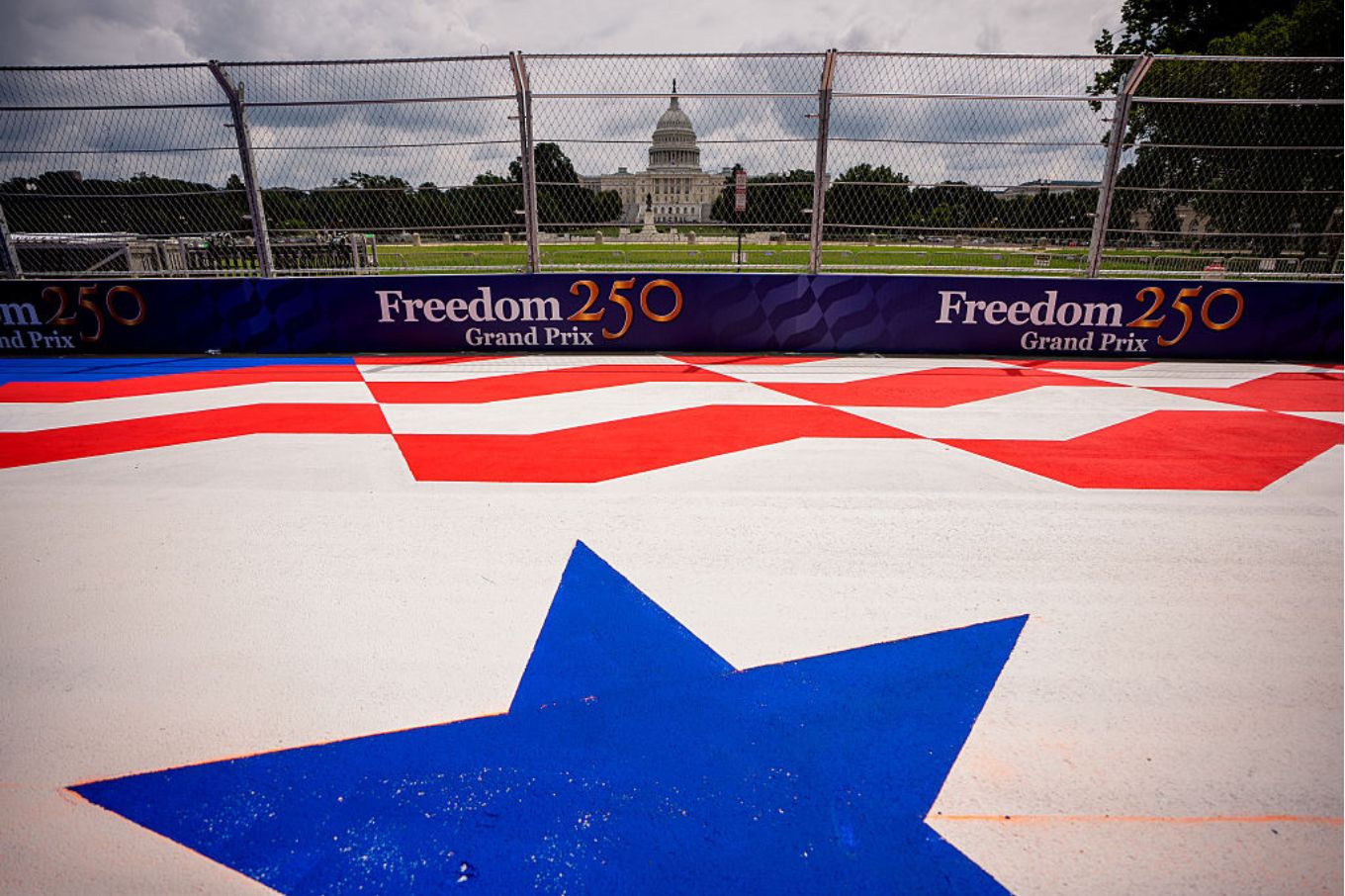
The infield at the Washington street circuit, 23 August 2026, just after 16:30 UTC: Donald Trump, behind the wheel of a ceremonial pace car, took a slow loop around a temporary IndyCar track cut into the capital's avenues, the visual centrepiece of a summer of events built around the United States' 250th birthday. Reuters logged the appearance as the capstone of a months-long programme of America-250 festivities; the BBC framed it as a president converting public infrastructure into a stage. The same lap, the same car, the same road, and two reads of what is happening to the republic's oldest self-celebration.
This publication's read is straightforward. The 250th-anniversary calendar has been quietly absorbed into the rhythm of the second Trump presidency, with marquee events timed to the campaign cycle and the news cycle rather than the historical calendar. An auto race staged on city streets is a useful test case: it is loud, photogenic, and impossible to mistake for a normal sporting fixture. The question worth asking is not whether presidents should attend races. They have done so for generations. The question is what it means when the presidency itself becomes the through-line of a national birthday, and when a sports broadcaster's microphone captures a presidential lap in the same frame as a campaign logo.
The race, and the choreography around it
The day belonged, on the timing sheets, to Alex Palou, who claimed his seventh IndyCar pole of the 2026 season in Washington, according to investing.com's race-day wire. Palou is the championship leader, and the pole matters for points. Reuters positioned Trump's appearance as the closing note of an America-250 summer that began with military parade imagery in June and stretched through the summer months. The BBC's report added texture that the wire did not: a ceremonial lap, the president greeting drivers, the race staged on a temporary circuit laid through the streets of the capital. None of the wire coverage of the race itself claims a record attendance figure, and the available reporting does not specify the size of the crowd lining the circuit. That detail is worth naming out loud: the spectacle is documented, the scale is not.
The choreography matters because it is the choreography the administration has chosen. Past America-250 and America-250-adjacent programmes have leaned on museum openings, civic commissions, and bilingual programming aimed at the country's hemispheric neighbours. This year's calendar, as Reuters and the BBC describe it, leans on visual scale: parades, fighter-jet flyovers, and now a city-centre race. The two registers are not mutually exclusive, but they pull in different directions. One asks the public to read; the other asks the public to look up.
The other reading the wires do not offer
The dominant wire framing is essentially ceremonial: president attends race, race marks anniversary, anniversary closes summer. A more sceptical reading starts from a different premise. A street circuit is a logistical operation. Closing several blocks of central Washington for an IndyCar event on a Sunday afternoon is a federal, municipal and private-sector undertaking, and the BBC and Reuters accounts together make clear that the president's office treated the race as a stage rather than a guest slot. The motor sport itself is incidental to the political optics. Critics in the US press have argued for months that the 250th-anniversary branding has been repurposed as scaffolding for the president's preferred aesthetic of massed flags, military hardware and patriotic pop; supporters counter that a noisy, visible birthday is exactly what an anniversary deserves. Neither side has, on the available reporting, produced a poll on this specific race. The framing contest is being conducted in columns and on cable rather than at the ballot box.
That contestation is itself part of the story. The wire services do not adjudicate it, and they should not; their job is to record what happened, not what it means. The interpretive work is downstream, and the downstream is where the framing battle actually lives.
Monexus assessment: spectacle as governing style
Monexus finds that the pattern is consistent enough to call a style. Across the summer of 2026, the 250th-anniversary programme has functioned as scaffolding for a particular brand of executive visibility: large set pieces, presidential presence at the visual centre, and wire coverage that treats the politics as backdrop. The street race fits the template cleanly. A pace car, a camera-friendly turn, a track laid through the capital's avenues, and an anniversary frame pre-loaded with patriotic symbolism. The cost of the underlying federal involvement, and the share borne by Washington DC taxpayers specifically, is not stated in the available reporting, and this article has not independently established what that figure is. That is the kind of detail a follow-up piece should chase, ideally with a Freedom of Information request to the National Park Service and the DC Department of Transportation once the invoices are filed.
What can be said now is that the spectacle has a return on investment, and the return is measured in frames per minute rather than votes per precinct. A president on a parade route is not campaigning in the traditional sense; he is curating a feed. The motor sport is the pretext. The image is the point.
What to watch next
Two dates will tell us whether 2026 is a one-off or a template. First, the official end-of-year America-250 accounting, expected in the autumn, which will disclose the federal spend allocated to the summer's marquee events. Second, the early-2027 primary calendar in states that hosted the largest set pieces, where the political yield of the spectacle will be visible in fundraising numbers and earned-media equivalents. If those numbers line up with the visual investment, the street-race model travels. If they do not, the parade goes back to being a parade.
How Monexus framed this: the wire services recorded a president, a race and an anniversary. Monexus read the same three elements as a governing style in which the 250th birthday has become a recurring backdrop for executive visibility, and flagged the one material gap in the available reporting: nobody has yet published the price tag.
Wire provenance
This editorial synthesis draws on the following public wire/social posts:
- https://www.bbc.co.uk/news/articles/c0qvq24vlj4o?at_medium=RSS&at_campaign=rss
- https://x.com/Reuters/status/2091535953105940715
- http://reut.rs/4gfQE0C
- https://www.investing.com/news/general-news/motor-racing-palou-claims-seventh-indycar-pole-of-season-in-washington-4872400