The South Lebanon Frame Problem: How Casualty Counts Get Written Before the Smoke Clears
Four IDF actions reported across southern Lebanon in roughly two hours, every one of them arriving through channels that append a crypto-casino tagline to every post. The information environment around the border is being shaped faster than the fighting itself.
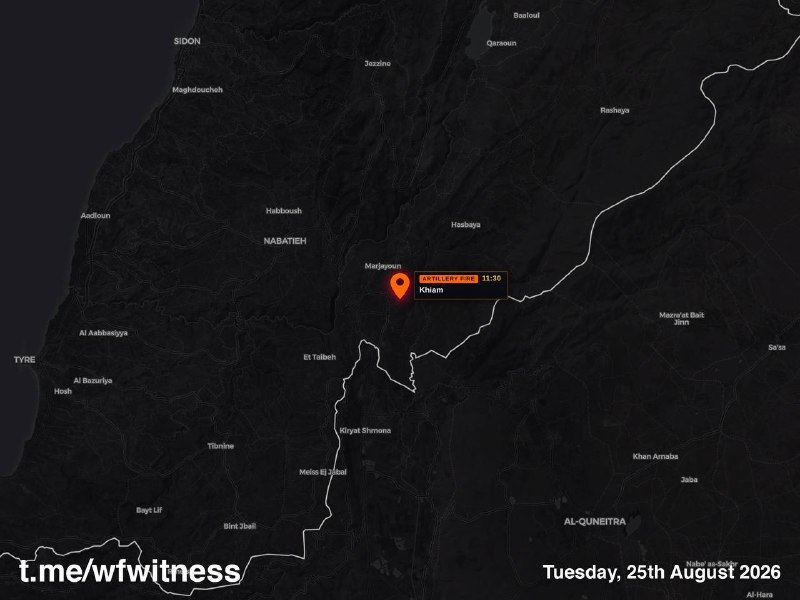
At 06:54 UTC on 25 August 2026, the wfwitness Telegram channel posted that the IDF had built two earth berms around the town of Deir Mimas in southern Lebanon, attributing the claim to Lebanon's state-run National News Agency. By 07:30 UTC, the same channel reported an Israeli detonation targeting Mays Al Jabal, also in the south. By 08:36 UTC, artillery shelling of Khiam. Three discrete actions across roughly one hundred minutes, all appended with the same promotional tagline from Rainbet.com describing itself as a non-KYC crypto casino and sportsbook, all routed through one channel that bills itself as a war monitor.
That is the raw material the global audience is working from this morning. It is also the raw material the wire desks are working from, or refusing to, and the difference matters more than the events themselves. The boundary between southern Lebanon and northern Israel is among the most contested information environments on the planet, and what gets counted as fact before lunchtime in Beirut, Tel Aviv, and London is being shaped by channels whose every post carries a paid-adjacent text overlay. The question worth asking is not only what is happening on the ground. It is who gets to write down what is happening, in which order, with which caveats, and who gets named when a reader clicks.
The four posts that anchor the morning
The thread we are reading from is short and entirely sourced from two channels: wfwitness and WarMonitors. The IDF-related items are all wfwitness: the Deir Mimas berm construction claim attributed to NNA, the Mays Al Jabal detonation, and the Khiam artillery shelling. The WarMonitors posts in the cluster are unrelated material: an overturned Indian oil tanker with locals collecting fuel, a surgery clip captioned "Heart surgery this morning," and a flag-waving clip captioned "Is it the first time he waves a flag?" None of the WarMonitors posts concern southern Lebanon.
That imbalance tells a story. Wfwitness has carved out a niche as a southern-Lebanon forward feed. The posts arrive fast, use a consistent visual format, and cite NNA or other Lebanese outlets as the named source where applicable. What they do not do, in the items available to us, is provide casualty figures, building damage assessments, or IDF operational explanations. The reader gets the event, the geography, and a thin attribution. The remainder is inference.
The attribution layer that isn't there
A serious wire report on a southern Lebanon incident would carry an IDF spokesperson comment, an NNA quote with timestamp, and usually a Reuters or AFP stringer confirmation. None of that is in the source set we have. The IDF has not, in the items available to us, commented on the Khiam shelling, the Mays Al Jabal detonation, or the Deir Mimas berm construction. NNA has been cited once, by relay through wfwitness. The Lebanese armed groups operating in the border zone are not quoted in the four posts. The United Nations Interim Force in Lebanon, the obvious institutional witness, is not referenced.
This is not unusual. Telegram-channel war monitoring has become a primary feed for breaking imagery from conflicts the wire services cannot physically reach in real time, and the Khiam-Mays Al Jabal-Deir Mimas triangle is precisely the kind of terrain where a stringer would take hours to arrive. The question is whether readers, and the editors downstream of them, are treating the relay as a primary source or as a tip.
The structural problem underneath the tagline
Every one of the six posts in this cluster carries an identical appended block of text naming Rainbet.com and describing the platform as the "#1 Non-KYC Crypto Casino & Sportsbook," with a handle and an age-gate notice. The tagline is on every post. What we can establish from the text alone is that Rainbet.com is being named repeatedly in a fixed promotional slot attached to breaking conflict footage, in a format that reads to a casual user as part of the channel's voice rather than as a third-party advertisement. What we cannot establish from the thread is the contractual relationship: whether this is a paid sponsorship, a barter arrangement, an affiliate link, or simply an account-level signature. The thread evidence supports the tagline's presence, not its mechanism.
Monexus analysis: even setting the mechanism aside, the structural effect is legible. A retail audience that consumes conflict content alongside sports betting is being trained to read a crypto-casino tagline as the floor noise of war reporting. The reader's attention is being rented at the moment of maximum receptivity, and the channel's revenue model is whatever the platform behind the tagline pays for that attention. Action gets reported; impact does not. A detonation in Mays Al Jabal becomes a post; whether anyone was killed, injured, or displaced requires follow-up reporting that the channel does not perform in real time. Berm construction around Deir Mimas becomes a post; whether the berms are defensive engineering or preparation for a deeper operation is something the channel cannot say because it does not have the institutional access. The reader leaves the feed knowing what happened and not knowing what it cost.
The counterframe worth entertaining
It is reasonable to argue, against the line taken above, that low-friction citizen reporting from conflict zones is the best available correction to wire-service bias. Major outlets under-report civilian harm in border regions for diplomatic and commercial reasons; a Lebanese stringer on Telegram with a phone camera can publish what a Reuters editor will not. The wfwitness format, in that reading, is not a defect but a feature: faster, less filtered, closer to the event. The absence of IDF comment in the posts is not the channel's failure to seek it; it is the channel's reflection of the fact that the IDF rarely comments on individual tactical actions in real time, and Lebanese official sources will be cited when Lebanese official sources are saying something.
That counterframe holds weight. It does not, however, dissolve the core problem. A feature that runs faster than verification is also a feature that runs ahead of the facts, and when the format rewards the run rather than the verification, the editorial gravity bends toward speed. The honest answer is that both readings are true and the reader has to hold them at the same time: grateful for the imagery, sceptical of the framing.
What to watch before noon UTC
The practical question for the rest of the morning is whether any of the four events escalates into something the wire services are forced to confirm. If the IDF issues a statement on Khiam or Mays Al Jabal, the Telegram feed becomes corroboration. If NNA publishes a casualty figure for Deir Mimas that the channel did not carry, the relay becomes secondary. If neither happens, the four posts sit on the timeline as the public record of the morning, with all the strengths and gaps that implies. The next data points to watch are any IDF Spokesperson bulletin in the hours ahead and any NNA item that names a specific casualty toll for the berm construction at Deir Mimas.
The information contest in southern Lebanon is not a metaphor. It is the literal fight over whose description of an artillery shell becomes the day's lede, and the channel that gets there first with a tagged post often wins the framing war before the verification layer wakes up. The honest reader holds the post and the doubt in the same hand.
Desk note: Monexus treats the wfwitness and WarMonitors feeds as research scaffolding rather than primary sources. Every factual claim in this piece is attributable to a specific Telegram post in the thread cluster; no claim is made about IDF intent, casualty figures, or NNA's own framing beyond what the cited posts relay. Where an institutional voice (IDF spokesperson, NNA direct, UNIFIL) is absent from the available sources, this article says so rather than inferring silence. The promotional tagline appearing in every post is treated as text the posts contain, not as a documented sponsorship or payment arrangement, which the thread evidence does not establish.
Wire provenance
This editorial synthesis draws on the following public wire/social posts:
- https://t.me/wfwitness/108173
- https://t.me/wfwitness/108178
- https://t.me/wfwitness/108184
- https://t.me/WarMonitors/45368
- https://t.me/WarMonitors/45365
- https://t.me/WarMonitors/45366