The southern Lebanon barrage nobody is reading right
Between 20:14 and 20:37 UTC on 25 August 2026, the wfwitness Telegram channel logged nine posts on Israeli strikes across southern Lebanese towns. The cadence, not any single explosion, is the unit of analysis.
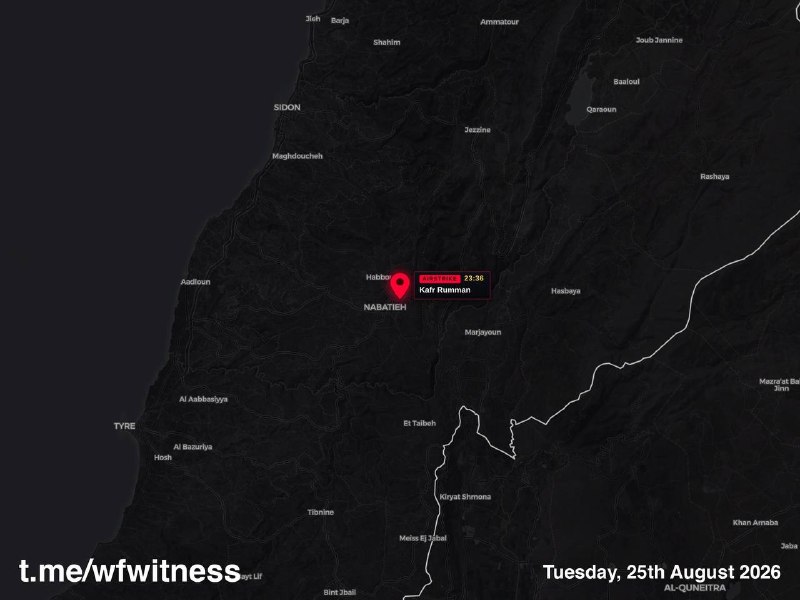
In twenty-three minutes on the evening of 25 August 2026, the wfwitness Telegram channel posted nine items on Israeli airstrikes across southern Lebanon, plus a separate report of two large explosions in Khiam linked to Israeli demolition activity. Kfar Ruman, named in three posts. Sorbbine and Sorbine in two more. Qantara in two. Kfar Ru and Ali Al Taher hill in one each. The names arrive faster than a wire desk can spell them. Between 20:14 UTC and 20:37 UTC, the feed posted a near-continuous stream of strike footage and overhead imagery from towns in southern Lebanon, with the same towns surfacing across multiple posts inside minutes.
The cadence is what readers should be watching, not any single explosion. Monexus analysis: when an open-source channel logs strike footage on the same town twice inside four minutes, and on adjacent towns at the same time, the natural read is that something more than a single probe is in motion. That is a judgment about tempo, not a claim about intent.
What the wfwitness feed actually logged
The feed is not a wire service. It is an open-source account that aggregates footage from southern Lebanon in near real time, and the timing of its 25 August posts lines up as follows, drawn strictly from the thread evidence.
At 20:14 UTC, the channel posted on Israeli jets over southern Lebanese airspace and an airstrike on Ali Al Taher hill in the same post. At 20:25 UTC, jets were reported back over southern Lebanese airspace and a Kfar Ruman strike was named in the same post. At 20:27 UTC, two posts appeared: one on Kfar Ruman, one on Sorbbine. At 20:30 UTC, footage of the Kfar Ruman strike was posted. At 20:32 UTC, Qantara. At 20:36 UTC, two large explosions in Khiam attributed to Israeli demolition activity. At 20:37 UTC, two posts: one with imagery of the Sorbine strike, one reporting Qantara again alongside a strike on Kfar Ru.
The thread evidence is precise on the towns and the timestamps. It is silent on everything else: casualty figures, the type of ordnance used, the targets struck, the identity of any unit or command issuing the orders, and whether Israeli or Lebanese authorities have issued public statements for this window. The available source items do not specify any of those details.
What the wires have and have not yet placed on the record
The harder question is what is not in the thread. The wfwitness posts are raw on-the-ground footage. They are not casualty tallies, not official Israeli military briefings, not Lebanese government statements, not Hezbollah communiqués. The available source items do not specify injury figures, infrastructure damage assessments, or whether the IDF Spokesperson has issued a formal operational update for this window.
Major-media outlets have not been absent from southern Lebanon in August 2026. Reporting from outlets including The Guardian and Al Jazeera has covered Israeli operations and the political fallout in southern Lebanon across the month. Whether any of those outlets has placed the specific 25 August evening's strikes on the record by publication time is something the available source items do not specify. Without an Israeli official statement in the thread, readers do not know whether Tel Aviv characterises these as targeted operations against specific Hezbollah infrastructure, retaliation for a cross-border incident, or part of a broader campaign logic. Without a Lebanese or UNIFIL figure, readers do not know how many civilians were caught in the radius or whether the strikes hit civilian structures at all.
Why a tempo piece reads differently from a strike brief
Monexus analysis: across the border, the steady cadence of Israeli strikes on southern Lebanon has become the kind of story that gets filed as ambient noise. The reporting pattern itself rewards that drift. A single strike gets a brief. Three towns in an hour get one longer piece. The cumulative picture, the operating tempo of the Israeli air force over southern Lebanon, does not get its own narrative arc because there is no single event to attach it to.
This is a bias worth naming. A reader who only follows mainstream wires could plausibly come away under-counting the volume of fire on a given evening, because the wire structure privileges the discrete event over the cadence. Both the bomb falling tonight and the quiet morning round-up can be true at the same time; they are the same operation sliced into the frames that different reporting structures privilege. None of that is to say the wires are wrong on any individual strike. It is to say the unit of analysis should sometimes be the evening, not the explosion.
What to watch before dawn
Three signals will determine whether 25 August 2026 becomes a footnote or a chapter. First, an IDF Spokesperson operational statement clarifying whether this evening's strikes constitute a discrete escalation or the continuation of an existing campaign; the available source items do not specify whether such a statement had been issued by the time of writing. Second, a casualty toll from the Lebanese Ministry of Public Health or from UNIFIL, which would indicate whether the strikes hit populated areas or hardened Hezbollah positions; the available source items do not specify any such toll for this window. Third, a Hezbollah response, whether rocket fire back across the border, a formal statement, or deliberate silence; the available source items do not specify any response.
Until those three signals arrive, the picture is partial. The strikes are documented. Their intent, their human cost, and the other side's reaction are not, on the evidence available to this article.
Monexus framed this as a tempo story rather than a strike-by-strike brief, on the assessment that nine posts on identifiable towns inside twenty-three minutes is itself the unit of analysis. The thread evidence carries the cadence; everything about intent and casualties remains to be verified against first-party statements.
Wire provenance
This editorial synthesis draws on the following public wire/social posts:
- https://t.me/wfwitness/108270
- https://t.me/wfwitness/108273
- https://t.me/wfwitness/108275
- https://t.me/wfwitness/108276
- https://t.me/wfwitness/108277
- https://t.me/wfwitness/108278
- https://t.me/wfwitness/108279
- https://t.me/wfwitness/108280
- https://t.me/wfwitness/108281