Southern Lebanon, One Demolition at a Time: What Steady Artillery Tells Us
Within roughly five hours on 24-25 August 2026, Israeli artillery fired on Kafr Rumman and Srbin, then a demolition operation hit Haris. Read together, the items sketch a sustained campaign, not a single strike.
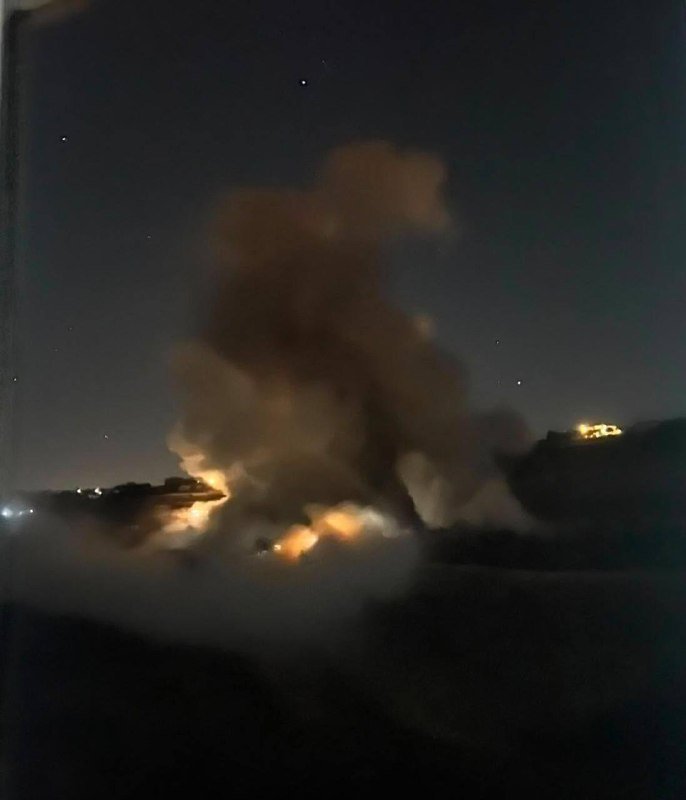
At 20:35 UTC on 24 August 2026, the Telegram channel wfwitness reported Israeli artillery fire in the southern Lebanese village of Kafr Rumman. Sixty-eight minutes later, at 21:43 UTC, the same channel logged Israeli artillery fire in the nearby town of Srbin. At 00:14 UTC on 25 August, observers in Haris reported an explosion attributed to Israeli demolition activity. By 00:21 UTC, the Iranian state channel Press TV was carrying an explicit line: the Israeli military was conducting a "massive demolition operation on the outskirts of Haris."
Five hours, three localities, two forms of firepower. Each item, taken alone, is the kind of regional flash that scrolls past a war-channel feed and disappears. Read together, they sketch a pattern of nudges. Monexus analysis: what is striking is not the volume of any single event but the cadence across one night, the shift in vocabulary as the operation in Haris grew in scale, and the absence of any Israeli military spokesperson statement attached to the cluster.
What the night actually said
The earliest item in the cluster describes artillery fire in Kafr Rumman at 20:35 UTC. A second artillery item places fire in Srbin at 21:43 UTC. Both come from the same Telegram channel, and both reach across two distinct localities in the same southern district. Artillery on a village map is rarely a precision instrument against an individual structure; its signature is a spread of impact points and a road that becomes harder to drive. The available sources do not specify what was hit or whether any casualties resulted.
The 00:14 UTC report shifts register, from artillery to demolition, in Haris. A demolition operation, in the language of the channel carrying the item, is purposeful, close-quarters engineering rather than a standoff barrage. By 00:21 UTC, Press TV was using the phrase "massive demolition operation on the outskirts of Haris." That is a sharper description than the earlier summary, which had used the more elastic "explosion" and "demolition activity." The escalation in vocabulary tracks the escalation in scope.
None of the four items carries an Israeli military spokesperson statement. None names a casualty. The frames are operational, not political, and that is itself a tell about how this campaign is being communicated.
The grammar of a slow campaign
Regional channels carry incidents at this hour of the morning before the wire desks in Beirut, Jerusalem, and Dubai have caught up. Their value to a reader is not that they are accurate down to the building number. Their value is that they are early, geographically specific, and consistent across multiple channels when the underlying event was substantial.
Monexus analysis: across one night, three localities, and four posts from two channels, the operational signature is consistent. That consistency, more than any single item, is what warrants attention. The cluster also carries an editorial seam worth naming. The same operation in Haris moves from "demolition activity" to "massive demolition operation" over the space of seven minutes, and the more forceful phrasing arrives from an Iranian state outlet. That is not, on its own, a reason to discount the underlying report, but it is a reason to flag which voice is amplifying the strongest framing. A reader using only the wfwitness feed would see a quieter description of the same event.
Why this reads like a deliberate ceiling
Three signals, taken together, point to a deliberate operational ceiling rather than a major offensive.
The first is type-of-munition. Artillery is not the lead tool of a ground push. It is being used on villages in the same southern district, and that regularity suggests it is also being used to demonstrate persistent presence. The second is tempo. Five hours, three localities, no reported ground incursion in the available record; the activity is sustained but narrow. The third is messaging. The Israeli press apparatus has, in past escalations, attached a strategic frame to incidents at this scale, naming the bigger target as a justification. The available items carry no such frame. Our assessment: the operation is being pitched as routine in the regional press, and the routine framing is itself part of the political product.
That product has buyers. Domestically, a return to "quiet border, active southern belt" sells well. Internationally, every artillery round that does not draw a Western capital's rebuke is a normalisation artefact. In Beirut, the calculus is more granular; the ceasefire architecture that took months of US-French-Qatari shuttle diplomacy to broker is treated as something not to be tested by either side in a single dramatic gesture.
What is still genuinely unclear
The available items do not specify whether the night involved any Israeli ground entry, any civilian casualty figures, or any Hezbollah return fire. They also do not specify whether the IDF Spokesperson's office has issued a same-day statement tying the demolitions to a named weapons site or cell. Press TV carried the late post; the IDF's own readout is not in the cluster. That gap is the most consequential unknown. If a named target is attached to Haris in the next 48 hours, the operation reads as law-enforcement-grade; if no target is ever named, it reads as a political-leverage event whose value lies precisely in being unspecific.
Watch, in order: the IDF Spokesperson's English-language readout for 25 August; any UNIFIL or Lebanese Armed Forces statement on ground movement; and whether Hezbollah-aligned outlets acknowledge return fire in the same 24-hour window. The story of this night will be less in the demolition itself than in whether anyone, on the Israeli side, is willing to put their name on what was done and why.
Desk note: this publication is reading the cluster as a single event arc rather than four independent flashes. Where the Western wire carries Israeli framing by default, regional channels carry the operational detail the wires omit. This piece uses the latter for the operational ledger and stays neutral on motive until first-party readouts appear.
Wire provenance
This editorial synthesis draws on the following public wire/social posts:
- https://t.me/wfwitness/108137
- https://t.me/wfwitness/108140
- https://t.me/wfwitness/108154
- https://t.me/presstv/204068