Tehran and Muscat move to redraw the Strait of Hormuz traffic map
Iran's deputy foreign minister says a draft arrangement with Oman would route traffic through Iranian waters, close the southern passage, and exclude military vessels. The proposal has surfaced in state-affiliated and independent channels over a 24-hour window.
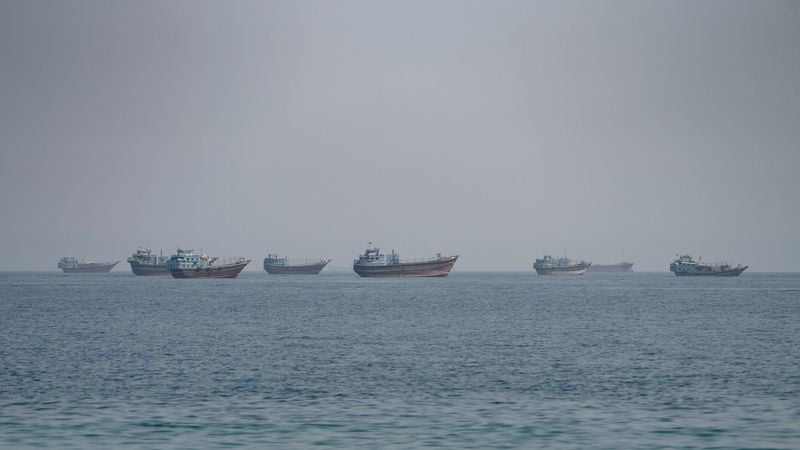
At 21:09 UTC on 25 August 2026, Iran's Deputy Foreign Minister Kazem Gharibabadi began spelling out, in remarks relayed by the wfwitness Telegram channel, the maritime arrangement under negotiation with Oman that he said would redraw the traffic geometry of the Strait of Hormuz: inbound and outbound vessels channelled through specific coastal waters, the southern passage closed to general traffic, and military vessels excluded altogether. Press TV's Telegram feed reposted the Iranian framing at 00:05 UTC on 26 August 2026, while a Sprinter Press account on X carried a separate excerpt of the remarks at 21:45 UTC on 25 August.
Read narrowly, this is a bilateral border negotiation between two adjacent Gulf states, with the wfwitness excerpts explicitly conditional on an Omani-Iranian agreement being finalised. Read against the recurring drumbeat of tanker seizures, drone attacks on shipping, and the long-running question of who controls passage through Hormuz, the same remarks are something closer to a charter for a new traffic regime in one of the world's most consequential energy corridors. The Iranian side is the only side on the public record here.
What Gharibabadi said
According to Press TV's Telegram channel, timestamped 00:05 UTC on 26 August 2026, Gharibabadi told reporters that, under the arrangement with Oman, "the entry route to the Persian Gulf will pass through Iran's waters and the exit route through Oman's territorial water." A separate X post by Sprinter Press at 21:45 UTC on 25 August 2026 quoted Gharibabadi directly: "The southern passage of the Strait of Hormuz will be closed, and an agreement has already been reached on this matter. Oman agrees with the closure of this passage." The same Sprinter Press item adds, per the Iranian remarks, that the International Maritime Organization "will be notified" of the arrangement.
Two further wfwitness Telegram posts, timestamped 21:32 UTC and 21:47 UTC on 25 August, restated the Iranian position and added conditions. The 21:47 UTC wfwitness post carries the wording that, under a finalised Omani-Iranian agreement, "no military vessel … will be granted permission to transit." Press TV's Telegram framing of the remarks characterises the arrangement as "temporary," with reopening tied to "the realisation of Tehran's demands." That qualifier is consequential. It recasts the proposal from a permanent corridor redesign into a conditional one, with the conditions set by Tehran.
Where the conditional language sits
The wfwitness excerpts from 25 August 2026 repeatedly frame the routing and closure language as terms that would apply "if an Omani-Iranian agreement is finalized." That conditional scaffolding is in tension with the Sprinter Press quotation that an agreement "has already been reached" on the southern-passage closure. Read together, the most consistent reading of the public record is that a political understanding on certain elements has been reached between the two sides, while the operational implementation remains subject to formalisation and to the conditions Gharibabadi himself named. Press TV's "temporary" label, with reopening tied to demand fulfilment, reinforces that read.
The available source items do not specify whether Muscat has issued a matching on-the-record confirmation of the corridor geometry or of the no-military-vessel clause, what "Tehran's demands" refers to, the timetable for any operational change, or whether other Gulf states have been consulted or notified.
Why this is more than a traffic-management story
Under the arrangement as described across the four Telegram and X items, both the inbound and outbound legs would pass through Iranian waters in part, the southern passage would be closed to general traffic, and military vessels would be excluded from the transit scheme. The Iranian side is also the side setting the conditions under which, in its own framing, the arrangement would be reopened.
Monexus analysis: the political substance of the remarks is that Iran is seeking to concentrate routing decisions in the hands of the two coastal states it has negotiated with, with the IMO notified rather than used as the codifying forum, and with the corridor itself opened and closed at Tehran's discretion. The no-military-vessel clause, on the public record, applies to the transit scheme under negotiation; the available source items do not specify whether the clause is intended to bind third-state navies operating under international freedom-of-navigation principles, or only the commercial traffic regime.
What to watch next
Three signals will tell operators, insurers, and naval planners whether the proposal moves from remarks to operational reality. First, a written communiqué from Oman's foreign ministry confirming the bilateral framework; the available source items do not specify that one has been issued. Second, an IMO notification, which the Sprinter Press post indicates is planned, converting the political claim into an international record. Third, a reaction from other Gulf states, including the Gulf Cooperation Council as a body, which would indicate whether the arrangement is being treated as a Muscat-Tehran bilateral or as a wider regional reset. Until at least one of those signals is on the public record, tanker masters and charterers will treat the announcement as a negotiating posture, with the added wrinkle that Tehran itself has framed it as conditional on demand fulfilment.
Monexus framing note: the desk leans on Iranian state-affiliated channels (Press TV) and on relays of the Iranian official's remarks (wfwitness, Sprinter Press), because those are the inputs the pipeline received; the Muscat side, the IMO side, and the wider Gulf response are not on the public record in the thread evidence, and the desk has left those gaps visible rather than papered over.
Wire provenance
This editorial synthesis draws on the following public wire/social posts:
- https://t.me/presstv/204195
- https://t.me/wfwitness/108291
- https://x.com/SprinterPress/status/2092367687640924238
- https://t.me/wfwitness/108289
- https://t.me/wfwitness/108287