Iran's speaker ties Gulf oil flows to Tehran's own exports in Hormuz standoff with Washington
Parliament Speaker Ghalibaf responds to CENTCOM Commander Cooper with a cross-regional warning: no Gulf state exports to customers while Iran is blocked. The equation is now on the table, in public.
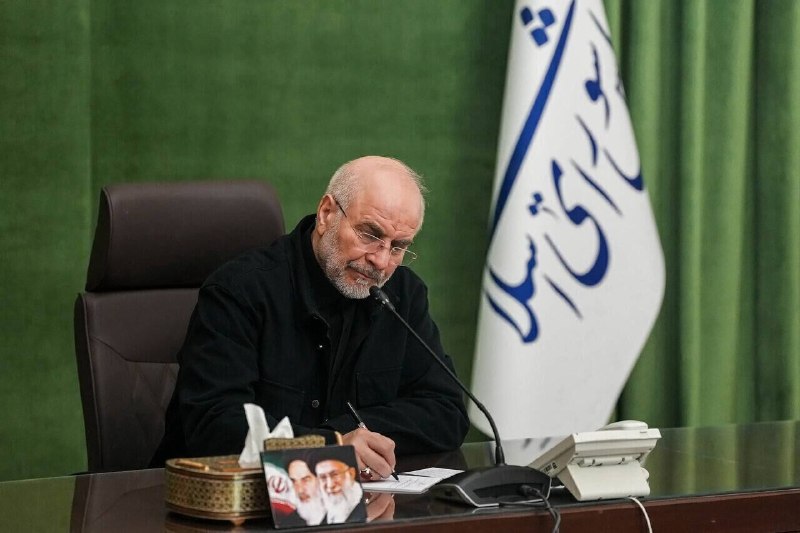
Iran's Parliament Speaker Mohammad Bagher Ghalibaf escalated a confrontation with US Central Command on Thursday 28 August 2026, publicly warning that no regional state will be permitted to export oil to global customers while Iran's own energy shipments are shut off. The remarks were posted to his X account within hours of CENTCOM Commander Admiral Brad Cooper's claim that US forces held full control of the Strait of Hormuz and had halted Iranian oil exports, and they were relayed by Iranian state outlets IRNA, Press TV, and the Beirut-based The Cradle throughout the afternoon.
The framing has shifted from maritime interdiction to collective economic retaliation, and the venue is no longer private diplomacy but public posturing. Iran's leadership is now treating any US effort to single out Iranian crude as an act against the wider Gulf energy complex, a calculus designed to price in the cost of any Hormuz squeeze for Washington's regional partners before the next tanker sails.
The equation, in Tehran's words
The substance of the warning is reciprocity without geographic limits. According to English-language Iranian state outlet IRNA, Ghalibaf "firmly responded" to Cooper's comments by reiterating Tehran's standing position that any disruption to Iran's energy trade would be met with a regional response, language that Press TV described as the speaker reposting his X post directly in reaction to the CENTCOM commander. The Cradle, an outlet based in Lebanon with editorial sympathies aligned to the Iranian-aligned axis, framed the warning in its own bulletin at 13:48 UTC as a threat to halt regional oil exports to customers if Tehran's shipments were blocked.
The three bulletins, all carried within minutes of one another on 28 August 2026, do not contain a single attributable sentence from Ghalibaf that identifies a trigger threshold, a mechanism, or a timeline. What they do contain is the choreography: a US military officer describing a fait accompli on a transit chokepoint handling roughly a fifth of global seaborne oil, followed in hours by Iran's parliamentary speaker asserting the converse, that pressure on Iranian barrels becomes pressure on every barrel that moves alongside them.
What the underlying claim looks like from Washington's side
Cooper's framing, as relayed by the Iranian state channels on Thursday, is that the US has effectively closed the strait to Iranian crude and that Iran's exports have been halted as a result. Independent confirmation of that operational picture is not present in the cited bulletins. The sources do not specify which vessels, which ports, or which insurance arrangements Cooper was describing, nor whether the halt is enforced by naval boarding, by sanctions designations on shippers, by war-risk premiums, or by some combination. The most natural reading, Monexus analysis suggests, is that the CENTCOM commander is signalling an enforceable posture rather than announcing a specific operation on a specific morning.
That reading matters because the counter-warning is calibrated to the posturing, not to a confirmed tactical event. The Iranian speaker's public response functions as a deterrent signal aimed at the Gulf monarchies and at the tanker market, not as a reaction to a verifiable interception that the available bulletins document.
A wider pattern: corridor politics priced into oil
A Hormuz standoff is the textbook version of corridor politics, the practice of converting control of a narrow geographic bottleneck into leverage over the wider market. Roughly one-fifth of seaborne crude transits the strait, alongside a comparable share of liquefied natural gas, which means that any actor able to police the corridor can credibly threaten the price level that buyers and sellers clear on, even without touching a single barrel. Iran's standing inventory of asymmetric tools, from fast-attack craft to anti-ship missile batteries positioned along the northern shore, is what gives the speaker's cross-regional threat its economic weight.
The warning, in that sense, is the diplomatic translation of a military balance. It tells Gulf producers such as Saudi Arabia, the UAE, Kuwait and Iraq that the cost of any sanctions architecture that singles out Iranian crude while allowing theirs through will be the threat of a collectively priced shock. It tells Asian and European importers that the safe-passage premium on Gulf-flagged vessels will move in step with the credibility of that threat.
Who absorbs the cost if it holds
The constituents sitting in front of the Iranian equation are not the obvious ones. A successful US interdiction of Iranian crude, fully enforced, would in principle redirect Asian buyers toward Saudi and Emirati barrels and tighten global supply. The Iranian counter-threat inverts that logic: any partial enforcement of Hormuz closure would, by the terms of Ghalibaf's warning, expose regional producers to retaliation that does not distinguish between Iranian and non-Iranian cargo. Energy-import-dependent economies in Asia and Europe, which absorb the price signal first, would carry the bill regardless of which side prevailed at sea.
The unanswered question is whether Tehran's speaker is signalling a policy Tehran can deliver on, or a public line that raises the cost of escalation without committing to one. The sources do not specify whether Iran's military, the Islamic Revolutionary Guard Corps navy, or the regular naval command have been tasked with the cross-regional interdiction that the bulletin language implies. What the reporting does establish is that the warning has been delivered, in English-facing channels, with attribution to the speaker of parliament and not to the more caution-prone foreign ministry, a deliberate choice of voice and venue.
The next marker on the ledger
The Friday 29 August 2026 oil-session open, and any tanker-insurance notices issued through the London market overnight, will be the first hard read on whether the diplomatic signalling has bled into commercial pricing. Iran has, in the cited bulletins, put its own equation on the table: regional exports continue, or Iran's do too. The US has, through Cooper's remarks, claimed the strait is already under its control. The two claims cannot both be operationally true at once, which is the condition under which the next 48 hours of market movements become the next read on whether this is posturing or prelude.
Desk note: Monexus treated the Iranian outlets as primary sources for Iran's stated position, with their alignment made explicit in the bulletin's framing language; the absence of independent Western-wire reporting on Cooper's operational claim is itself part of the story and is flagged here rather than treated as confirmation.
Wire provenance
This editorial synthesis draws on the following public wire/social posts:
- https://t.me/Irna_en/38645
- https://t.me/presstv/204527
- https://t.me/thecradlemedia/66948
- https://t.me/TheCradleMedia/66948