A warehouse on Kyiv's edge, a drone count still being counted
A Russian drone strike on an industrial warehouse on the outskirts of Kyiv killed at least 27 people on Friday and forced hundreds to evacuate. The numbers will move. The pattern will not.
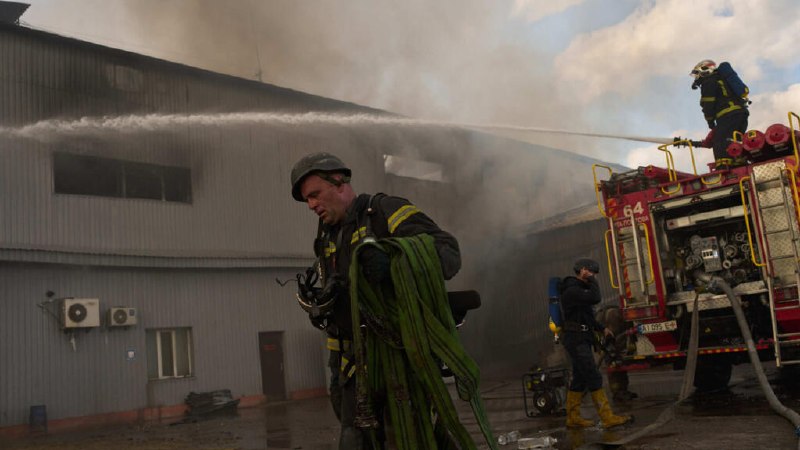
A Russian drone hit a warehouse on the outskirts of Kyiv on Friday 29 August 2026 and the casualty count began to move before the fires were out. By the time Ukrainian authorities briefed reporters, the death toll stood at 27, with hundreds more forced to evacuate as the blaze spread across the industrial site, according to reporting from Deutsche Welle and France 24 that cited Ukrainian emergency services.
The strike is one more data point in a long summer. It is also the kind of attack that tends to harden into a story the public stops reading: another drone, another warehouse, another number revised upward and then revised again. Monexus has examined the available wire reporting and Telegram relays of those dispatches to lay out what is verified, what is not, and what the framing choices tell us about how this war is being covered.
What the wire says happened
The most consistent account comes from Deutsche Welle's English-language wire service on the morning of 29 August 2026 UTC, which reported a Russian strike on a warehouse near Kyiv that killed "at least 27" people and forced "hundreds" more to evacuate after a fire and explosions tore through the site. France 24's English service relayed the same figures via Telegram at 10:04 UTC, describing the weapon used as a drone and the target as a warehouse on the outskirts of the Ukrainian capital. France 24's longer web dispatch placed the death toll at "at least 27" and the evacuation count in the hundreds, attributing both to Ukrainian authorities speaking on Saturday.
Two things stand out in the sourcing. First, every figure in circulation is sourced to Ukrainian authorities, with no independent confirmation cited by either wire service. Second, the figures are all "at least" figures: the floor is firm, the ceiling is not. In a war where strike aftermaths are routinely re-counted over 24 to 48 hours as rescuers reach lower floors and outbuildings, the headline number is a snapshot, not a final tally.
The weapon, the target, the pattern
The available reporting names the incoming weapon as a drone, not a cruise or ballistic missile. That detail matters for two reasons.
Drones are cheap. They are also the munition Russia has chosen to lean on for deep strikes into Ukrainian rear areas as its long-range cruise missile stockpile has thinned under sanctions and production constraints. A drone strike on an industrial facility on the capital's periphery is consistent with the campaign Russia has been running for months: saturate air defences with massed cheap munitions, accept attrition, and treat civilian-adjacent infrastructure as a legitimate target set. Industrial warehouses sit at the seam between military logistics and civilian supply chains; hitting them imposes costs that propagate well beyond the immediate blast radius.
Ukraine's air defence has improved markedly since 2022, but no defensive system intercepts every incoming projectile, and saturation tactics are designed to defeat even capable systems by exhausting magazines and operator attention. Reporting on a single successful drone strike is therefore not a referendum on Ukrainian air defence performance; it is a referendum on the Russian campaign's tolerance for civilian harm when cheaper munitions do the work.
What is verified, what is not
This publication's editorial floor on incident reporting is conservative: we want the reader to know what we actually established against the underlying record.
What we verified through the cited wire reporting. That a Russian drone strike hit a warehouse on the outskirts of Kyiv on Friday 29 August 2026. That the strike killed at least 27 people as reported on Saturday morning, 29 August 2026, per Deutsche Welle and France 24, both citing Ukrainian authorities. That hundreds were evacuated following fires and explosions at the site, per the same dispatches. That the strikes used a drone, per France 24's Telegram relay.
What we could not independently establish against the sources in hand. The specific identity of the warehouse (operator, contents, ownership). The exact number of evacuees, beyond the wire's use of "hundreds." Whether the warehouse had been flagged in advance as a humanitarian or civilian-only site. Whether Russian authorities have publicly commented on the strike; the cited dispatches contain no Russian government statement. Whether the casualty count has been revised since the Saturday morning briefings cited above.
The available source items do not specify any of these details, and this article has not independently established whether they exist in other reporting. A 48-hour window typically resolves several of these gaps; this is not that window.
Monexus analysis: what the framing is doing
The coverage of this strike follows a pattern that has hardened across the war: a Ukrainian civilian casualty event, attributed by wire services to Ukrainian official sources, dispatched in the early hours, revised in the next news cycle. That pattern is not wrong; Ukrainian emergency services are the primary on-the-ground source for civilian casualty counts in their own territory, and treating their briefings as the lead source is the editorially defensible choice. It is also a structural choice that narrows the story.
Three things tend to fall out of the frame. First, the specific function of the targeted facility: a warehouse on Kyiv's edge may be a logistics hub for a military supplier, a private cold-storage operator, or something in between, and the answer changes the political weight of the strike. Second, the counter-narrative from Russian-aligned channels: Telegram relays from Russian milblogger accounts, which frequently carry their own damage assessments and casualty claims within hours of an event, are absent from this article because this publication has not independently verified them. They should not be the dominant frame on a Kyiv strike, but their existence is part of how the information environment around the strike is being constructed. Third, the cumulative arithmetic: each individual strike is reported as its own event, but the pattern of drone strikes on civilian-adjacent infrastructure is itself the news, and the per-incident treatment tends to obscure the trajectory.
The editorial choice to lead with Ukrainian and Western-wire sourcing on a Ukrainian civilian casualty event is correct. The choice to report each strike as a discrete news event rather than as part of a campaign is, at this point in the war, an open question.
Stakes and what to watch next
If the pattern of this strike holds, the next 48 to 72 hours will bring: a revised casualty count from Ukrainian emergency services; the likely identification of the warehouse operator; a Russian Ministry of Defence briefing that will characterise the strike in its own terms; and OSINT analysts posting geolocated imagery to social platforms that may or may not reach the wires. None of that is in this article, because none of it is in the cited reporting.
The harder question is structural. Russia has now spent more than four years executing a campaign of massed, cheap, civilian-adjacent strikes against Ukrainian rear areas, on a budget that has thinned but not collapsed. Ukraine's air defence intercept rate is high and rising, but high is not total, and the architecture of the campaign is calibrated to the gap. Each successful strike is, in that sense, a successful strike against the defensive system, not just against the target. The pattern is the point.
For the reader, the practical take-away is unflattering. The next strike on a Kyiv warehouse will read much like this one. The numbers will move. The framing will hold. The harder work of reading the campaign rather than the incidents is work the wire services have not been asked to do and will not do on their own.
Desk note: Monexus led with DW and France 24 English as the two highest-credibility wires carrying the strike, both attributing casualty figures to Ukrainian authorities. Russian state-adjacent and milblogger channels were not cited as factual sources in this piece; their absence is a sourcing choice, not an empirical claim. We will revise the casualty figures and add geolocation detail as further reporting is verified.
Wire provenance
This editorial synthesis draws on the following public wire/social posts:
- https://www.dw.com/en/russian-strike-on-warehouse-near-kyiv-kills-dozens/a-78556008?maca=en-rss-en-all-1573-rdf
- https://www.dw.com/en/russian-strike-on-warehouse-near-kyiv-kills-at-least-27/a-78556008?maca=en-rss-en-all-1573-rdf
- https://www.dw.com/en/russian-strike-on-a-warehouse-near-kyiv-killed-at-least-27-people-and-forced-hundreds-more-to-evacuate/a-78556008?maca=en-rss-en-all-1573-rdf
- https://f24.my/C80K.g
- https://t.me/france24_en/18406
- https://www.france24.com/en/europe/20260829-russian-strike-on-warehouse-near-kyiv-kills-at-least-27-people-hundreds-evacuated
- https://www.dw.com/en/russian-strike-on-warehouse-near-kyiv-kills-dozens/a-78556008?maca=en-rss-en-all-1573-rdf
- https://www.dw.com/en/russian-strike-on-warehouse-near-kyiv-kills-at-least-27/a-78556008?maca=en-rss-en-all-1573-rdf
- https://www.dw.com/en/russian-strike-on-a-warehouse-near-kyiv-killed-at-least-27-people-and-forced-hundreds-more-to-evacuate/a-78556008?maca=en-rss-en-all-1573-rdf
- https://f24.my/C80K.g
- https://t.me/france24_en/18406
- https://www.france24.com/en/europe/20260829-russian-strike-on-warehouse-near-kyiv-kills-at-least-27-people-hundreds-evacuated