Nepal pegs post-flood rebuild at $4–5bn as Chinese border crossing reopens
Kathmandu's finance minister puts the recovery bill at $4–5bn, while a Chinese police officer's video guiding pilgrims away from a stricken border post has become the visual shorthand for the disaster.
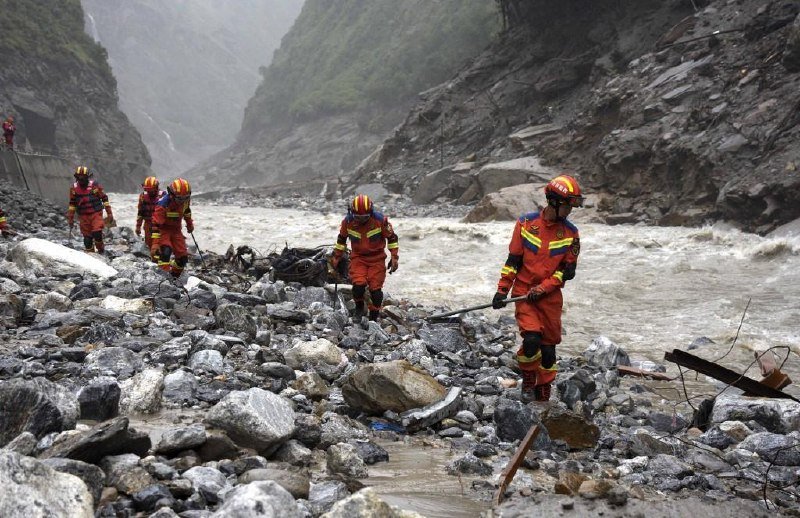
Nepal's finance ministry has put a preliminary price tag of $4–5bn on rebuilding the areas of the country hit by this month's catastrophic floods, according to Iranian state-affiliated outlet Tasnim, which cited the minister on 29 August 2026. The figure lands the same day that South China Morning Post video showed a Chinese police officer shepherding people away from a damaged crossing on the China–Nepal frontier, and CGTN's official X account circulated a video explainer asking what triggered a mudslide that officials on both sides have called devastating.
The disaster exposes how exposed the Himalayan republic remains to a single weather event. A reconstruction bill equivalent to roughly one-fifth of Nepal's annual GDP, on preliminary numbers, would reshape a budget already stretched by debt-service obligations and a chronic trade deficit with its northern neighbour. Beijing's response, both rhetorical and logistical, will determine how much of that bill Nepal ultimately absorbs alone.
A price tag, and a policeman
Tasnim's English wire reported on 29 August that Nepal's finance minister described the damage assessment as preliminary and the cost band as $4–5bn, with reconstruction to be financed through a combination of domestic resources and external assistance. The outlet did not specify which ministry briefed the press, nor whether the figure included damage to hydropower, the country's principal export earner and the asset class most exposed to siltation and reservoir damage after high-volume floods.
The visual frame of the day came from a different direction. South China Morning Post video, distributed via its Telegram channel at 12:26 UTC, showed a Chinese police officer guiding people away from a stricken border post. The post itself is one of the principal crossings for pilgrims and traders between Tibet and the Nepalese highlands, and its condition has become a proxy for how completely the road and bridge network on the Chinese side has been disrupted. CGTN's English-language X account at 12:23 UTC ran a longer explainer asking what triggered the mudslide and why the impact was so severe, signalling that Beijing's state broadcasters are framing the disaster as a geological event with regional, not bilateral, causation.
The sequencing matters. Within minutes of each other, two Chinese state-aligned channels put a Chinese first-responder and a structural explanation of the disaster at the top of the global information queue. That is a coherent communications posture: it positions China as the proximate helper, and recasts a disaster with bilateral consequences as a natural event that demands a multilateral, engineering-led response.
What Kathmandu actually needs
The $4–5bn figure, even on preliminary numbers, sits inside a fiscal envelope that Nepal cannot close alone. The country's external debt stock runs well below the regional average for South Asia, but its revenue base is narrow, and disaster-response financing has historically come from a familiar triad: the World Bank's contingent credit lines, the Asian Development Bank, and bilateral donors led by China, India, Japan and the United States. Each of those creditors arrives with its own procurement rules, its own preferred contractors, and its own geopolitical signalling.
The post-flood reconstruction ledger will, in practice, be fought over along three lines. First, hydropower. Several run-of-river projects in the worst-affected basins were damaged or silted; their insurers and offtakers will need to be reconciled with state-led reconstruction priorities. Second, the road and bridge network, including the crossings into Tibet, where Chinese construction firms have the equipment and the altitude experience that Indian and Western contractors do not. Third, the housing stock in mountain districts, where the political credit for rebuilding will be sharpest and the unit cost per beneficiary highest.
The dominant Western wire framing of disaster financing in small South Asian economies treats external assistance as a question of concessional versus commercial terms, with the implicit warning that Chinese bilateral lending carries collateral and political exposure that multilateral lending does not. The available Chinese-state framing, by contrast, emphasises engineering capacity and delivery speed, and points to a record of post-quake reconstruction in Nepal itself in 2015 as evidence that Chinese contractors and Chinese policy banks can move faster than the multilateral system. Both framings have empirical support; neither is complete without the other.
The structural read
What this disaster is doing, beneath the reconstruction arithmetic, is testing the operational meaning of China's claim to be the principal security partner of the Himalayan republic. The Tibet border crossings are not just trade infrastructure; they are the physical seam between the Chinese party-state's western security perimeter and a buffer state whose domestic politics have tilted, in recent years, between New Delhi and Beijing depending on the coalition in power in Kathmandu.
A reconstruction programme of this size, financed in significant part by Beijing, would entrench Chinese contractors and Chinese policy-bank lending in Nepalese infrastructure for at least a decade. That is the structural consequence regardless of which finance ministry figure ultimately anchors the final bill. It is also why the Indian, Japanese and US responses to the same appeal will be calibrated not only to humanitarian need but to the procurement map that follows.
Monexus analysis: the most consequential variable in the next sixty days is not the headline reconstruction number. It is whether the multilateral lenders and the Western donors match Chinese delivery speed with comparable concessional terms, or allow the procurement map to harden around Chinese contractors by default.
What we do not know
The Tasnim report does not specify the methodology behind the $4–5bn band, nor whether it includes lost economic output from disrupted hydropower generation and trade through the border crossings. The South China Morning Post video does not identify the officer, the post, or the date the footage was recorded; the available source items do not specify the condition of the road and bridge infrastructure on the Chinese side of the frontier as of 29 August. The CGTN video explainer, distributed via X, asks causal questions it does not, in the available excerpt, answer.
What remains genuinely contested is whether the mudslides that drove the disaster were primarily a meteorological event, primarily a glacial-lake outburst, or primarily a consequence of land-use change in the catchments above the border posts. Beijing's state broadcasters appear to be steering the explanation toward the first framing. Hydrologists cited in the regional press in past comparable events have, more often than not, pointed to the third. Until a joint Nepal–China damage assessment is published, the balance of those probabilities is not knowable from the available record.
Desk note: Monexus has framed the reconstruction bill as a fiscal and procurement event, not a humanitarian one. The wire coverage leads with casualty and displacement figures; the financial story is downstream, and it is where the geopolitical contest will actually be fought.
Wire provenance
This editorial synthesis draws on the following public wire/social posts:
- https://t.me/tasnimnews_en/33215
- https://t.me/SCMPNews/109923
- https://www.scmp.com/news/china/politics/article/3365701/china-nepal-floods-police-officer-filmed-guiding-people-away-stricken-border-post
- https://x.com/CGTNOfficial/status/2093675861106987517
- https://t.me/tasnimnews_en/33223