Twenty-one days of raids on Qusra sit on top of a documented settler arson pattern
Twenty-one consecutive days of settler attacks on one West Bank town now rest on a Palestinian Authority commission figure putting settlers and occupation forces at nearly eighty-nine percent of property fires since 2023.
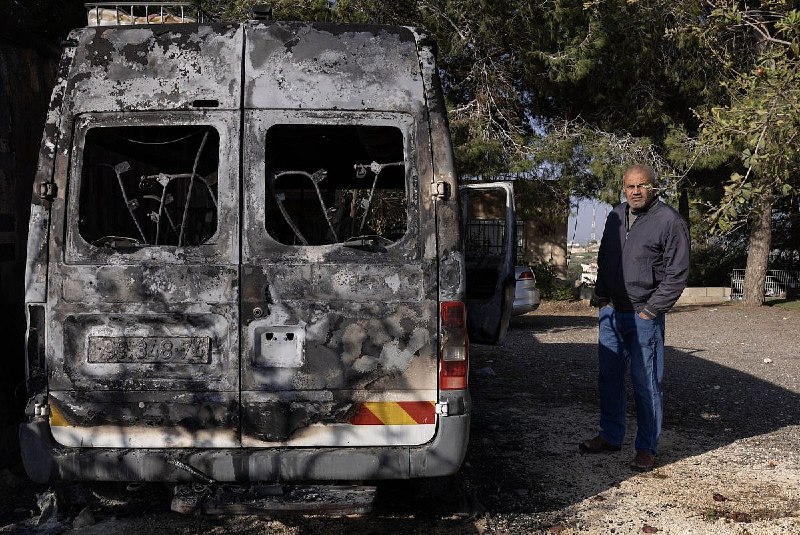
At 11:20 UTC on 29 August 2026, local sources relayed by The Cradle Media counted twenty-one consecutive days of Israeli settler attacks on Qusra, a Palestinian town in the occupied West Bank. The attacks, the channel reported, are carried out under the protection of Israeli occupation forces. Earlier the same morning, at 11:07 UTC, the same outlet had posted that settlers were again raiding the western areas of the town, south of Nablus. The Cradle's earlier update on 29 August, timestamped 11:01 UTC, carried the load-bearing statistic: the Colonization & Wall Resistance Commission, a Palestinian Authority body, puts the settler and occupation-force share of property fires across the occupied West Bank since 2023 at roughly eighty-nine percent.
Read those three timestamps together and the arithmetic tightens. The incidents on a single town are daily. The protection is uniform. The cumulative figure that frames the daily incidents has just been put on the public record by a Palestinian commission. That is the news. The rest of this piece is what to make of it.
What the thread actually documents
The Cradle Media's 29 August 2026 thread, the only evidence available for this article, is narrower than the pattern it sits inside. The 11:01 UTC post carries the eighty-nine percent commission figure for property fires in the occupied West Bank since 2023. The 11:07 UTC post reports that settlers continue to raid the western areas of Qusra, south of Nablus, under the protection of Israeli occupation forces. The 11:20 UTC update reports an Israeli settler attack on Qusra, also under the protection of Israeli occupation forces, and counts twenty-one consecutive days of such attacks.
That is the full evidentiary ledger from the available source items. The thread does not specify, in the items available, what was destroyed on the twenty-first day, what was destroyed across the previous twenty days, or whether the 11:20 UTC update describes a new assault, a continuation of an earlier one, or both. The available thread items do not itemise damage to fields, trees, water infrastructure or harvest cycles in Qusra across the twenty-one day window. They confirm the daily cadence and the uniform accompaniment of Israeli forces; they do not, in the items available, catalogue the damage.
Why the eighty-nine percent figure matters anyway
The Colonization & Wall Resistance Commission figure is the part of the thread that can be tested against wider reporting, even if the daily specifics cannot. The commission is a Palestinian Authority body tracking settlement activity, and its eighty-nine percent share for settler-plus-forces responsibility in property fires since 2023 is the kind of claim that does work in the diplomatic file only if it can be checked.
International organisations track the same phenomenon. The UN Office for the Coordination of Humanitarian Affairs (OCHA) publishes monthly settler-violence data drawn from field monitors. The available thread items do not include the OCHA September 2026 dashboard, and this article has not independently established whether that dashboard, when published, will corroborate, soften or contradict the commission's eighty-nine percent share. The figure stands as the commission's tally for now. Western wire desks that cite OCHA rather than the Palestinian commission typically frame the underlying pattern as a policing problem rather than a structural one; the commission's framing treats it as a land-take question. The two framings collide on the same data.
What the framing looks like from each side
The dominant Western wire frame treats settler violence in the West Bank as a law-and-order matter. Individual arsonists are condemned, investigated, and in a small fraction of cases indicted. The structural argument is that more prosecutions will bend the curve. The commission's eighty-nine percent figure is awkward for that read, because a prosecution rate that does not move a near-ninety percent causal share is, on the face of it, not bending the curve it claims to address. The wire frame is technically defensible. It is also the frame that allows diplomatic files to keep treating arson as ambient background rather than as a documented pattern with a quantified direction.
The regional press frame, including The Cradle Media's reporting on 29 August 2026, treats the same data as evidence of a territorial project. The Cradle's editorial choice to count days rather than file incident reports is itself part of the argument: a single raid could be weather; twenty-one consecutive days of raids on the same town, under the same configuration, is weather that someone is making. That framing carries weight, and it carries weight specifically because the commission's tally now puts a number on it.
Monexus assessment: the available evidence supports the cadence claim and the commission figure. It does not, in the items available, support a full damage catalogue for the twenty-one day window. The most defensible reading is that the daily-attack pattern at Qusra, combined with the commission's eighty-nine percent tally across the occupied West Bank since 2023, points to a structural pattern whose full accounting has to wait for the next OCHA dashboard and the next round of independent field reporting.
What to watch
Three indicators will sharpen or soften this picture over the next four to six weeks. First, the OCHA monthly settler-violence dashboard, due in early October, will either corroborate or soften the commission's near-ninety percent share for international readers. Second, the olive harvest opens in October, and past seasonal reporting by international outlets has consistently linked that window to spikes in settler attacks on groves and harvesters; whether that pattern repeats in 2026 is a separate, observable test. Third, the diplomatic file, principally through the US State Department and the EU's Humanitarian Aid office, will signal whether the arson pattern has crossed from a policing matter to a sanctions-relevant one. As of 29 August 2026, on the public record available here, that threshold has not been crossed.
The serious paragraph
A Palestinian commission's tally of who sets the fires, a daily-attack count on a single town, and a diplomatic file that still calls the result "tension" are three readings of the same pattern. Two of the three readings come with numbers. The third comes with verbs. When a town's residents describe the same configuration on the same ridge for twenty-one days in a row, and a commission quantifies the causal share at eighty-nine percent, the gap between the numbers and the verbs is the story. Closing that gap is a job for the next OCHA dashboard, the next round of independent field reporting, and the next set of diplomatic statements. Until then, the arithmetic stands, and the daily count continues.
The desk note: Monexus framed this piece around the eighty-nine percent figure and the twenty-one day cadence because both are explicitly carried in The Cradle Media's 29 August 2026 thread. The piece does not catalogue damage at Qusra beyond what the thread documents. Where the wider pattern is described, it is labelled as analysis and as a reading of available evidence, not as a wire-confirmed inventory.
Wire provenance
This editorial synthesis draws on the following public wire/social posts:
- https://t.me/thecradlemedia/66995
- https://t.me/thecradlemedia/66996
- https://t.me/thecradlemedia/66997