BIS wire, ETF flow split, and a Goldman Solana 13F: what four Cointelegraph headlines actually say
A 29 August 2026 Cointelegraph wire carried the BIS chief dismissing stablecoins as a credible payments layer and backing tokenised bank deposits. The same wire cluster showed Goldman holding the largest known Solana ETF stake, ETH ETFs extending a ten-day inflow streak while BTC broke its own on a $201M Friday outflow, and Bitcoin heading for its best August since 2017.
On 29 August 2026 at 15:36 UTC, a Cointelegraph Telegram wire carried an item tagged "OPINION" summarising the head of the Bank for International Settlements as saying stablecoins are not credible for payments at scale, and as backing tokenised bank deposits instead. The wire is one line and does not contain the underlying speech. What it does contain is the framing label "OPINION" and the preference statement itself.
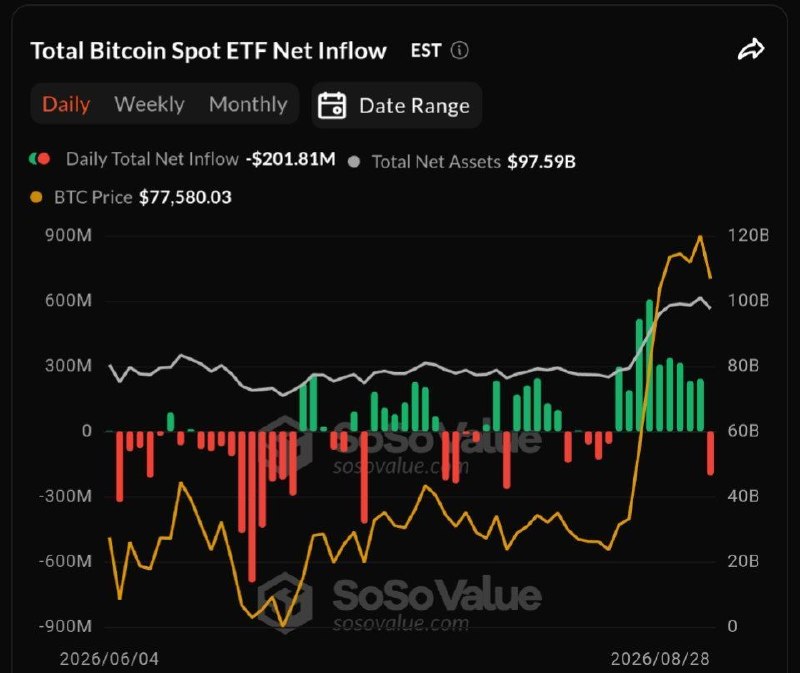
Underneath that headline sits a second cluster of wires from the same Telegram channel, dated 28 and 29 August 2026, in which Goldman Sachs is named as the largest known holder of spot Solana ETFs at about $88.1 million in exposure attributed to 13F filings, ETH spot ETFs are reported at ten straight days of net inflows while BTC spot ETFs broke their own streak on a Friday net outflow of $201 million, and Bitcoin is described as having its best August since 2017. Four headline-sized items, no underlying documents. What follows is a wire-cluster read at that level of evidence.
What the four headlines actually say
The 29 August 15:36 UTC item is a single Telegram post carrying a "BIS chief" preference for tokenised bank deposits over stablecoins. Monexus reading: the headline frames the position as opinion rather than as a Basel Committee communiqué, which is the only internal marker in the wire for distinguishing a speech from a rule. The wire does not name the individual, does not quote them, and does not link to a transcript. The body can report the preference and the framing label; it cannot independently upgrade the statement into a rationale beyond what the headline states.
The 28 August 16:36 UTC item is a "LATEST" wire attributing the Goldman Sachs Solana ETF position to "13F filings" at about $88.1 million in exposure. Monexus reading: the wire identifies the institution, the approximate dollar figure, the asset class, and a stated source category (13F). It does not publish the filing, does not break the $88.1 million into line items, and does not specify whether the position sits in a treasury, prime-brokerage, or discretionary sleeve. The headline is the reportable fact.
The 29 August 06:23 UTC item carries two numbers in a single headline: ten straight days of net inflows for ETH spot ETFs and a $201 million Friday net outflow for BTC spot ETFs that broke the BTC streak. Monexus reading: both numbers are wire-headline figures, the streak count is the wire's own tally attributed to its prior reporting, and the Friday figure is reported as a single-session print. The wire does not specify the length of the BTC streak that ended, nor the issuer-level composition of the $201 million.
The 29 August 14:57 UTC item is a "BTC" headline stating that Bitcoin is having its best August since 2017. Monexus reading: this is a price-comparison claim against a single named prior year, carried entirely by the wire headline, and is the cleanest comparative statement in the cluster.
The institutional-versus-private counter-read
The structural critique the BIS headline implies sits on one side of a long-running debate: regulated issuers with supervised balance sheets versus private stablecoin issuers operating outside that perimeter. That critique is one reading. It is not the only reading the public record contains, and the wire cluster does not carry the counter-position.
Monexus assessment: the counter-narrative has at least three threads that the cited wires do not supply. First, stablecoins have functioned as dollar settlement infrastructure for cross-border flows in jurisdictions where the correspondent-banking alternative is slow or costly, but the wires do not specify volume. Second, retail and emerging-market dollar access via stablecoin wallets is a use case the BIS headline does not address, and which the wires do not mention. Third, separate reporting dated 29 August 2026 has framed the BIS event as a "warning" about digital dollarisation; the Monexus read is that the headline-level "not credible" language and the "warning" framing are compatible, with the underlying speech plausibly containing both a diagnostic and a stated direction. None of those three threads is entailed by the cited wires.
The structural frame in plain prose: the next decade of tokenised finance will be shaped less by which chain wins than by which liability structure regulators allow to scale. Tokenised bank deposits, in the BIS headline's framing, sit inside the existing supervisory architecture. Stablecoins, in the same headline's framing, sit outside it. The cited wires do not specify how that choice resolves in rule-making.
What the ETF split actually shows at headline level
Per the 29 August 06:23 UTC wire, ETH spot ETFs extended a streak of ten consecutive net-inflow days while BTC spot ETFs printed a $201 million net outflow on Friday and broke their own streak. Monexus reading: the cleanest live read on this split, at the level of the wire headlines, is that institutional product flows are diverging between the two largest crypto assets over the same window, with ETH-side products absorbing net new dollars and BTC-side products seeing net redemptions on at least one session. The wires do not specify the length of the BTC streak that ended, the issuer composition of the outflow, or the AUM base against which the $201 million is being measured.
The Solana piece sits alongside. Per the 28 August 16:36 UTC wire, Goldman Sachs is reported as the largest known holder of spot Solana ETFs at about $88.1 million in exposure, attributed by the wire to 13F filings. Whether that is treasury balance-sheet deployment, a prime-brokerage client line, or a discretionary sleeve is not stated by the wire and is not established here. The wire also does not specify whether "largest known holder" refers to the largest among 13F-filing institutions or among all known holders, and the cited wires do not specify which other institutions appear in the comparison set.
What to watch into Q4
Three things, all framed against what the wires did not specify. First, whether any G7 central bank issues operational rules rather than speeches on tokenised deposit issuance at commercial banks; the wire carries a preference statement, not a rule, and the gap between the two is where the next round of the debate will be contested. Second, whether the Solana ETF position broadens beyond a single named institutional holder, because breadth is what turns one reported 13F line into market structure rather than a one-off disclosure. Third, whether the BTC ETF outflow session was an isolated position trim or the first leg of a longer rotation; the ETH-versus-BTC flow split is, per the wire, the cleanest live read on that question.
The harder, slower question is whether the institutional consensus now visibly forming in the headlines, BIS leadership on one side, a named bank holder and ETF flow splits on the other, can coexist with the retail and emerging-market dollar-access use case that built the asset class. The available source items do not specify how that question resolves.
Desk note: Monexus held the framing at the level of four Telegram headlines. The body reports what each wire states, attributes analytical moves to "Monexus reading" or "Monexus assessment," and does not infer rationale beyond the headline texts. The desk did not name the BIS chief (the wires do not), did not name the underlying speech or filing (the wires do not link to them), and did not assert issuer-level detail on the ETF flows (the wires do not specify it).
Wire provenance
This editorial synthesis draws on the following public wire/social posts:
- https://t.me/Cointelegraph/71836
- https://t.me/Cointelegraph/71835
- https://t.me/Cointelegraph/71831
- https://t.me/Cointelegraph/71828