A 25-year oil handshake, a Pentagon stake, and the price of Venezuela's interim order
Caracas has signed a 25-year energy arrangement with Washington. The Pentagon is reported to take a 35% stake. The interim leadership in Caracas is selling a country back to a foreign power, and the price has barely begun to count.
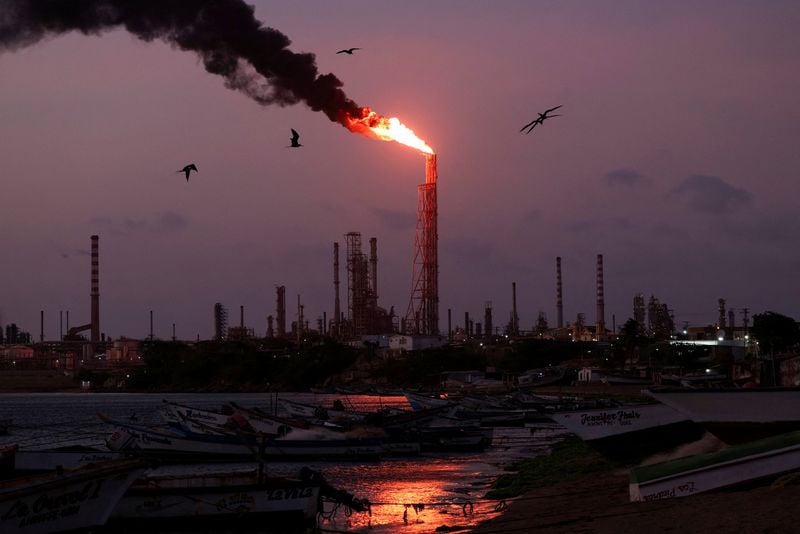
On 30 August 2026, Venezuela's interim government put a number on the price of the country's re-entry into Washington's good graces: twenty-five years. The interim president told reporters the agreement with the United States would run for that duration, a term long enough to bind a generation of Venezuelan fiscal planning to a single foreign counterparty (Reuters, 30 August 2026, 06:45 UTC). Within hours, a Wall Street Journal report surfaced, carried by Investing.com, saying the Pentagon would take a 35% stake in the joint venture that will operate the country's most valuable hydrocarbon real estate (Investing.com, 30 August 2026, 03:20 UTC). Two headlines, one document, and a great deal of daylight in between.
What is actually on the table is less a commercial deal than a new architecture for how Venezuela's oil sits inside the US-led order. Read together, the reporting describes a country under transitional leadership handing Washington a multi-decade concession with a defence-department-sized equity claim, in exchange for whatever licences, sanctions relief and political cover the interim administration needs to stay in office. The longer the term, the deeper that dependency locks in.
The terms on the page
Reuters, citing Venezuela's interim president, put the headline figure at 25 years (Reuters via X, 30 August 2026, 06:45 UTC). Investing.com's commodities desk, in a parallel wire, also attributed the 25-year horizon to the interim president (Investing.com, 30 August 2026, 02:30 UTC). The Polymarket news desk flagged the same figure as a breaking item on 30 August 2026, 03:18 UTC. Three independent relay points, one number.
The Pentagon stake is the second pillar. Investing.com's economy desk carried the Wall Street Journal report that the US Department of Defence would hold a 35% interest in the venture (Investing.com, 30 August 2026, 03:20 UTC). A 35% equity position is not a consulting role; in a hydrocarbons joint venture, that share gives Washington a structural voice on operating tempo, capital allocation, and which barrels go to which customers at which discount. The interim Venezuelan government's counterparties are now, formally, the US Treasury and the Department of Defence, not a private oil major.
Who is at the table
The phrase "interim president" does the work of normalising a transitional authority. The sources do not specify the name of the official Reuters quotes, nor do they specify the legal pathway by which the 25-year horizon was approved, whether by decree, by executive agreement, or by a parliamentary vote. That omission matters. A quarter-century concession signed by an administration that itself rests on contested legitimacy is, by definition, contestable. The available source items do not specify which institution would inherit the deal if the interim order is replaced.
On the US side, the named institutional actor is the Pentagon, not the State Department and not ExxonMobil, Chevron or any of the majors that historically dominated Venezuelan upstream. The Department of Defence taking equity in foreign production is unusual enough to be newsworthy in its own right. The wire does not specify whether the stake will be held directly, through the Defense Security Cooperation Agency, through a vehicle such as the Development Finance Corporation, or via a special-purpose entity. Each route implies a different congressional notification regime and a different answer to the question of who, exactly, will cut the cheques.
The counter-narrative on both sides
The deal has two natural critics. In Caracas, the political opposition to the interim order, the exiled civic movements that have spent a decade documenting asset stripping inside the state oil company, and the chavista base that the interim order displaced will each find something to reject. For the opposition, a 25-year concession that locks in the present leadership's signature is a fait accompli that crowds out any future government's room to renegotiate. For the chavista base, the political cost is the inverse: a foreign occupying stake in the country's patrimony, signed by leaders who are not theirs. The wire has not yet carried either side's formal response in the materials available for this piece.
In Washington, the natural tension is constitutional. Equity stakes held by the Department of Defence in commercial extraction overseas have a thin precedent set. The available source items do not specify whether Congress has been notified under the Arms Export Control Act or any equivalent statute, nor whether the deal triggers Committee on Foreign Investment in the United States (CFIUS) review in reverse. The Republican and Democratic sceptic factions will find common ground on the question of oversight, if not on the underlying policy. That bipartisan lane is exactly where a deal like this becomes politically vulnerable.
The structural counter-read is also worth airing plainly: a longer concession term lowers the upfront political cost to the interim government while shifting the country's bargaining power onto a much later timeline. If Caracas is trading present legitimacy for present cash flow, the price is the option value of every barrel produced between year six and year twenty-five. The buyer is collecting that option in 35% increments. Monexus assessment: this is the dynamic the deal's design makes possible, not a characterisation any one source has spelt out.
What the architecture looks like from inside the region
Read against the longer pattern of US engagement with Latin American hydrocarbons, the Venezuela arrangement sits inside a familiar template. The same playbook has been visible in deals with Guyana's offshore blocks, in the renegotiated terms for Suriname's recent finds, and in the structured presence of US majors in Brazilian pre-salt. The novelty is not the equity stake or the long horizon; novelty is the Pentagon, rather than a treasury special-purpose vehicle, sitting at the table. A defence department holding production equity in a foreign country converts an economic arrangement into something closer to a strategic one, with implications for sanctions architecture, for the routing of crude to Gulf Coast refiners, and for the diplomatic posture of every neighbour watching.
The corridor politics angle matters. Venezuela's refining complex, its ports, and its pipeline grid sit in the same Caribbean basin where US Southern Command has spent two decades building logistics capacity. A 25-year arrangement with a 35% US equity position is, in infrastructure terms, the legal cousin of that posture. The wire has not specified where the crude will land, but the gravitational pull of Gulf Coast and Eastern Seaboard refineries is strong. Whatever the contractual routing, the US refining complex is the most natural destination, and that destination has been capacity-constrained for light grades that Venezuelan barrels can fill.
Stakes, and what to watch next
Three dates deserve a reader's attention. First, the formal text. The interim government's English-language announcement, as relayed through Reuters, describes the deal as "historic," but the actual contractual instrument has not been published in the source items available here. The first public reading of the term sheet, when it surfaces, will be the first real test of the 25-year figure. Second, the Pentagon's equity vehicle. If the stake is held through DFC, OFAC or some new authority, the notification regime will tell observers how durable the arrangement is meant to be. Third, Caracas's political calendar. Venezuela's electoral timetable under the interim order is the variable that decides whether the contract's counterparty is still in office in 2027, 2029 or 2031. A 25-year contract signed by a leadership whose own mandate is measured in months is, in bond-market terms, a strange instrument.
The honest limit of this piece is the source set. The 25-year figure appears in three relay points that all reference the same underlying statement; the 35% Pentagon stake is a single wire report attributed to the Wall Street Journal. The legal text, the named institutional counterparties, and the response from the affected Venezuelan political factions are not specified in the materials available for this article. Readers should treat those gaps as the unfinished edges of a story that has at least three more reporting cycles left in it before the architecture is legible.
This article maps the wire's relay points onto the structural question of how Venezuela's oil sits inside the US-led order; the substantive contract, and the political counter-mobilisation it will provoke inside Venezuela, remain to be reported.
Wire provenance
This editorial synthesis draws on the following public wire/social posts:
- https://reut.rs/4xsRsVT
- https://x.com/Reuters/status/2093953154685472809
- https://www.investing.com/news/economy-news/pentagon-to-take-35-stake-in-venezuela-oil-venture-wsj-reports-4882013
- https://x.com/Polymarket/status/2093901021613293707
- https://www.investing.com/news/commodities-news/venezuelas-interim-president-says-us-energy-deal-will-last-25-years-4882011
- https://x.com/Polymarket/status/2093829140138897738
- https://x.com/Polymarket/status/2093809932382445638
- https://x.com/Polymarket/status/2093779448147456395
- https://x.com/Polymarket/status/2093527890805641415
- https://reut.rs/4xsRsVT
- https://x.com/Reuters/status/2093953154685472809
- https://www.investing.com/news/economy-news/pentagon-to-take-35-stake-in-venezuela-oil-venture-wsj-reports-4882013
- https://x.com/Polymarket/status/2093901021613293707
- https://www.investing.com/news/commodities-news/venezuelas-interim-president-says-us-energy-deal-will-last-25-years-4882011
- https://x.com/Polymarket/status/2093829140138897738
- https://x.com/Polymarket/status/2093809932382445638
- https://x.com/Polymarket/status/2093779448147456395
- https://x.com/Polymarket/status/2093527890805641415