Athens signs its biggest-ever defence deal with Israel, a $3.5bn air-defence package
Dubbed 'Achilles Shield,' the deal packages David's Sling, BARAK MX and SPYDER air-defence systems at a reported €3.1 billion (US$3.5 billion), with 19 Greek firms named as participants in the work share.
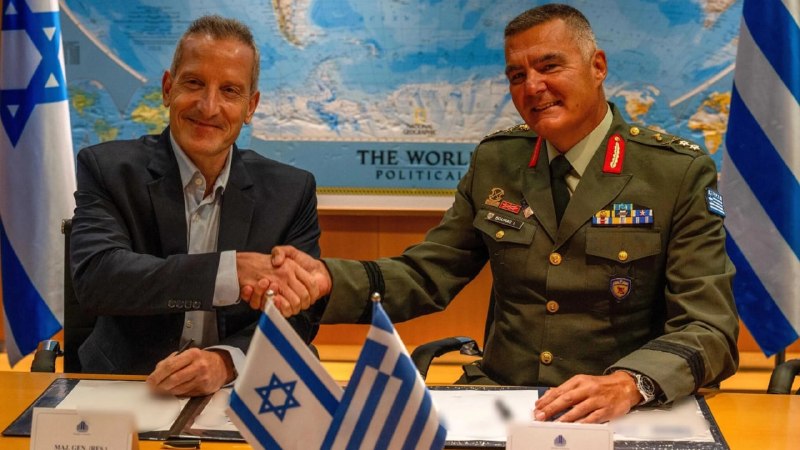
Greece signed a defence package with Israel on 31 August 2026, the largest bilateral arms agreement ever concluded between the two countries, covering several tiers of air-defence systems and a substantial Greek industrial work share. The package, marketed under the name Achilles Shield, bundles Israeli-made air-defence systems named in available reporting as David's Sling, BARAK MX and SPYDER, according to regional intelligence channels tracking the announcement.
The deal tells two stories at once. On the surface, it is a transaction: a NATO member on the eastern Mediterranean buying layered air defence from one of the region's most prolific defence exporters. Underneath, it is a quiet piece of geopolitical plumbing. Athens is choosing Jerusalem over the United States and France for a major air-defence purchase, while binding Israeli and Greek defence industries together at a moment of persistent Turkish overflight activity in the Aegean.
What is actually in the package
The headline figure has been reported in two currencies. Regional intelligence reporting places the deal at €3.1 billion, while South China Morning Post's coverage of the signing values it at US$3.5 billion. The available source items do not specify a single canonical exchange rate for the announcement, and the discrepancy is best read as the customary practice of quoting defence contracts in both the buyer's and the manufacturer's currencies. Monexus analysis: where contract values are quoted in both euro and dollar terms without a stated conversion date, the figures should be treated as parallel headline numbers rather than as a precise arithmetic conversion.
Three Israeli air-defence systems sit at the core of the deal. Available reporting names David's Sling (an upper-tier system in Israel's own inventory), BARAK MX and SPYDER, packaged under the Achilles Shield banner. The available source items do not specify how the three platforms are tiered inside the Greek contract, nor do they confirm whether the configuration is identical to the Israeli inventory or a country-specific export variant. Reporting from The Cradle names David's Sling explicitly; the listing of all three systems together is consistent with RN Intel's summary of the announcement.
The contract also names 19 Greek companies as already involved in the work, according to a regional intelligence summary of the signing. The available source items do not name the firms, specify their share of the work, or indicate whether their role is contractual or indicative at this stage.
The contract is, on the figures reported by South China Morning Post, the largest defence agreement ever signed between Greece and Israel.
Why Athens is buying
The procurement sits inside a familiar Greek defence logic, in which Athens has spent heavily in recent years on French Rafale fighter jets, American F-35s and US-made transport aircraft, alongside domestic frigate construction. Air defence has been the conspicuous gap in that stack, and the available reporting frames the new package as filling it.
The contract also gives the Hellenic defence industry a foothold in the supply chain of three of Israel's most exportable systems, an industrial dividend that European capitals from Warsaw to Brussels have been pursuing with mixed results.
The Israeli calculus
For Israel, the deal is industrial policy with strategic consequences. A multi-billion-dollar contract with a NATO member state lands at a moment when Israeli defence exports have been a matter of public debate in Europe, and a southern European customer widens the map of countries operating Israeli air-defence platforms without requiring a US sign-off on every export licence. The available reporting also frames the package as embedding three named Israeli systems with a new NATO customer alongside existing deployments, expanding the user base of each platform at a stroke.
How to read the politics
Two readings are plausible. The first is that Athens is simply filling a doctrinal gap with the most capable off-the-shelf package available, and the choice of Israel over the United States or France reflects industrial schedule and pricing rather than alignment politics. The second is that Greece is quietly diversifying its defence supplier base, reducing single-vendor dependence on Washington and Paris, and embedding itself in a non-EU defence ecosystem at a moment when European defence industrial policy is in active rebuild.
The evidence available supports both readings simultaneously. The contract's industrial work-share language, with 19 Greek firms named at signature, reads more like a long-relationship hedge than a one-off purchase. The choice of a non-EU manufacturer for the headline system reads like a market decision. The available source items do not specify the relative weight of industrial, doctrinal and political motives, and that weighting is the central unanswered question about the contract.
Stakes to watch
Three items sit on the desk. First, ratification. Greek parliamentary defence procurement agreements above a threshold value typically require prior legislative approval; the available sources do not specify whether this contract has cleared that step. Second, regional response. A near-term watch item is how Ankara, and other Eastern Mediterranean capitals, frame a Greek air-defence acquisition of this scale. Third, follow-on sales. If Achilles Shield delivers on schedule and on budget, the template is replicable for other southern European buyers inside and outside NATO.
Desk note: Wire coverage on this signing was thin at the moment of publication, with primary reporting concentrated in regional channels and one Asian-wire pick-up. Monexus has quoted system names and headline figures only where the cited sources name them, and flagged where the available reporting does not specify a detail. The €3.1 billion and US$3.5 billion figures circulate in parallel rather than as a confirmed conversion; both are recorded as reported.
Wire provenance
This editorial synthesis draws on the following public wire/social posts:
- https://t.me/TheCradleMedia/67097
- https://t.me/thecradlemedia/67097
- https://t.me/SCMPNews/110019
- https://www.scmp.com/news/world/middle-east/article/3365876/israel-and-greece-sign-us35-billion-defence-deal-largest-ever-between-two
- https://t.me/rnintel/65907