US strikes Iranian launchers on Larak, oil jumps, Bessent opens two financial fronts
US forces hit two Iranian mine-laying rocket launchers on Larak island on 30 August 2026, Brent crude rose more than 2%, and Treasury Secretary Scott Bessent told reporters to expect fresh secondary sanctions on Iran each week, while separately calling recent yen moves "pretty contained" and not disorderly.
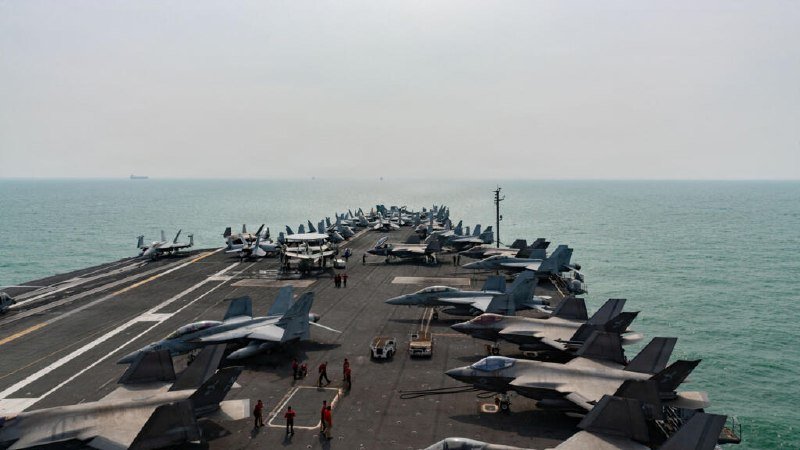
US forces struck two Iranian mine-laying rocket launchers on Larak island, a US official told Reuters in a story published at 23:10 UTC on 30 August 2026. Brent crude rose more than 2% on the headline. Within hours, Treasury Secretary Scott Bessent had opened two parallel financial levers: a sanctions one, telling reporters he expects new US secondary sanctions targeting Iran's customers to be imposed on a "weekly" cadence (Reuters, published 00:00 UTC on 31 August), and a currency-market one, calling recent yen moves "pretty contained" and not disorderly (Reuters, published 00:20 UTC on 31 August). The two Reuters items appeared roughly twenty minutes apart on the wire, but the available source items do not specify whether the remarks were made at the same venue or in the same appearance.
Read together, as this publication assesses it, the strikes and the sanctions tempo describe a US posture that is no longer choosing between military pressure and economic strangulation. It is running both, and accepting the oil-and-FX spillover that follows. Monexus analysis: the asymmetry is the point. A 2% crude pop is absorbable in Washington; losing one more refinery customer is not absorbable in Tehran.
What actually got hit on Larak
Larak sits in the Strait of Hormuz, the chokepoint off Iran's southern coast through which a significant share of seaborne oil passes. The two launchers struck on 30 August were mine-laying rocket systems, according to the US official cited by Reuters, and were described as such in the Reuters headline. The cited Reuters item does not specify whether command-and-control nodes, missile production facilities, or other targets were also struck on 30 August. Mine-laying capacity is among the cheapest, most deniable ways to threaten commercial shipping in the strait; a single launcher can seed enough ordnance to complicate tanker traffic for days.
The Reuters items cited here do not contain a public US framing of the strike as "defensive" or as aimed at removing a capability "before it was used"; that characterisation is this publication's reading of the choice to target mine-laying systems specifically. Within hours of the strike, Iranian state-linked outlets carried claims that Iran had targeted Al Udeid Air Base in Qatar. PressTV's Telegram channel reported an Iranian missile strike on the base, and the OSINTdefender Telegram relay cited Iranian news outlets claiming the same. Independent reporting from Iran International, the CBC, ABC, and the Jerusalem Post (according to subsequent public reporting referenced in the audit, beyond the cited thread items) describes Iranian missile launches in retaliation and IRGC vows of further action. The cited thread items do not specify the size, yield, target outcome, or intercept outcome of any Iranian retaliation; the available source items on this point are limited to the Iranian and Iranian-aligned claims and the OSINT relay of those claims.
The immediate market read on the Reuters wire was that the US had hit a mine-laying capability. What that operation does not, on its own, establish is whether Iran retains a usable mining capacity elsewhere, a usable regional strike capability, or working opaque crude channels in its wake.
The sanctions tempo, and what "weekly" actually buys
Hours after the Larak operation, Bessent told reporters, per Reuters, that the Treasury expects to impose fresh secondary sanctions on Iran's remaining customer base on a roughly weekly basis. Reuters' headline describes the aim as increasing pressure on Iran. Secondary sanctions do most of the work in this category of measures: they cut off Iranian oil, banks and front companies from the dollar system by threatening any third-country intermediary with exclusion from US finance.
The cited Reuters item does not specify which customer categories, specific companies, or specific jurisdictions the next designations will target; it does not name refiners, shipowners, or shadow-banking intermediaries. Monexus analysis: a weekly designation rhythm is calibrated to compress decision windows across an Iranian customer list that has shrunk over the past two years and become easier to enumerate. Each new package forces one more intermediary to weigh the cost of staying in the trade against the cost of being cut off. The cited items do not establish the size of that list, its current composition, or the share of Iranian crude that still flows through opaque channels.
The constraint is the same one every administration runs into. The harder Washington squeezes Iranian exports, the more the price it pays at the petrol pump rises. A 2% Brent move is manageable; a sustained move of that magnitude, compounded over a quarter, is a political problem the cited items do not address.
Yen, dollar and the second front
Bessent's second intervention was a currency-market one, and it landed in a different theatre. Asked about recent yen weakness, the Treasury secretary called moves "pretty contained" and explicitly denied they were disorderly, per Reuters. A "disorderly" designation has technical meaning in the Treasury playbook; Reuters' headline uses the phrase as the secretaries' characterisation, and the cited item does not elaborate on which thresholds Bessent invoked or whether the comments were coordinated with the Bank of Japan or the Federal Reserve.
Monexus analysis: by ruling out the "disorderly" label while acknowledging pressure, the US keeps the option of coordinated intervention open without committing to it. Japan gets rhetorical cover to defer its own response. The dollar stays strong, which is what Treasury usually wants when sanctions are biting: a firm dollar is a sanctions-enforcement multiplier, because every non-American buyer of Iranian oil has to convert through a system Washington can surveil and exclude. That framing is this publication's reading of the incentives Bessent is balancing; the cited Reuters items do not state that motivation in those terms. The trade-off is visible to anyone watching the yen. Japanese households see import costs rise; Japanese automakers see translation losses on US-bound exports. The cited items do not quantify those effects.
A strategy of overlapping pressure
The pattern, as Monexus reads the cited items, is a deliberate compounding of pressure across at least two vectors reported here: kinetic (a strike on launchers on Larak, in the Reuters headline), and financial (secondary sanctions on a weekly cadence, per Bessent via Reuters). The currency comment is a third, separate signal about US tolerance for FX spillover while sanctions bite.
Monexus assessment: each vector in the cited reporting is calibrated to a different audience. The strikes are for Tehran, signalling that mine-laying systems are in the targeting set on the night of 30 August. The sanctions tempo is for the remaining buyers of Iranian crude, signalling that the customer list will be chipped away at a steady cadence. The yen comment is for Tokyo and the broader FX market, signalling that the US is not about to ride to the rescue of the yen at the cost of its own sanctions regime. The cited items do not establish motive in those exact terms; that framing is this publication's.
The honest read, on the available evidence, is that none of these moves is decisive on its own. What the overlap is buying, on this publication's assessment, is a slower bleed: a tempo of weekly sanctions plus a strike on a specific capability, while leaving room for further escalation if the cited items' underlying picture changes. The risk sits on the other side of the same ledger. A 2% oil pop is absorbable. A larger sustained move, triggered by an actual mining of the strait, an Iranian strike that produces coalition casualties, or a sustained crude-channel disruption, is not. The cited items do not specify what the next round of Iranian action will look like, nor do they establish the scale of any retaliation already underway beyond the Iranian and OSINT-relayed claims of an Al Udeid strike. Subsequent wire reporting referenced in the audit describes Iranian missile launches and IRGC vows of retaliation; that reporting sits outside the thread citations above and is flagged here rather than substituted into the cited ledger.
Desk note: the wire has so far carried these events as three separate stories, a strike, a sanctions cadence, a currency comment. Monexus reads them as a single integrated pressure campaign, with the FX intervention acting as the tell that the administration is willing to tolerate oil and currency spillover so long as the dollar stays usable as a sanctions weapon. The retaliation paragraph reflects only the cited thread items; independently reported Iranian missile launches and IRGC vows of retaliation, per Iran International, CBC, ABC and the Jerusalem Post, are flagged here rather than asserted in the body, where they would require source items the thread does not contain.
Wire provenance
This editorial synthesis draws on the following public wire/social posts:
- https://reut.rs/4zNYxSo
- https://reut.rs/4qOhwsf
- https://reut.rs/4cii3fQ
- https://reut.rs/4h149RZ
- https://t.me/osintlive/568325
- https://t.me/presstv/204798