Trump's 20% GDP pitch lands in front of a Fed chair selling a quieter hand
On 31 August 2026 the president floated 20% growth and argued rapid expansion should not by itself justify Fed tightening, while his Fed chair told the G20 a savings glut was turning into an investment surge. The two messages are not quite the same.
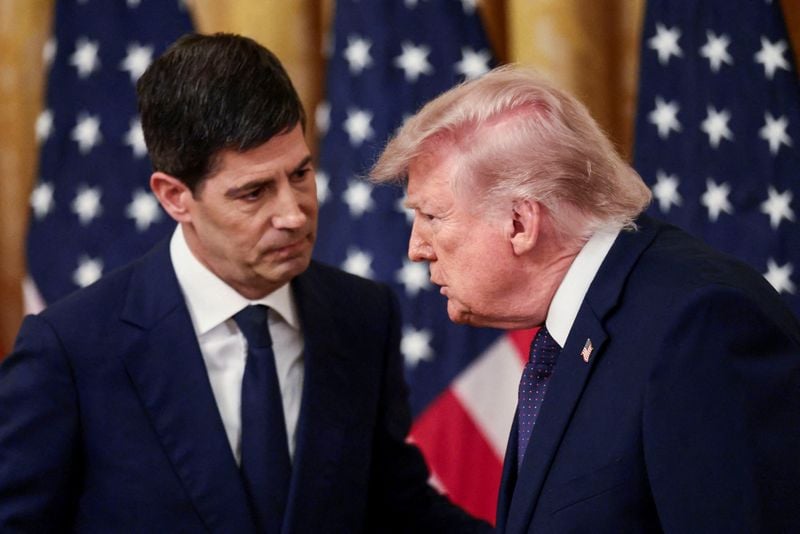
At 20:50 UTC on 31 August 2026, CNBC reported that President Donald Trump had argued the United States could grow at a 20% annual rate and that the Federal Reserve should not raise interest rates even if such growth materialised. CNBC's framing of the 20% figure: it has been recorded only once since the second world war, with inflation still running above the central bank's 2% target.
The remarks put the White House, in tone at least, alongside a Federal Reserve that the same day was speaking a different language. Fed Chair Kevin Warsh told a G20 gathering that a savings glut built up after the 2008 financial crisis was turning into an investment surge, per reporting carried by Reuters at 23:10 UTC on 31 August 2026 and by Investing.com at 19:19 UTC. An Investing.com analysis piece timestamped 17:01 UTC on 31 August 2026 characterised the institution as a "quieter Fed" and described Warsh's guidance as a "smidgen." Two messages, same news day: a president pulling on the accelerator, a central banker signalling less than he once did.
What follows is an attempt to read those two messages together without claiming more than the source material supports.
A growth pitch priced into a tighter curve
The 20% figure is a provocation in CNBC's framing rather than a forecast. The components that would have to fire for the United States to print a peacetime 20% are not in the source material, and the available reporting does not specify which lines of GDP the administration has in mind. What the reporting does establish is the political claim sitting underneath the headline number: Trump argued rapid growth should not, on its own, be grounds for the Federal Reserve to tighten, and that the present rate path is, by implication, too restrictive for the level of output the administration believes the country can reach.
That is the part Fed staff are most likely to read carefully. With inflation above the 2% target, a rate-setting committee does not have to accept the premise; it does have to live with the politics of saying no to a White House that has chosen to make growth the dominant rhetorical metric. The source material does not specify how the committee has read the message, only that the message was delivered.
The G20 message, with the caveats the reporting actually carries
The Reuters and Investing.com headlines on the G20 remarks establish the direction: a savings glut is morphing into an investment surge. The Reuters wire is dated 23:10 UTC, the Investing.com recap 19:19 UTC. What neither headline, on its own, supports is a fuller paraphrase of Warsh's argument, the structural claim that central banks have been managing primarily a demand-side cycle and now face a world in which supply-side investment is the binding variable, or the implication that monetary policy calibrated to consumer-price inflation misses the point. Monexus assessment: that is a reasonable reading of what a savings-glut-to-investment-surge narrative implies for monetary policy, but it is a reading, and the thread evidence is the headline-level framing rather than the full speech.
The Investing.com "quieter Fed" analysis, dated 17:01 UTC, adds the second hedge. The chair's guidance is described in that piece as a "smidgen," a deliberate signalling choice that gives the committee room to act without tying its hands. Monexus assessment: that posture is consistent with a central bank that wants to be judged on outcomes over a multi-quarter horizon rather than on the next print. It is also, by the same token, consistent with a central bank that wants to keep its options open in both directions.
A separate thread item at 20:18 UTC carried Trump characterising Warsh in four words ("he'll do what he has to do"), in Investing.com's headline. The reporting does not specify the venue, the fuller exchange, or whether Warsh was named directly; the item is a thin peg, and on that peg alone the desk does not load interpretation. What is clear across the day's items is that the White House and the chair's office spent 31 August 2026 making different cases to different audiences, on the same economy.
The drug-pricing thread, kept close to what CNBC actually said
At 17:20 UTC on the same day, CNBC reported that the Trump administration plans to announce a new slate of drug-pricing agreements with nearly a dozen manufacturers, building on what CNBC described as the administration's push to link the nation's drug prices to cheaper ones abroad. The available reporting is, in Monexus's reading, a description of intent and a stated mechanism, not a confirmed contract ledger. The thread evidence does not specify which manufacturers are in the slate, what the foreign benchmarks are, what reimbursement formulas the deals would use, or when pricing would actually change at the pharmacy counter.
The headline says "reportedly plans to announce." That phrasing matters. Until the announcements are made and the contracts are readable, this is a White House signalling event timed for the same news cycle as the GDP pitch and the G20 remarks, and Monexus assessment: the timing is itself part of the message. What we will not do, on the present evidence, is parse the sectoral economics of US-versus-foreign pharmaceutical pricing, characterise manufacturer margin structures, or estimate pass-through to consumers. Those questions deserve a thread that contains at least one report from the manufacturer side or from the relevant federal agency.
Read against the GDP pitch and the Fed story, the drug-pricing item looks like a third data point in a single news cycle rather than a fully drawn policy action. The thread does not establish that the three items are coordinated beyond the calendar coincidence, and on the present evidence the desk holds that judgment open.
What remains genuinely uncertain, and what the Fed has recently said
The 31 August 2026 thread does not specify whether the G20 audience accepted Warsh's savings-glut-to-investment-surge framing, how the committee's other members read the chair's "smidgen" of guidance, the contract terms of the drug-pricing announcements, the foreign benchmarks chosen, or the manufacturers' positions on the deals.
It is also worth flagging, since the day's "quieter Fed" framing can be read too cleanly, that this article has not independently established the broader posture of the Fed's senior officials in the days leading up to 31 August 2026. The source items in scope are dated to 31 August 2026 only. Monexus assessment: a single-day snapshot of one chair's G20 remarks and one Investing.com analyst's characterisation of those remarks is a thin basis on which to declare a regime change at the institution. Readers should treat the "quieter" label as the desk's reading of the 17:01 UTC Investing.com analysis, not as an independent characterisation.
The story as it stands is a snapshot of a coordinated messaging day: a 20% growth pitch, a savings-glut-to-investment-surge narrative at the G20, a "smidgen" of guidance read by markets as dovish, and a drug-pricing announcement framed by CNBC as imminent. The test is what happens to the curve and to consumer prices when the prints start to come in.
How Monexus framed this vs the wire: the wire reporting on 31 August 2026 gave us two distinct policy voices and one sectoral signal; we held the structural reading of Warsh's argument to a labelled analysis paragraph rather than asserting it as paraphrase, we kept the drug-pricing thread to what CNBC actually said and explicitly declined to characterise manufacturer margins or foreign-benchmark mechanics, and we flagged that the "quieter Fed" framing rests on a single Investing.com analysis piece rather than a first-party characterisation.
Wire provenance
This editorial synthesis draws on the following public wire/social posts:
- https://www.cnbc.com/2026/08/31/trump-us-gdp-growth-20-percent-economy.html
- https://www.investing.com/news/economy-news/trump-on-warsh-hell-do-what-he-has-to-do-4883217
- https://www.investing.com/news/economy-news/feds-warsh-tells-g20-world-seeing-global-investment-surge-93CH-4883178
- https://www.cnbc.com/2026/08/31/trump-drug-pricing-deals.html
- https://www.investing.com/news/economy-news/warshs-quieter-fed-now-includes-a-smidgen-of-guidance-4883101
- https://reut.rs/4xC0VdM
- https://www.cnbc.com/2026/08/31/trump-us-gdp-growth-20-percent-economy.html
- https://www.investing.com/news/economy-news/trump-on-warsh-hell-do-what-he-has-to-do-4883217
- https://www.investing.com/news/economy-news/feds-warsh-tells-g20-world-seeing-global-investment-surge-93CH-4883178
- https://www.cnbc.com/2026/08/31/trump-drug-pricing-deals.html
- https://www.investing.com/news/economy-news/warshs-quieter-fed-now-includes-a-smidgen-of-guidance-4883101
- https://reut.rs/4xC0VdM