Southern Lebanon pounded as Israeli strikes hit Ali al-Taher and Zawtar, with Iranian ballistic missiles reported over the Bekaa
A late-evening barrage across Nabatieh and the Bekaa coincided with reports of Iranian ballistic missiles transiting Lebanon, while an Iranian energy CEO said US strikes had hit points in the Hormozgan grid.
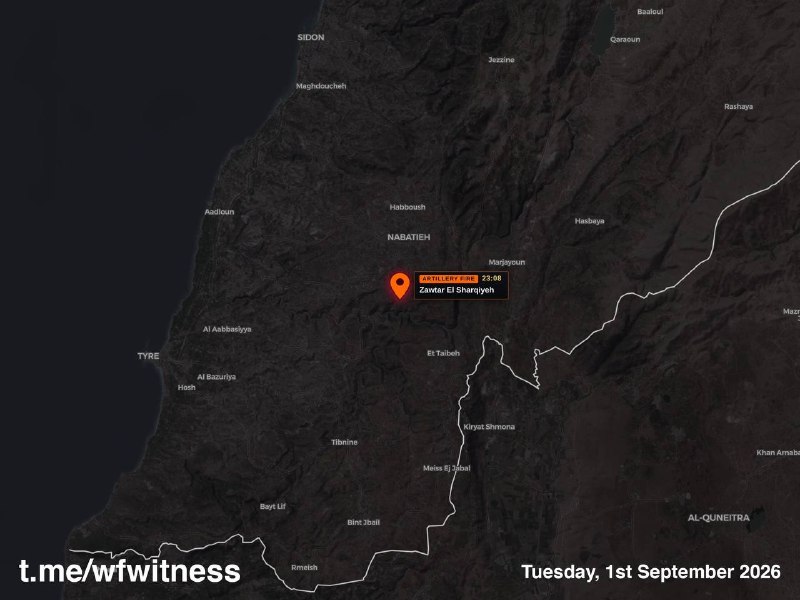
At 19:54 UTC on 1 September 2026, an Israeli airstrike hit the town of Kfar Ruman in southern Lebanon, according to a Telegram post by the field channel wfwitness. The next three minutes brought two more posts from the same channel: a strike on Zawtar Al Gharbiyeh at 19:57 UTC, and a separate item flagging what wfwitness called "non-stop" Israeli artillery shelling over the Ali al-Taher area. By 20:02 UTC the channel was reporting that explosions from the Ali al-Taher bombardment were echoing across the Nabatieh area. The Ali al-Taher strike picked up cross-channel confirmation a few minutes later, when WarMonitors cited an Al Jazeera correspondent reporting an Israeli airstrike on the Ali al-Taher area at 19:59 UTC.
What this article sets out to do is place that stack of Telegram-originated reports inside the simplest frame the thread supports: an evening of intense southern-Lebanon shelling, accompanied by a report of Iranian missile traffic further north and a separate Iranian claim of US action against the grid in Hormozgan. The reporting is fragmentary and runs through two channels; the picture it draws is consistent within those channels, but it cannot, on its own, establish the operational truth of any single strike. Monexus analysis: each of the three components, the southern strikes, the Bekaa missile sighting, and the Hormozgan claim, is single-sourced except for the Ali al-Taher strike, which carries a second-source flag.
What the southern front looks like tonight
Within roughly forty-five minutes, the wfwitness feed logged six discrete reports of Israeli action across southern Lebanon: airstrikes on Kfar Ruman, Zawtar Al Gharbiyeh, Zawtar Al Sharqiyeh, the Dawhat neighbourhood of Kfar Romman, and the Ali al-Taher area, plus the channel's separate characterisation of "non-stop" artillery shelling over Ali al-Taher with audible explosions across Nabatieh. The Al Jazeera correspondent cited by WarMonitors at 19:59 UTC corroborates the Ali al-Taher strike specifically; this is the only cross-channel confirmation in the batch. The available source items do not specify casualty figures, the type of ordnance used, or whether any of the struck locations are residential, military, or mixed. The channels' own framing of "airstrike" and "artillery bombardment" is the only characterisation on the record.
Within the same thread, a separate wfwitness post at 20:02 UTC on the Ali al-Taher explosions also contains the phrase "Israeli airstrike reported in Al Mansuri, southern Lebanon" in its trailing text. The available source items do not include a standalone post reporting an Al Mansuri strike; the location appears only inside that combined excerpt. Monexus has not independently verified whether Al Mansuri was struck as a separate event on the night of 1 September 2026, and the thread evidence does not specify.
The Iranian thread over the Bekaa
At 20:03 UTC, wfwitness posted what it described as Iranian ballistic missiles spotted over the Bekaa region. The wfwitness post does not specify launch origin, intended target, or interception status; it does not say whether the missiles were inbound, outbound, or transiting. It does, however, change the centre of gravity of the thread. From 19:54 UTC to roughly 20:11 UTC the reporting is a southern-Lebanon air-and-artillery campaign. At 20:03 UTC, with the Bekaa missile post, the same channel places Iran directly inside the operational picture, in a single line and without further detail.
Monexus analysis: the most that can be said on the thread evidence is that one channel reported a sighting of Iranian ballistic missiles over the Bekaa at that timestamp. Whether the missiles were launched from inside Lebanon, transited the country from elsewhere, or were observed during an outbound trajectory is not specified by the source item. The thread contains no second channel independently corroborating the Bekaa missile traffic, and no Israeli, US, or Iranian official statement is in the source set. On the evidence available, the post stands as one channel's report and nothing more; broader claims about the volley's composition or operational purpose go beyond what this thread contains.
Hormozgan and the US dimension
At 20:35 UTC, wfwitness added a second Iran-adjacent item. The CEO of Tavanir, Iran's state-affiliated power utility, was reported to have said that several points in the Hormozgan power grid had been targeted in US attacks, and that specialists were working to restore outages. The source items do not specify which facilities were hit, when the strikes occurred, or whether the Tavanir CEO spoke on the record, on camera, or through a relay. There is no second-source corroboration in the thread.
Monexus assessment: read together, the three threads, the southern-Lebanon strikes, the Bekaa missile sighting, and the Tavanir statement, are at minimum consistent with a night in which the southern-Lebanon front was active, an Iranian missile event was reported over the Bekaa, and Iran publicly claimed US action against its grid. Each individual claim except the Ali al-Taher strike is single-sourced. The aggregate pattern, if accurate, would suggest a multi-theatre evening; whether the three items are operationally connected is not established by the thread evidence, and this article does not assert that they are. The story tonight is the gap between a high volume of reports and the thin base of independent confirmation behind them.
What to watch next
Three questions are now live. First, whether Israeli, Lebanese, or UNIFIL spokespeople confirm or contradict the southern-Lebanon strike pattern in the hours ahead, and whether the Ali al-Taher location in particular shows in any official tally. Second, whether the Bekaa missile report is corroborated by Israeli or Western wire reporting on radar tracks, intercepted communications, or imagery. Third, whether the Tavanir CEO statement is picked up by Iranian state outlets such as IRNA, Mehr, or Tasnim, or by Western wires, which would convert a single-channel claim into a cross-source event. Until at least one of those three breaks, the 1 September evening is best read as a high-volume but thin-source night, with the operational details still owed to readers.
Desk note: Monexus logged six southern-Lebanon strike reports in standalone posts from one Telegram channel in a forty-five-minute window, plus one Iranian missile sighting and one Iranian claim of US action against Hormozgan from the same channel; only the Ali al-Taher strike carries a second-source flag, via an Al Jazeera correspondent cited by WarMonitors. A phrase referencing Al Mansuri appears inside the trailing text of one combined post, but no standalone Al Mansuri post is in the source set. Where mainstream wires have not yet picked up the Bekaa or Hormozgan claims, this publication has chosen to attribute rather than to assert.
Wire provenance
This editorial synthesis draws on the following public wire/social posts:
- https://t.me/wfwitness/109299
- https://t.me/wfwitness/109303
- https://t.me/wfwitness/109304
- https://t.me/WarMonitors/45427
- https://t.me/wfwitness/109308
- https://t.me/wfwitness/109309
- https://t.me/wfwitness/109311
- https://t.me/wfwitness/109325
- https://t.me/wfwitness/109326