What a Ten-Minute Stack of Telegram Notices Says About the 31 August Strike Wave on Kyiv
Between 23:22 and 23:32 UTC on 31 August 2026, two open-source Telegram channels posted eight short notes on launches reported inbound to Kyiv. The arithmetic of the cluster, not the body count, is where this piece sits.
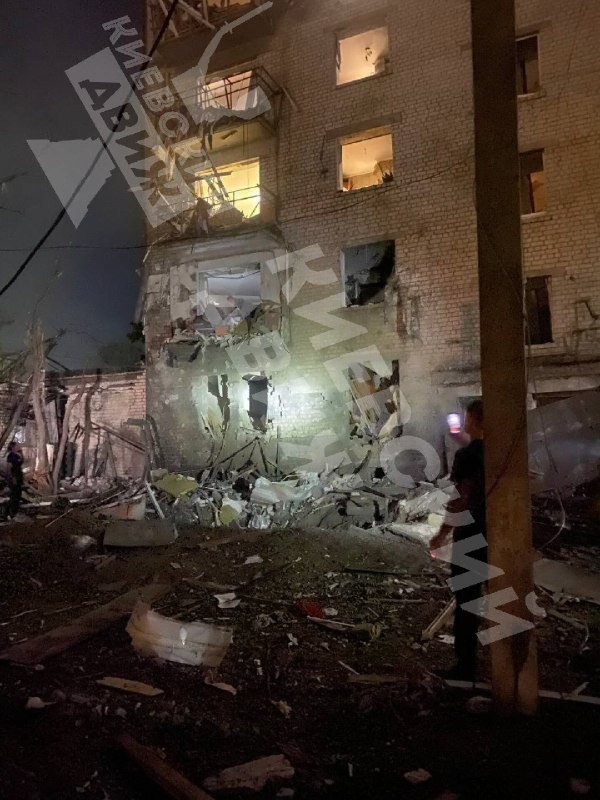
Between 23:22 and 23:32 UTC on 31 August 2026, two open-source Telegram channels posted eight short notes on what their authors framed as additional launch activity toward Kyiv. The first post in the cluster, timestamped 23:22, logged "2 Iskanders on Kyiv"; the last, at 23:32, logged "2 impacts in eastern Kyiv." In between sits a stack of terse, type-labelled entries from a single dominant channel and one corroborating post from a second.
The cluster is short, dense, and type-coded rather than consequence-coded. What it can support is a claim about tempo, mix, and source architecture. What it cannot support, on the thread evidence alone, is a body count, an interception tally, or a clean attribution of intent. The piece below reads the available posts as documents, not as reports.
What the eight posts actually say
Strip the alarm bells away and the chronology is sober. At 23:22 UTC, AMK_Mapping's post #36901 named two Iskander trajectories on the capital. Over the following ten minutes the same channel logged further entries, including #36912 ("More Iskanders on Kyiv"), #36932 ("2 more Iskanders from Bryansk to Kyiv"), #36938 ("More Iskanders on Kyiv. The others impacted."), #36940 ("More Zircons on Kyiv"), and #36942 ("More Iskanders on Kyiv. The others impacted. These Iskanders are approaching"). The closing notice, #36943 at 23:32 UTC, flagged "2 impacts in eastern Kyiv." A second channel, GeoPWatch, contributed one entry in the same window: post #39255 at 23:27 UTC, recording that "More Oreshniks launched towards Kyiv."
Monexus reading: counted on the cited posts, AMK_Mapping supplies seven of the eight entries in the cluster; the Oreshnik reference appears only once, in the GeoPWatch post. Iskander is the dominant category across the AMK_Mapping stack; Zircon is attested in a single AMK_Mapping post; Oreshnik is attested in a single GeoPWatch post. The launch origin for the Oreshnik entry is not specified in the cited post. On the strict thread evidence, a three-family count is asserted but not corroborated across independent channels.
What the posts do not say
Several common framings cannot be supported from the thread as it stands. The cited posts do not specify interception outcomes, the number of missiles that reached ground, casualty figures, or the precise location of the reported impacts beyond "eastern Kyiv." The cited posts do not state whether the entries constitute a single coordinated wave or a sequence of overlapping alerts. The cited posts do not name a launch area for the Oreshnik reference, and the channel that logged it does not, on the thread evidence, cross-reference the AMK_Mapping feed.
None of the eight posts uses the word "barrage" or any synonym. Characterising the cluster as a "saturated missile barrage" is this publication's framing of the cadence, not a quotation of the channels. The phrase "the others impacted" appears in two AMK_Mapping posts and is left unparsed by the cited evidence. Where this article reads pattern into the stack, that reading is labelled analysis.
Monexus assessment: tempo, mix, and what is doing the signalling
Monexus analysis: the analytically interesting beat is the typology, not the volume. The AMK_Mapping feed alone logged six entries naming Iskander-class launches in roughly ten minutes, with one Zircon notice filed in the same window and a separate GeoPWatch notice naming Oreshnik. Three distinct missile families appear across the two channels; only one channel is internally consistent on type labels; only one channel names a launch area (Bryansk, for an Iskander salvo); only one channel reports an outcome ("2 impacts in eastern Kyiv").
The most natural reading is that the cadence and the mix together do signalling work, not tactical work. A single Iskander solves a known coordinates set; six entries of additional Iskander-class launches in ten minutes, paired with a Zircon notice and a single Oreshnik reference on a second channel, reads as a display of available type-lines on a single urban target. That reading has limits. Telegram trackers have a documented history of mis-attributing launches that later turn out to be decoys, debris tracks, or flights that fell outside the capital's airspace. The thread contains no imagery that this article has independently geolocated. The available posts do not specify how many missiles were intercepted, how many reached ground, or where, beyond "eastern Kyiv." Building an analysis on notice cadence alone is an analysis of intent signals, not of consequence.
The other side of the framing, and where it breaks
The Russian-aligned framing, available on channels not represented in this thread, treats sustained strikes on Ukrainian cities as a symmetrical response to Ukrainian long-range strikes on Russian territory. Read charitably, that framing has internal logic; this article does not adjudicate it. The thread evidence available here does not contain material that supports or refutes it. Monexus finds the framing incomplete without specific sourcing on the launch mix and the strike outcomes on both sides of the front line, and the cited posts do not supply that sourcing. The cluster on 31 August cannot bear the weight of a strategic argument on its own. It can only support a careful description of what two channels said they saw.
What to watch next
The trajectory question worth tracking is whether the type-mix logged on 31 August repeats. If the AMK_Mapping feed continues to log multi-family stacks inside single-digit-minute windows, and if a second independent channel begins to cross-reference those entries with launch origins, the cluster pattern stops being a one-off and starts being a doctrine. Until then, the cited posts describe a single evening on a single capital, posted by two channels with overlapping but not identical coverage, and the appropriate register is restraint.
A staff-writer note on framing: the major wires overnight led with the volume of incoming missiles; the Telegram trackers led with the types. Monexus reads both, and treats the typology as the analytically interesting beat. The shift on display in the thread evidence is from single-shot salvos to a multi-family stack on a single capital, with one second-channel reference to Oreshnik that the cited posts do not corroborate as originating from the same launch area. The available posts also do not specify interception outcomes. That uncertainty is the story behind the story.
Wire provenance
This editorial synthesis draws on the following public wire/social posts:
- https://t.me/AMK_Mapping/36901
- https://t.me/AMK_Mapping/36912
- https://t.me/AMK_Mapping/36932
- https://t.me/AMK_Mapping/36938
- https://t.me/AMK_Mapping/36940
- https://t.me/AMK_Mapping/36942
- https://t.me/AMK_Mapping/36943
- https://t.me/GeoPWatch/39255