Netanyahu's '60% of Gaza' line is a position, not a plan
On a staged visit to the yellow line, the Israeli prime minister announced a territorial figure and a refusal to withdraw. The harder questions of postwar governance were not on the page.
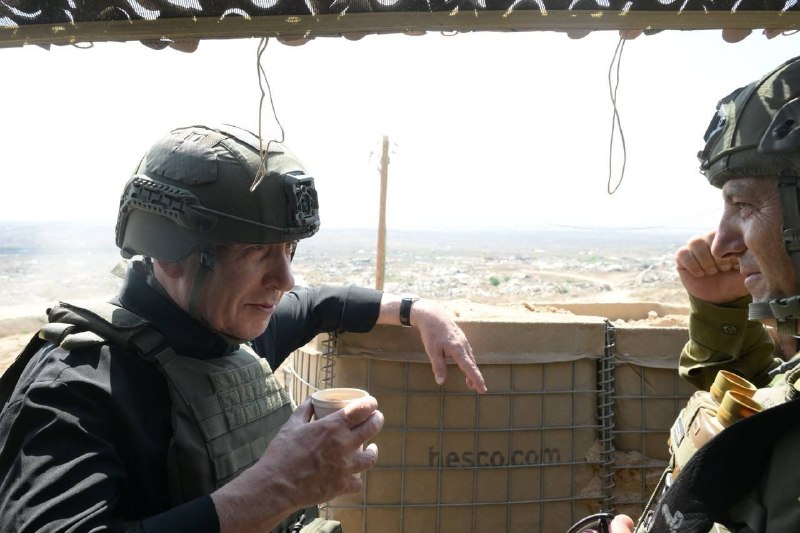
On 2 September 2026, at roughly midday local time, Israeli Prime Minister Benjamin Netanyahu stood on a piece of cleared ground inside the Gaza Strip and delivered a figure. Israel, he said, controls 60% of the territory. The rest, he added, will come, because "we are eliminating the terror." He then said the line Israel is holding would not be surrendered. "We are not withdrawing. We are staying on this line."
The clip, distributed within minutes by several Telegram channels tracking the conflict, is the most visible statement an Israeli prime minister has made from inside Gaza since the war began. Read narrowly, it is a battlefield claim: forces here, not there, and the map is moving. Read against the politics it sits inside, it is something else: an announcement that the war's territorial phase has a number, while its political phase still has none.
A number, not a doctrine
The 60% figure is doing two jobs at once. It is being sold to an Israeli audience as proof that the military campaign is producing measurable, irreversible ground. And it is being sold to an international audience as evidence that the campaign has a ceiling, that there is a line on the map beyond which Israel does not intend to advance in this phase. That second reading is the generous one. The first reading is the operational one.
Israeli military correspondents have used the term yellow line for months to describe the de facto forward edge inside the Strip, a notional boundary behind which ground operations are concentrated and beyond which, for now, manoeuvres are limited. Netanyahu's decision to stage the appearance at that line, rather than at a crossing or a press podium in Tel Aviv, is itself a message. Visuals are policy. Standing on the ground you claim to control is a different sentence than announcing from a lectern that you control it.
What the appearance did not contain is the harder part. No named Palestinian administration to receive the Strip once it is "cleared." No Arab state presence described in operational role. No donor-reconstruction timetable. No prisoner-exchange framework beyond the rhetorical repetition of "disarming Hamas and demilitarizing Gaza." The text of the clip is a position statement. It is not a plan.
The counter-reading is also a problem
The reading this publication finds less convincing is that the line is essentially cosmetic, that the 60% figure is a domestic-political number designed to pacify a coalition that wants the war framed as a winning one, and that the line itself is negotiable. There is real evidence for that read: the Israeli government has shifted its own declared objectives several times since October 2023, and the line on the map has moved with them.
But the counter-reading has its own problem. It treats the territorial claim as if it were separable from the political claim, when Netanyahu is making them in the same breath. "We control the territory. We are not withdrawing" is one sentence, not two. A government that publicly refuses to relinquish ground is harder to bargain with on the political endgame than a government that has merely described a military perimeter. The line and the politics are welded together on purpose. Dismissing one as theatre misses that.
Monexus analysis: the statement's authority comes from the fact that it is being made while standing on the ground, not from its diplomatic content. The diplomatic content is, by design, thin.
What the wire has not pinned down
Two questions are upstream of any verdict on what Netanyahu announced, and the available reporting does not resolve either.
First, who exactly is governing the 60%. The Israeli framing in the clip is explicit that Israeli forces hold the ground. It is silent on civilian administration inside that held ground, on the presence or absence of any Palestinian interlocutor, and on what, if anything, replaces the structures that existed before the war. The cited Telegram posts do not specify; this article has not independently established a governance arrangement for the Israeli-held portion of Gaza beyond continued military presence.
Second, what "more to come" means in weeks, not in speeches. The phrase implies continuing operations. It does not specify a timetable, a target percentage, or a triggering condition under which the line advances. Coverage of the campaign over the past months shows Israeli forces have moved the operational perimeter before. Whether they do so again, and on what signal, is the actual decision being deferred.
Stakes, written plainly
If the 60% line holds and the political file stays empty, the war continues in its current shape: ground being held, civilians being displaced into the un-held portion, and reconstruction postponed indefinitely. If the line advances, the human consequences inside Gaza deepen before any political track opens. If the line is traded, in whole or in part, for a hostage framework or a normalisation track, then today's clip will be reread as the high-water mark of maximalist positioning, not a serious map.
Those are the three trajectories. The statement on 2 September does not choose between them. It announces a number and refuses to move. That is a position. The plan, if there is one, has yet to be written down anywhere a reader can verify.
Desk note: Monexus has framed this as a position statement, not a policy document, because the cited material contains the territorial figure and the withdrawal refusal but not the governance, reconstruction, or prisoner-exchange architecture that a serious endgame plan would have to specify. Wire coverage of Netanyahu's Gaza visits has tended to lead on the percentage; this article leads on the absence of the political annex.
Wire provenance
This editorial synthesis draws on the following public wire/social posts:
- https://t.me/osintlive/569169
- https://t.me/gazaalanpa/24926
- https://t.me/ClashReport/94708
- https://t.me/englishabuali/78655