Southern Lebanon: the framework nobody signed is already redrawing the map
An unnamed 'framework agreement' is being implemented in southern Lebanon without a public text. One town has been folded into the IDF's yellow zone; the framework itself remains unverified.
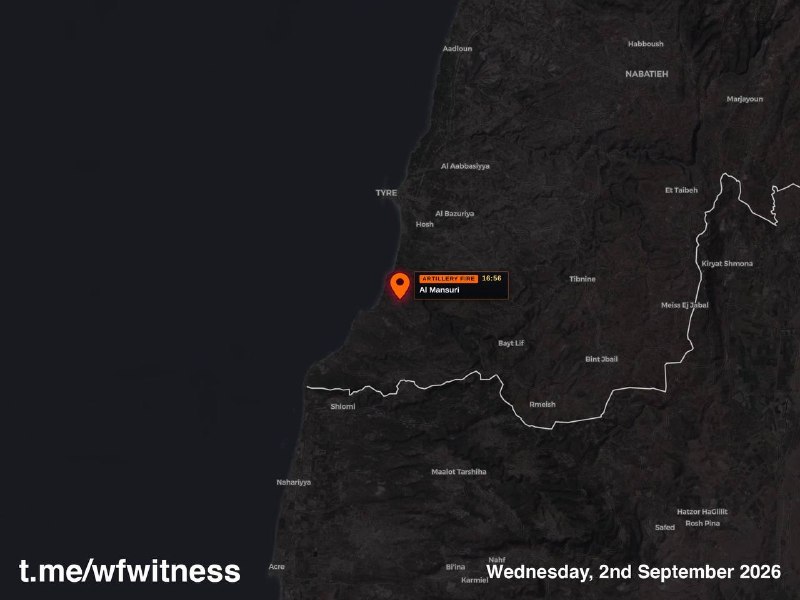
At 13:26 UTC on 2 September 2026, the wfwitness Telegram channel logged Israeli artillery fire on Al Mansuri in southern Lebanon. A second alert on the same town followed at 13:42 UTC. A third alert at 13:48 UTC recorded a detonation in Al Mansouri rather than a strike. Artillery fire on Mays al-Jabal came at 13:51 UTC, in two near-simultaneous posts. By 13:54 UTC the IDF had pushed into the northern outskirts of Mais al Jabal, reaching the town's western outskirts and the vicinity of Doubiyeh Castle, amid artillery shelling and machine-gun fire per the channel's own description. A detonation in Markaba followed at 13:57 UTC. At 13:58 UTC an admin note from the channel tied the sequence together: since the framework agreement emerged, the IDF has expanded its yellow zone to include Al Mansouri, which had previously sat outside it. None of this was announced by any party named in the available source items. All of it followed a framework whose text, signatories and triggers the available source items do not specify.
This is the strange new shape of the southern Lebanon front as it appears on a single time-stamped wire. Monexus finds that the gap between the framework's stipulations and its observable effects is itself the story: a ceasefire architecture whose terms exist, on the present source base, mainly as a series of military moves narrated on Telegram, with the framework itself never quoted, named in full, or formally attributed.
The yellow line drawn in real time
The yellow zone in southern Lebanon is the operational buffer inside which the IDF conducts demolition, artillery and manoeuvre activity, distinct from the wider blue-line area of declared operations. The channel's 13:58 UTC admin note is unusually direct on this point: since the framework emerged, Al Mansouri has been absorbed into the yellow zone, even though it had previously sat outside it. The available source items do not specify whether any other named town has been reclassified in the same way, nor who within the chain of command made the decision, nor whether it was coordinated with any external party.
That matters because the yellow zone is the difference between a town that receives warning and a town that does not, between a structure that is evacuated before demolition and one that is detonated in place. The Markaba detonation at 13:57 UTC and the Al Mansouri detonation at 13:48 UTC, against the same town that the 13:58 UTC admin note reclassifies, are the operational currency of that reclassification on the record available here. Each blast is also a data point in the new map.
The framework nobody has read
The most striking feature of the wfwitness reporting from 2 September is what is missing from the channel itself: a text. The channel refers repeatedly to "the framework agreement" but supplies no clauses, no annexes, no parties, no named drafter, no guarantor, no public version. The available source items do not specify who negotiated the framework, which state or non-state actors endorsed it, what its triggers and off-ramps are, or whether any third-party mediator has acknowledged its existence.
This matters because a framework implemented without a legible text becomes whatever its enforcers decide it is on the day. A published document constrains interpretation. A spoken agreement, narrated in fragments on Telegram channels, can be widened or narrowed by the next artillery salvo. Monexus analysis: the most natural reading of the sequence, on the evidence available here, is that the framework is functioning less as a negotiated settlement than as a permissive operating doctrine, a standing authorisation for IDF action up to a notional line that nobody outside the operations room can precisely plot, and that the channel itself describes as redrawn in real time.
What is actually being enforced
Strip the framing away and the operational substance is concrete. At 13:26 UTC, artillery fire on Al Mansuri. At 13:42 UTC, further artillery fire on Al Mansuri. At 13:48 UTC, a detonation in Al Mansouri. At 13:51 UTC, two near-simultaneous artillery-fire reports from Mays al-Jabal. At 13:54 UTC, an IDF ground advance into the northern outskirts of Mais al Jabal, the Al-Shandibeh and Wadi al-Jamal areas, and the western outskirts of the town near Doubiyeh Castle, described in the source item as occurring amid artillery shelling and machine-gun fire. At 13:57 UTC, a detonation in Markaba. At 13:58 UTC, the yellow-zone redraw that names Al Mansouri for the first time on the record as having been reclassified.
Of the eight wfwitness items in this window, four reference Al Mansuri or Al Mansouri by name, two reference Mays al-Jabal, one references Markaba, and one references the IDF ground advance into Mais al Jabal. Only one of the eight items, the 13:58 UTC admin note, explicitly describes a town as reclassified into the yellow zone. The framework, in its observable form on this source base, is the channel's own claim that the IDF has the right to act inside a perimeter it can extend by the act of acting.
What this leaves undecided
There is a plausible counter-reading that this article has not ruled out: that the framework is a real, substantive ceasefire architecture whose details are being withheld for diplomatic reasons, and that the yellow-zone redraw reflects agreed-upon phasing rather than unilateral extension. Monexus cannot, on the present source base, confirm or deny that reading. The available source items do not specify whether any party has endorsed the redrawn lines; they do not specify whether the IDF's advance into the Mais al Jabal outskirts was authorised under a standing provision of the framework or under a separate operational order; and they do not specify whether Al Mansouri's placement inside the yellow zone was mutual or unilateral.
What the source material does establish is narrower and firmer: a series of named artillery and detonation strikes on named towns in southern Lebanon on the afternoon of 2 September 2026; an IDF ground advance into specified neighbourhoods of Mais al Jabal described by the channel itself as occurring amid artillery shelling and machine-gun fire; and an administrative expansion of the yellow zone, reported by a single Telegram channel, to include at least one town that the channel says had previously sat outside it. The framework is the connective tissue of those reports. Until somebody outside the channel publishes the framework, the connective tissue on this record is doing more work than the agreement itself.
The wfwitness Telegram channel provided the only time-stamped reporting on the sequence above; Monexus read it as a wire feed rather than as editorial framing. The story it surfaces, a framework implemented before it is published, is one the wire services named in the approved-citable list have not, on the source base available here, yet caught up to.
Wire provenance
This editorial synthesis draws on the following public wire/social posts:
- https://t.me/wfwitness/109469
- https://t.me/wfwitness/109468
- https://t.me/wfwitness/109467
- https://t.me/wfwitness/109465
- https://t.me/wfwitness/109464
- https://t.me/wfwitness/109462
- https://t.me/wfwitness/109458
- https://t.me/wfwitness/109457