Trump moves to centralise AI policy under a new White House 'AI Force'
The president says he will name an AI czar and stand up an 'AI Force,' pairing a 25% GDP claim with a push to consolidate health-research funding. The proposal arrives as a rebrand demand and a research-funding power grab at the same time.
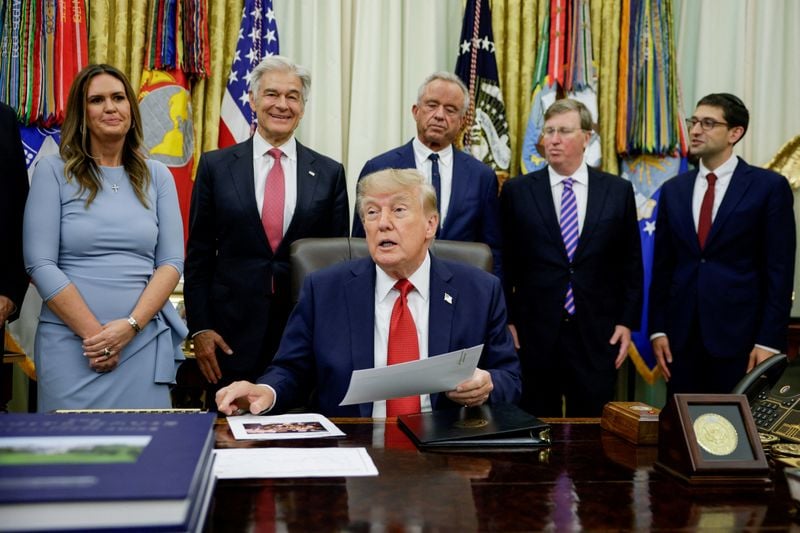
At a White House appearance on 19 September 2026, President Donald Trump said the United States would form an "AI Force," appoint a dedicated AI czar, and resist any effort to "slow or stifle" domestic AI development, while claiming that artificial intelligence could eventually account for a quarter of US gross domestic product. The remarks, reported by Investing.com and TechCrunch within hours of the event, paired a sweeping industrial-policy declaration with a separate Politico scoop on bringing federal health-research funding under direct White House control.
The announcement is best read as the political shape of an AI policy that, until now, has lived in scattered agencies and a handful of defence-adjacent offices. A czar with cross-department remit and a force by that name gives the executive a vocabulary to match a sector that has spent the year writing its own. The bet is that whoever owns the framing owns the budget.
The Force and the czar
Trump framed the AI Force as the institutional answer to a sector he described, without citing evidence, as the target of a Democratic "hoax" backlash. TechCrunch reported that the president "suggested rebranding AI with a new name" alongside the Force announcement, and quoted his claim that "the AI backlash is a Democratic hoax." The Investing.com wire, filed at 17:36 UTC on 19 September, said Trump told reporters he would create the AI Force and name a czar to oversee it.
What a "Force" legally is, in this context, the available reporting does not specify. Czar-style appointments have been used across modern administrations to coordinate policy across agencies that do not formally report to a single principal; the term carries no fixed statutory meaning. The 25% of GDP figure is a ceiling estimate, not a forecast, and the source items do not cite the model behind it. Taken together, the announcement is less a plan than a marker: this White House intends to be the venue where AI policy is settled, not delegated.
The funding fight that is already underway
The AI announcement landed against a quieter but more concrete story. Investing.com, citing Politico, reported at 03:36 UTC on 20 September that the Trump administration is seeking to bring federal health-research funding under White House control. Health research is not AI on its face, but it sits inside the same logic: research dollars are a lever, and the lever is currently held by agencies, advisory boards, and congressional appropriations that do not move on the president's schedule. Centralising that authority, even partially, would change which AI-adjacent questions get funded, and on what timeline.
The pattern, in plain terms, is familiar from earlier industrial-policy pushes in semiconductors and critical minerals: pick a sector, name a coordinator, fold the money into a single chain of command, then negotiate with Congress from a position of consolidated discretion. The Force is the new wrapper. The funding fight is the substance.
Monexus analysis: what the rebrand is really buying
The proposal to "rebrand AI" is the line that has drawn the most ridicule in the day's coverage, and it is also the most revealing. A name change does nothing to the underlying compute, data, or model ecosystem. What it does is reset the political baseline: a fresh term carries no incumbent baggage, no existing regulatory perimeter, and no settled set of critics. Coverage that has spent two years writing about "AI safety," "AI bias," and "AI risk" is being asked, mid-stream, to start over.
The strategic logic, read carefully, is straightforward. A new vocabulary gives the executive the option to argue that rules written under the old name do not bind the new one. It also lets the administration position itself as the adult in the room against a Democratic opposition that, in this telling, has been crying wolf about a technology that has not, in fact, done any of the harm attributed to it. Whether that framing survives contact with the actual safety record of frontier models is a separate question. As a rhetorical move, it is competent.
Stakes and what to watch next
The near-term stakes are budgetary and bureaucratic rather than technical. If a czar is named in the coming weeks, the test will be whether that office commands real interagency authority or functions as a spokesperson. The Force label, if it sticks, will tell us how seriously the administration intends to be taken on defence-relevant AI procurement, where the dollars are large and the contracting pathways already exist. The health-research centralisation, if it advances, will reshape which AI applications in biomedicine get prioritised and which academic centres retain their traditional autonomy.
Three dates are worth circling. First, any formal executive order establishing the czar's office. Second, the next congressional appropriations cycle, where the funding-consolidation story will either harden into a budget line or be negotiated away. Third, the first contested regulatory action under the new vocabulary, which will tell us whether the rebrand is cosmetic or load-bearing. None of those dates appear in the source items; this article has not independently established when they will land.
What the available reporting does not specify is the identity of the czar, the legal vehicle for the Force, or how either will interact with existing AI work at the Department of Commerce, the Department of Defense, or the National Science Foundation. Until those details surface, the announcement functions as a marker of intent rather than a policy.
Desk note: Monexus is treating this as an industrial-policy story first and a tech story second. The wire coverage framed the rebrand demand as the day's headline; the funding-consolidation piece is the slower-moving and more consequential of the two.
Wire provenance
This editorial synthesis draws on the following public wire/social posts:
- https://techcrunch.com/2026/09/19/trump-suggests-rebranding-ai-with-a-new-name-says-hes-also-creating-an-ai-force/
- https://www.investing.com/news/world-news/trump-says-he-will-create-ai-force-name-ai-czar-4908109
- https://www.investing.com/news/economy-news/trump-calla-for-plans-to-form-federal-ai-force-4908110
- https://www.investing.com/news/world-news/trump-seeks-to-bring-healthresearch-funding-under-his-control-politico-reports-4908137
- https://t.me/AngelList/6505
- https://t.me/producthunt/6505
- https://techcrunch.com/2026/09/19/trump-suggests-rebranding-ai-with-a-new-name-says-hes-also-creating-an-ai-force/
- https://www.investing.com/news/world-news/trump-says-he-will-create-ai-force-name-ai-czar-4908109
- https://www.investing.com/news/economy-news/trump-calla-for-plans-to-form-federal-ai-force-4908110
- https://www.investing.com/news/world-news/trump-seeks-to-bring-healthresearch-funding-under-his-control-politico-reports-4908137
- https://t.me/AngelList/6505
- https://t.me/producthunt/6505