Pezeshkian at UNGA: martyrdom, Palestine, and the diplomacy left unspoken
Iran's president used his UN General Assembly address to invoke martyred leadership, decry strikes on universities and clinics, and frame Tehran as victim rather than aggressor. The available wire material is exclusively Iranian state and state-adjacent channels, and that shapes the read.
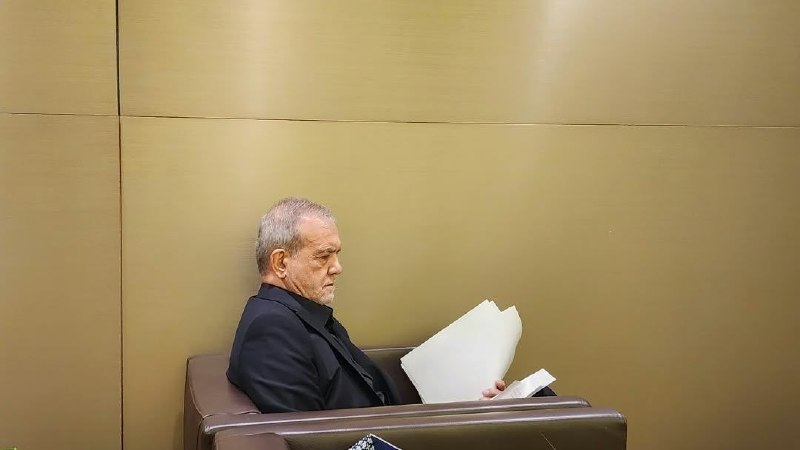
At 14:08 UTC on 23 September 2026, Iran's state-aligned PressTV pushed the first frames of President Masoud Pezeshkian walking into the United Nations General Assembly hall. By 14:14 UTC, the Tasnim News Agency English feed had his first quoted line on the record. By 14:54 UTC, when IRNA's English desk posted that he had left the chamber, the choreography was complete: roughly forty-five minutes between photograph and exit, with three distinct rhetorical registers compressed into a single address. What the delegates heard, what Tehran wanted them to hear, and what the available wire material captures, are three different questions.
This publication's reading of the available wire material is that Pezeshkian used the platform not to propose anything new but to perform Iran's preferred victimhood narrative at maximum volume. The structural tell is what he reached for: the martyred supreme leader, the bombed universities, the framing of Tehran as a target rather than a perpetrator. That is a domestic-audience speech wearing international clothing, and the available sources do not specify whether the address contained any concrete policy proposals at all.
The martyrdom register
The line that traveled fastest, per the Tasnim English wire at 14:14 UTC, was a direct rebuttal of Donald Trump: "Trump said yesterday that we are terrorists. We are not terrorists; we are victims of terrorism. They killed our leader without any reason." The Tasnim relay attributes the line to Pezeshkian at the General Assembly; the source item does not name the leader killed, does not state when the killing occurred, and does not identify the actor responsible. Monexus analysis: by opening on martyrdom rather than diplomacy, Pezeshkian signalled to his domestic base that he would not normalise the existing order from the podium. The phrase "without any reason" does rhetorical work the diplomatic register would not: it converts an unspecified act of violence into an unprovoked crime, and it pre-empts any audience expectation that Iran might consider restraint.
That choice has a cost. UNGA addresses that succeed in shifting third-party positions tend to begin with a concrete proposal, a deadline, or a number. This one began with a grievance, as captured by the source items. Delegates from non-aligned states will read it as solidarity; delegations whose votes Iran needs on any future Security Council motion will read it as inflexibility.
The Palestine frame
At 14:35 UTC, the Middle East Spectator feed carried a second pull-quote: "As long as there is no justice in Palestine and as long as the Zionists continue their occupation, there will never be harmony in our region." The word "Zionists" rather than "Israel" is deliberate. It places the address outside the cautious language most Western-allied delegations now use, and it signals to the Iranian street, where the term carries unambiguous weight, that Tehran has not moderated its vocabulary for an American audience. Israeli security concerns are a legitimate subject of diplomacy; this speech treated the conflict as a settled question of occupier and occupied, with the regional stability question answered in advance.
The third pull-quote, at 14:21 UTC, returned to material destruction: "They targeted our universities, our healthcare centers, our schools, our hospitals, and our infrastructure. All of it is against international law." The "they" is unspecified in the available copies, and the source items do not name a country, a campaign, or a date for the strikes referenced. Civilian infrastructure targeting is a grave matter wherever it occurs and whoever carries it out, and the available source items do not specify which facilities, on which dates, in which cities. That ambiguity is itself part of the message: the speech catalogues harm without inviting verification.
What the captured wire contains
The structural frame here is the inverse of a normal UNGA appearance. Most addresses perform a public opening on a closed private negotiation. The economic sanctions file, the nuclear file, the prisoner-exchange file, the regional de-escalation file: each is the kind of agenda item a head of state raises precisely so that backchannel conversations in the days after can move around the stated position. The captured portions of Pezeshkian's address, as represented in the five available source items, contain no reference to sanctions relief, no reference to the nuclear file, no reference to any prisoner exchange, and no reference to a regional de-escalation track. Monexus assessment: that absence in the captured material is itself a signal. A speech that performs grievance without proposing structure is a speech that wants to be remembered rather than acted upon, and the diplomatic calendar rewards the latter.
There is a charitable reading. A president speaking before an audience that includes leaders of states with which Iran is in active confrontation has reason to keep the substance private and let the home audience hear the grievance. That reading is not falsified by the available sources; neither is it confirmed.
The audience problem
Iran's UNGA addresses have, over two decades, addressed three audiences simultaneously: the home audience, the non-aligned majority, and the United States. The first is captured by martyrdom language; the second is captured by Palestine solidarity; the third is the audience that has to be persuaded to lift pressure, unfreeze assets, or reopen a deal. The Pezeshkian pull-quotes captured by IRNA, Tasnim, PressTV, and Middle East Spectator do none of the third kind of work. That is the most consequential thing about the address, and it is the part the available sources actually support.
The next thirty days will tell which reading is correct. If a sanctions relief motion or a nuclear framework surfaces in the IAEA or P5+1 record, the speech will look like a hardened opening that bought Tehran room to negotiate behind it. If nothing moves, the speech will read as a closing of doors, and the pressure ratchet turns another notch. The available wire material is not yet sufficient to tell.
Desk note: The wire material for this address consists exclusively of Iranian state and Iranian-adjacent channels (IRNA, Tasnim, PressTV, Middle East Spectator). The available source items do not specify whether Western or Israeli delegations issued any statement on the address, and this publication has not independently identified the leader referenced in the 14:14 UTC martyrdom line or the specific infrastructure strikes referenced in the 14:21 UTC line. The captured portions do not address sanctions relief, the nuclear file, prisoner exchange, or regional de-escalation, and the available sources do not specify whether those files were raised in the un-captured portions of the speech.
Wire provenance
This editorial synthesis draws on the following public wire/social posts:
- https://t.me/Irna_en/39823
- https://t.me/Middle_East_Spectator/36997
- https://t.me/Middle_East_Spectator/36989
- https://t.me/tasnimnews_en/38227
- https://t.me/presstv/207913
Follow the event.
These dated source records provide context. They do not retrospectively verify this archive article.
Separate what the nuclear watchdog reported from what it could not determine after the June 2025 strikes.