Dolores Huerta dies at 96: a slogan, and the record it has to carry
Labour union co-founder, feminist and civil rights icon Dolores Huerta died in Bakersfield, California, her family said. She was 96, and she is credited with coining "Sí, se puede!"
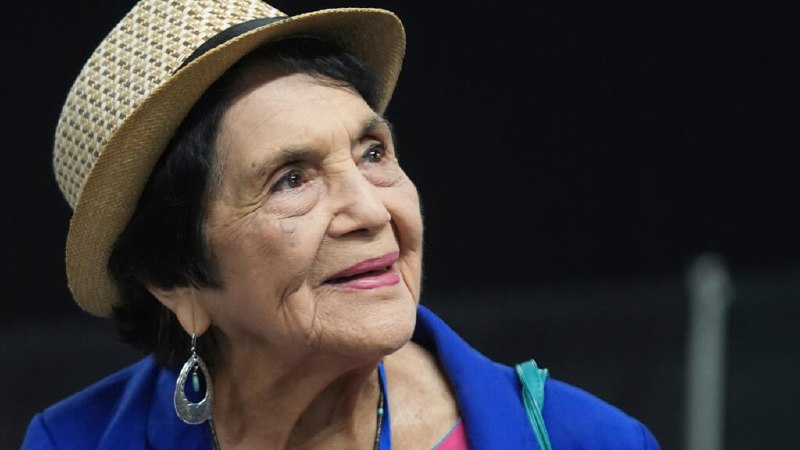
On Wednesday, 28 October 2026, Dolores Huerta died in Bakersfield, California, at the age of 96, her family said. France 24 carried the news in an English-language item stamped 17:49 that day, and its Telegram channel followed with a shorter post at 18:11. Both versions led with the same handful of facts: an influential co-founder of a US labour union, a feminist and a civil rights icon had died, and she was credited with coining the phrase "Sí, se puede!" The phrase is what the reporting leads with, and that choice is both a tribute and a narrowing.
An obituary decides which parts of a life enter the shared record and which are left to specialists. In the early coverage of Huerta's death, the record is a slogan, and that choice says something about how American labour and civil rights history gets remembered once the people who made it are gone. Our argument is that a phrase can carry a movement further than a biography does, and that the work the phrase points to needs documenting before the slogan becomes the whole story. The source items supplied for this piece do not specify the organisations Huerta co-founded or the campaigns she led, and this article has not independently established those details.
A death announced by family
The available reporting is short. France 24 states that Huerta died on Wednesday in Bakersfield and that her family said so. It describes her as an influential co-founder of a US labour union, a feminist and a civil rights icon, and it gives her age as 96. It also credits her with coining the phrase that has become her most recognisable line.
Every detail in this article traces to one news organisation's report and to the Telegram repost of that report. The Telegram post is a shorter version of the same item, so the two are not independent confirmations of the death. The source items do not include a direct quotation from a family member, which means the family's account reaches readers only as France 24 paraphrased it. That is the limit of what can be stated with confidence at this stage.
What the slogan carries
Sí, se puede is in Spanish, and that detail is easy to pass over. In an English-language news environment, a Spanish slogan makes its claim in the speaker's own language, which places authorship of the idea with the people using it rather than with the institution reporting it. Monexus analysis: a phrase with that property is built to travel. It is short, it is imperative, and it can be shouted at a rally or painted on a sign without translation. France 24 describes the phrase as enduring, and that description is the strongest evidence in the reporting of how far it has gone.
Monexus analysis: when an obituary leads with a slogan, it is making a judgment about what readers already know. France 24's headline assumes a reader will recognise the phrase without explanation. That assumption is a compliment to the slogan and a risk to the person. A phrase can be recognised by people who never learned the campaigns behind it, and recognition without context is cheap. The slogan works as a door into Huerta's life. The source items do not describe what lies behind it, and that gap is where the next wave of reporting should go.
The case for the short version
There is a serious argument for leading with a slogan. Obituaries are often read quickly, and a single phrase that a general reader can place does real work. It can be a form of respect, a way of telling the reader why a stranger's death matters before asking them to read further. Editors who lead with the line are making a practical bet that it will pull in readers who would otherwise scroll past. In this case the bet is reasonable, because headlines are often the only part of an obituary that gets read.
The difficulty is what comes after the hook. A slogan is a claim about influence, not a measure of it. Influence is documented through decisions taken, organisations built, workers and voters reached, and campaigns won or lost. None of those specifics appears in the supplied items, and this article will not supply them from memory. That does not mean they are absent from the historical record. It means a reader who learns Huerta through the slogan alone has been handed a conclusion without the evidence that would support it. A good tribute, then, does not refuse the slogan. It uses the slogan as a way into the record rather than a place to stop.
What the record still owes
The stakes extend beyond one death. As the people who built the movements Huerta is remembered for pass, the public record is increasingly assembled from a few facts that newsrooms can verify quickly: a date, a place, an age, a phrase. Those facts are accurate and thin. The long-term risk is a canon built from quotations that outlive the context that made them persuasive. For a figure whose most public association is a slogan, the distance between the phrase and the record is the work that remains to be done.
The open questions are simple. The sources do not specify whether a memorial, funeral or further family statement has been announced, and this article has not established whether one is planned. The reporting also does not say which of Huerta's causes the family wants emphasised. Those answers should come from primary material and from people who worked with her, not from inference drawn out of a headline.
The next useful document is not another tribute. It is a longer account, with dates, places and decisions that a newsroom can stand behind line by line. If the family releases its own words, watch which of Huerta's causes they name first, because that choice will show which part of the life they want carried forward.
Monexus treated this as a question about the record rather than a tribute, built on one France 24 report and its Telegram repost, and declined to fill gaps with details the sources do not supply.
Wire provenance
This editorial synthesis draws on the following public wire/social posts:
- https://www.france24.com/en/americas/20261028-si-se-puede-us-civil-rights-icon-dolores-huerta-dies-96
- https://t.me/france24_en/19151
- https://f24.my/CFTM.g