The Silence That Passes for Strategy on Iran
Both Washington and Tehran are telling each other, in ways that neither side can openly acknowledge, that the military option is not a viable option. That is the actual story underneath the war talk.
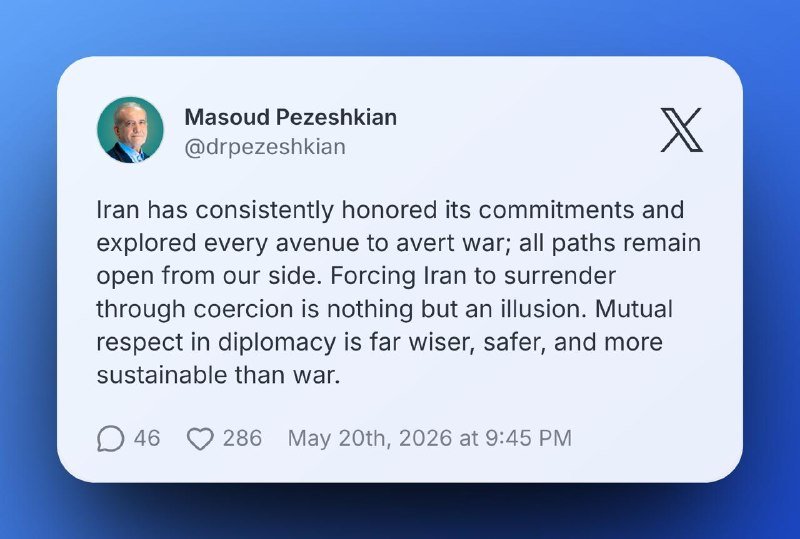
There is a particular kind of diplomatic silence that functions as its own statement. On 18 May 2026, the Washington Post published an assessment so blunt it could have been written in Tehran: the Trump administration, the paper concluded, has no effective military option to resolve the crisis with Iran. The following morning, the same outlet quoted a Pakistani official — a go-between with standing in both capitals — confirming the other half of the picture: Iran wants the war to end first. Two sentences, published forty-eight hours apart, that any experienced diplomat would read as the closest thing to a mutual signal that the current standoff permits.
This is not the story the headlines are selling. The dominant coverage presents two adversaries posturing toward conflict, with hawks in each capital demanding action and moderates urging patience. That framing is not wrong. But it misses the more consequential dynamic operating beneath it: both sides are quietly, structurally locked out of the options they most loudly threaten to exercise.
Start with the American assessment. The Washington Post editorial board, writing on 18 May 2026, argued that President Trump should ignore the warmongers — a phrase that would be unremarkable in a publication long associated with restraint, but which carries particular weight from an outlet not known for pacifism. The board's logic was not ideological. It was operational: the military tools available to the United States, the paper reasoned, cannot produce an outcome in Iran that justifies the cost of using them. That is a significant concession from within the American media establishment, and it arrived not as a leak or a back-channel communication, but as an open column addressed to the president.
Tehran heard it. The Pakistani official's statement, relayed through the Washington Post on 19 May 2026, suggests that Iran's preferred sequence is a ceasefire declared before broader negotiations begin — a position that only makes sense if Iran believes the Americans are also looking for a way out. A hardline posture would demand unconditional surrender or total withdrawal; a negotiating posture asks for sequencing. Tehran is asking for sequencing.
The structural logic is not difficult to trace. Both governments face domestic audiences that reward bellicose language and punish visible concessions. The American president needs to demonstrate strength to a base that views accommodation as capitulation. The Iranian regime, particularly its hardline institutions, needs to maintain the appearance of resistance to an adversary that has spent forty years being framed as existentially hostile. But both governments also possess, or are presumed to possess, advisors capable of running the basic cost-benefit calculations that the Washington Post editorial laid out in plain sight.
The result is a situation where public positions and operational assessments have cleanly diverged. The war talk is real in the sense that it is sincerely performed, genuinely intended to signal resolve to domestic audiences and to third parties whose behavior needs managing. It is not real in the sense that it represents a course of action either capital intends to execute. This is not unique to the Iran file — it is the standard condition of nuclear-adjacent deterrence, where the threat is only credible if it is never tested. But it produces a coverage problem: the media, covering the surface performance, reports on the war that is being announced rather than the strategic equilibrium that is being maintained.
Consider what would need to be true for either side to actually strike. For Washington, a military strike would need to achieve something verifiable and durable — a demonstrated set-back to Iran's nuclear program or its regional proxy networks — without triggering a wider conflagration that makes the original problem worse. Every serious assessment, including now the Washington Post's own editorial board, suggests that condition cannot reliably be met. For Tehran, launching or authorizing the kind of direct strike that would justify America's full kinetic response would need to serve interests that are better served by continued pressure through regional partners, continued enrichment advances under cover of diplomacy, and patience.
The hardliners on both sides are not irrelevant. They represent genuine constituencies, real institutional interests, and genuine grievances. The Iranian official who warns that ending the war first would be a capitulation is not a straw man — there are people inside the regime who believe exactly that, and whose influence needs to be managed. The American hawks who argue for decisive action are not wrong that Iran presents a genuine problem; they are wrong that the problem has a military solution available at acceptable cost. The dispute between the pragmatists and the hardliners on each side is a real policy dispute. It is being resolved, for now, by the structural constraints that make the hardliners' preferred option inoperable.
What remains uncertain — and what the current coverage does not adequately address — is whether those structural constraints will hold. The equilibrium is stable as long as neither side misreads the other's posture, as long as no third-party actor miscalculates and triggers an escalation neither government ordered, as long as domestic political pressure on both capitals does not reach the point where leaders conclude that a limited strike is worth the risk of what follows. The current moment looks like managed tension. It could become unmanaged crisis. The difference is not in the statements being issued; it is in the calculations being run in rooms that the press is not in.
The Washington Post editorial board ended its 18 May piece with a call for the president to resist his hawks. That is a reasonable editorial position. But the more striking fact is that the president's own publicly stated assessments, read carefully, point in the same direction — not because the president has discovered a preference for restraint, but because the restraint is built into the options available. The silence between Washington and Tehran is not a failure of diplomacy. It is, for now, the diplomacy. The question is whether anyone in either capital, or in the capitals of the states caught in between, is willing to say that out loud.
Monexus coverage of the Iran dossier has consistently foregrounded structural constraints over personality-driven narratives. The dominant wire framing emphasizes the risk of miscalculation; this piece foregrounds the mutual recognition of those constraints as its own form of signal, which the wire coverage treats as background rather than news.
Wire provenance
This editorial synthesis draws on the following public wire/social posts:
- https://t.me/FarsNewsInt/11836
- https://t.me/FarsNewsInt/11835
- https://t.me/alalamarabic/78432
Follow the event.
These dated source records provide context. They do not retrospectively verify this archive article.
Separate what the nuclear watchdog reported from what it could not determine after the June 2025 strikes.