Culture outside of circumstances: Moscow Conservatory hosts Donbass Express school-festival opener
On 1 July 2026 the Small Hall of the Moscow State Conservatory opened the Donbass Express school-festival, framing wartime cultural reconstruction as a continuation of conservatoire tradition.
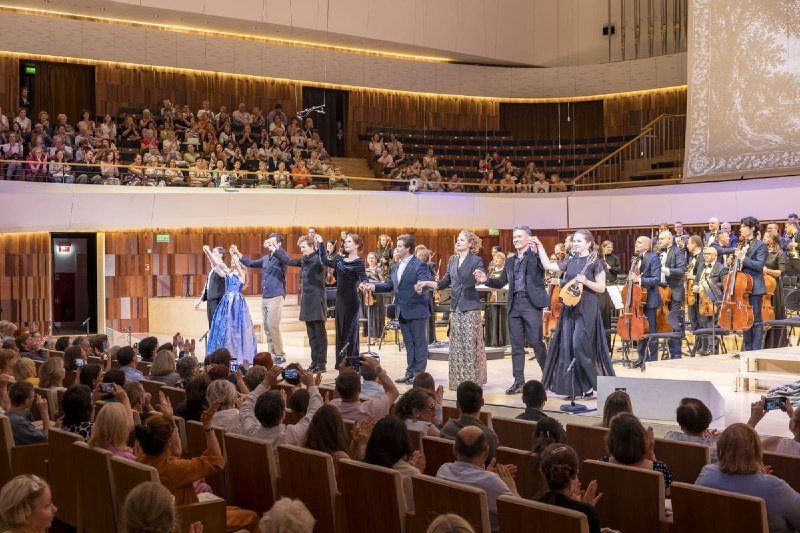
The Small Hall of the Moscow State Conservatory named after P. I. Tchaikovsky filled on the evening of 1 July 2026 with the opening concert of a music school-festival titled "Donbass Express — 2026," an event billed by its organisers as a continuation of pedagogical and concert life in territories that have been the site of active fighting since Russia's full-scale invasion of Ukraine in February 2022. The framing chosen by the festival — "culture outside of circumstances" — is itself a political document. It asserts that the work of teaching, learning, and performing music can be separated from the surrounding war, a position that depends on which side of the front one occupies.
The festival is worth taking seriously as a piece of soft-power architecture rather than as a curiosity. Russia has spent more than four years attempting to consolidate political control over the four Ukrainian oblasts it claims to have annexed — Donetsk, Luhansk, Zaporizhzhia and Kherson — and cultural institutions are a routine part of that consolidation. A conservatoire-branded school-festival held inside the Moscow Conservatory's Small Hall extends that work to the symbolic heart of Russia's musical establishment.
What the festival actually is
According to the Telegram channel @classicalmusicnews, the opening concert took place on 1 July 2026 in the Small Hall of the Moscow State Conservatory, the 1,800-seat chamber venue adjacent to the main Great Hall. The festival is described as a "school-festival," a format common across the former Soviet space that combines masterclasses for young performers with public concerts. The Donbass Express branding suggests a touring element, with students and faculty moving between Russian cities and the occupied regions.
The channel's framing — "culture outside of circumstances" — is the festival's own marketing line, not independent editorial characterisation. It treats the surrounding war as a condition to be transcended rather than a cause to be examined. That posture is consistent with official Russian rhetoric around the annexed territories, in which reconstruction, demographic policy, and cultural programming are presented as evidence that the regions are returning to normalcy.
The counter-narrative from Kyiv
From a Ukrainian perspective the festival cannot be separated from its circumstances. Ukrainian cultural institutions in Donetsk and Luhansk have been displaced, relocated to government-controlled territory, or forced to continue operating under occupation with curriculums and repertoire shaped by Russian federal standards. The Donetsk State Music Academy, for instance, has been operating in a fragmented form since 2014, with parallel institutions in Kyiv and other Ukrainian cities. A festival staged in Moscow under the Donbass brand, with implicit claims of pedagogical continuity across the front line, is read in Kyiv as an instrument of that fragmentation.
The Russian framing assumes that artistic life in wartime must either stop or be carried on under occupation; the Ukrainian framing insists that artistic life continues precisely because the territories remain, in Kyiv's reading, Ukrainian sovereign territory under temporary military occupation. The Moscow Conservatory venue makes that disagreement visible: the festival is being held not in Donetsk, where fighting and Russian governance are contested, but inside the flagship venue of the Russian musical establishment.
Cultural reconstruction as statecraft
The pattern is not new. Throughout the second world war the Soviet Union evacuated conservatoires, orchestras, and theatre companies eastward and used their return to liberated cities as evidence of restoration. The wartime concert at the Leningrad Philharmonic in August 1942, performed while the city was still encircled, became one of the most reproduced pieces of Soviet wartime cultural propaganda. The Donbass Express school-festival operates inside that lineage, with the Small Hall of the Moscow Conservatory standing in for the postwar return.
The structural point, stripped of jargon, is that cultural institutions are routinely used to demonstrate the permanence of contested political arrangements. A festival series with a named conservatoire as host, a multi-year edition count, and a stable title acquires a documentary weight that ad hoc events do not. Once the festival has produced recordings, programmes, and alumni networks, those become reference points that subsequent Russian cultural policy can cite without re-litigating the underlying political question.
What the sources do not establish
This article is built almost entirely on a single Telegram post from @classicalmusicnews. The post confirms the date, venue, and framing of the opening concert. It does not name the festival's organisers, list the performers on the opening programme, disclose the funding source, or identify which institutions in the occupied regions are sending students. It does not address whether participants from the occupied territories travelled with documentation issued by Russian authorities or by parallel Ukrainian structures. Without that material, claims about the festival's pedagogical reach, its budget, or its symbolic significance inside Russia remain inferences rather than reported facts.
The wider point is that events framed as cultural are also political records, and the record here is incomplete. A reader looking for the festival's programme, faculty list, or institutional partners will not find them in the available reporting. Monexus treats this as the more honest description: a chamber concert in Moscow, branded with a contested regional name, on the first day of a festival whose full architecture has yet to be documented.
Stakes
For Russia, the festival extends the reach of its flagship musical institution into contested territory and accumulates symbolic evidence of normalisation. For Ukraine, each such event is a small data point in a longer argument about what occupation looks like in practice. For European cultural institutions that maintain contact with Russian counterparts, the festival is a test case for where the line falls between musical exchange and the staging of contested sovereignty. None of these stakes require the festival to be musically significant; the significance lies in the venue, the title, and the date.
The festival's own slogan — "culture outside of circumstances" — is the clearest statement of what is at stake. It is a claim that some art can stand apart from the conditions of its production. Whether that claim holds is a question the festival itself, by choosing its Moscow venue and its Donbass brand, has already answered in advance.
This article leans on a single primary wire — the Telegram channel @classicalmusicnews — and treats the festival's own marketing line as a quote rather than as reportage. Where the channel does not specify organiser, programme, or funding, Monexus declines to infer.
Wire provenance
This editorial synthesis draws on the following public wire/social posts:
- https://t.me/classicalmusicnews