Iran army spokesman issues fresh warning as rhetoric war resumes
Tehran's army spokesman warns that any 'mistake' by Iran's enemies will draw a 'decisive and crushing' response, the latest volley in a slow-burn summer of mutual signalling.
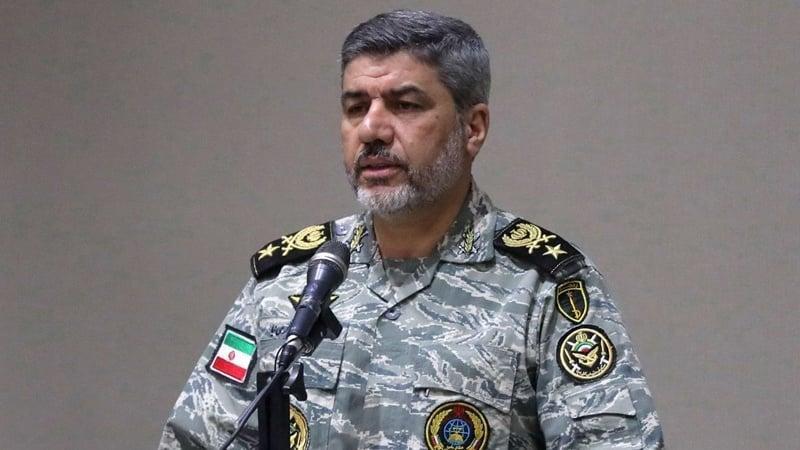
Tehran's regular-army spokesman has stepped back into the public frame with a sharply worded deterrent message, the latest in a stream of declarations by senior Iranian military officials aimed at an unspecified set of adversaries. At a briefing reported on 5 July 2026, Brigadier General Mohammad Akraminia, identified in Iranian state-aligned coverage as the army's spokesperson, said that any "mistake" by Iran's enemies would draw a "decisive and crushing" response from the Iranian armed forces.
The remarks were carried in parallel by Iranian state-affiliated media and by channels sympathetic to Tehran. Two Telegram channels — The Cradle, a Beirut-based outlet that frequently carries Iranian and resistance-axis framing, and thecradlemedia, its broadcast arm — published near-identical text versions of the statement at roughly 09:01 UTC on 5 July. A separate X account, @sprinterpress, circulated a paraphrased version about 83 minutes later, citing "the representative of the Iranian army, Brigadier General Mohammad Akramiya" — a transliteration variant of the same name. The simultaneous release across platforms suggests a coordinated push rather than a spontaneous leak.
The substance of the warning is itself the story. Read for what it actually says, the statement is a deterrent message: it names no adversary, sets no deadline and claims no specific operation. Read for what it leaves out, the same is true: there is no operational claim, no casualty count, no territorial reference. That is how official Iranian military messaging has tended to land this year — calibrated to a domestic audience that expects bellicose rhetoric and a foreign audience that watches the gap between the words and the movements.
From warning to posture
Iranian officials have leaned on deterrent language for decades; the Akraminia message follows a familiar template. The Iranian army, formally the Islamic Republic of Iran Army Ground Forces, sits structurally separate from the Islamic Revolutionary Guard Corps. Both branches have their own public spokespeople; both issue statements that emphasise readiness and reject foreign pressure. The 5 July remarks landed within that routine, not outside it.
That matters because routine rhetoric, when it clusters, can read as escalation even when nothing operational has changed. Over the summer of 2026, Iranian officials have issued overlapping statements with similar phrasing about "decisive" responses, often in the days surrounding IAEA board meetings, sanctions snap-backs or visible Israeli air activity over Lebanon. Coverage of those statements tends to magnify the loudest line and discount the institutional context. The Akraminia remark should be read against that pattern — not as an outlier, but as one more line item in an established deterrent register.
Counter-narrative
Western wires have, by long habit, treated Iranian deterrent statements as either serious operational warnings or as performative threats aimed at a domestic crowd. Both readings are partly correct, and neither alone captures how the messaging is constructed. The statements are simultaneously warnings to foreign adversaries and signals to internal constituencies — including reformist and conservative factions — that the military remains the ultimate arbiter of security. Reading them only as aimed at Washington or Tel Aviv misses the domestic audience. Reading them only as aimed at Tehran's street ignores the actual deterrent function.
A second counter-narrative worth surfacing: Iranian-aligned outlets such as The Cradle and thecradlemedia amplify these statements in English precisely because Western wires often run single-sentence summaries with no institutional context. The parallel — the same line about Iran and its "enemies" arriving simultaneously on Telegram and X — is itself a media strategy. It is the same architecture of distribution that Iranian outlets used through the Lebanon war coverage cycle: maximise reach on platforms where Western framing is thinnest.
Structural frame
What sits underneath the back-and-forth is a slow drift in the regional security architecture. The Israeli-Hezbollah front has not stabilised in any of the post-conflict months Western observers expected; the Iranian rial remains under pressure despite informal dollar-market float; Gulf states continue to mediate between Washington and Tehran on the nuclear file without committing to a deal. In that environment, calibrated deterrent messaging functions as a low-cost way to project seriousness without paying for the strategic consequences of escalation.
Iran, in this framing, is not signalling an imminent operation. It is holding a price on continued pressure — communicating that each Western or Israeli step has a reciprocal cost. That structural read sits awkwardly with the binary framing usually offered by either side of the Western press, where every Iranian statement is either empty bluster or an eve-of-war warning.
Stakes and what remains uncertain
If the trajectory continues, the cost falls on three sets of actors: Iran's neighbours, who must price insurance against escalation; European negotiators, whose limited bandwidth on the nuclear file is consumed by rhetorical echo rather than substantive progress; and ordinary Iranians, who absorb the foreign-policy risk through inflation and capital flight. The Iranian armed forces, by contrast, retain internal cohesion each time a senior officer can demonstrate that the message has been delivered on schedule.
Several things remain genuinely uncertain. The sources do not specify the operational timing behind the statement, nor do they indicate which external action prompted the warning. The transliteration of the spokesperson's name varies across the three source items ("Akraminiya" versus "Akraminia" versus "Akramiya") — a routine variance in transliteration that the Western wires would normally resolve in a single dispatch, but which here signals the speed of cross-platform republication. Finally, no Western wire has, on the record available to this article, picked up the 5 July message as a standalone story — itself an indicator that, at least for now, this register sits below the routine threshold of escalation coverage.
Wire provenance
This editorial synthesis draws on the following public wire/social posts:
- https://t.me/TheCradleMedia
- https://t.me/thecradlemedia
- https://t.me/Tasnimnews