Kenya's Tourism Sector Braces for Peak Season Under a Pile-Up of Levies
As Kenya heads into its high tourism season, operators say overlapping national and county charges are eroding margins in one of the country's most economically sensitive sectors.
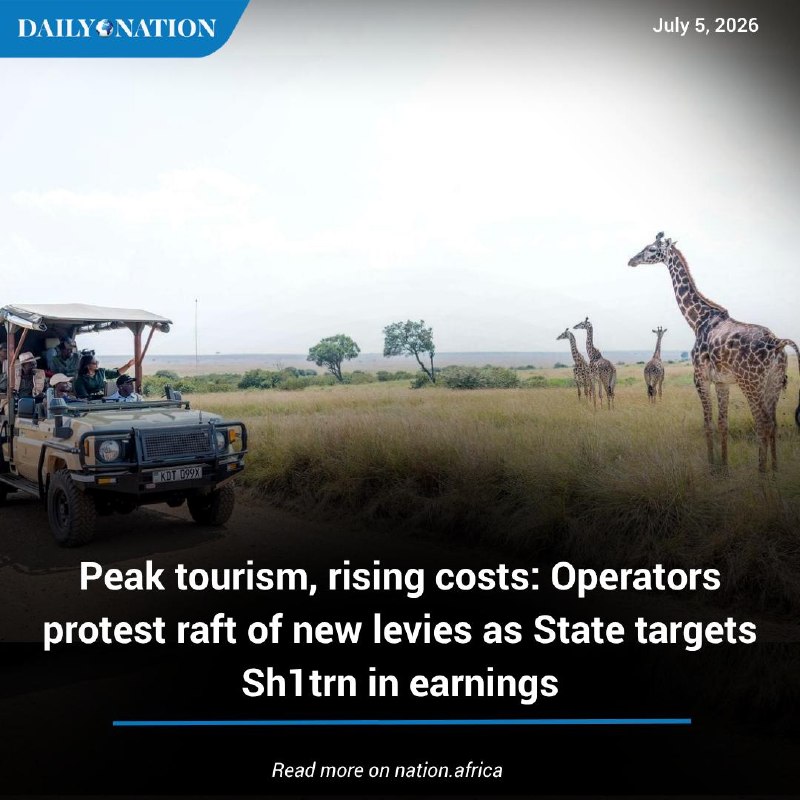
Kenya's tourism operators are walking into the year's busiest travel window carrying a heavier fiscal load than at any point in recent memory. As the country gears up for the high tourism season, the sector is reeling from multi-level levies imposed by the national and county governments on an economically sensitive sector, and operators warn that the cumulative cost is now reshaping pricing, hiring and route decisions across the country's flagship parks and coastal strips.
The pattern matters beyond any single county's budget arithmetic. Tourism contributes roughly a tenth of Kenya's gross domestic product and supports, by most government estimates, hundreds of thousands of direct and indirect jobs. A sector with that kind of weight rarely gets squeezed by accident; it gets squeezed because every level of government sees it as the easiest place to plug a revenue gap. The result is a quiet fiscal squeeze on one of Africa's most visible non-extractive industries, and a stress test of the country's devolved tax architecture.
What the operators are reporting
The most concrete complaints, as reported by Kenyan outlets covering the sector, centre on the layering of charges. Park entry fees set in Nairobi sit alongside county-level cess, vehicle charges, conservation levies and a thickening sheaf of local permits that vary by destination. Hotels say they are absorbing some of the cost to remain competitive against regional rivals in Tanzania and Uganda, where headline park fees are not always higher once the add-ons are tallied. The net effect, operators argue, is that Kenya's per-visitor yield is being quietly eroded at exactly the moment global travel demand is firming.
The structural concern is that the levies are not coordinated. National ministries set headline park tariffs and tourism levies; the 47 counties layer on their own charges; parastatals and conservancies add their own. There is no single consolidated invoice, and there is no public dashboard that lets an operator compare what a comparable guest in a comparable lodge will pay in, say, Narok versus Laikipia. That opacity is itself a competitive disadvantage.
The county-government case, and why it has weight
Counties are not extracting these levies for sport. Since the 2010 constitution devolved significant revenue-raising and service-delivery responsibility, governors have faced a chronic mismatch between mandates and own-source revenue. Tourism-rich counties — Narok, Kajiado, Kwale, Mombasa, Kilifi — sit on some of the country's most valuable natural assets but also bear the visible costs of road maintenance, garbage collection around park gates, and security in wildlife-rich areas. From their side, a tourism levy is a legitimate way to recover costs the national budget does not cover.
The national government's position, where it has been articulated, is that it is also strapped for cash and cannot fully subsidise the sector's infrastructure. Both points are empirically true: Kenya's debt service has crowded out discretionary spending, and county budgets remain tight even after the latest revenue-sharing formula adjustments. The political economy is, in other words, two squeezed tiers of government reaching into the same shallow pocket at the same moment in the calendar.
What the Global South framing adds
Covered locally, this is a story about a specific sector's cost base. Covered structurally, it is about the kind of fiscal pressure that commodity- and tourism-dependent economies in the Global South face when global capital tightens and growth slows. The World Bank and IMF have, for years, pushed African governments to broaden their tax base and reduce dependence on a narrow set of large taxpayers. Tourism operators are exactly that: a small number of visible, easily-billed firms sitting on a foreign-currency revenue stream. When the macro environment worsens, the temptation to extract more from that stream grows — even if the medium-term cost is fewer arrivals, fewer jobs, and a slower build-out of higher-yield products such as conferencing, film, and medical tourism.
The deeper question is whether Kenya is treating tourism as a strategic industry to be defended, or as a cash cow to be milked. The line between the two is being drawn, levy by levy, in the run-up to the high season.
Stakes and what to watch next
If the current trajectory holds, the most likely outcomes are uneven. Large, internationally-branded lodges with foreign-currency cost bases can absorb a marginal levy increase and pass it on to overseas tour operators. Smaller, locally-owned camps and curio economies — the parts of the sector that employ the most Kenyans per dollar of revenue — have thinner margins and fewer options. They will, in aggregate, cut hiring, defer maintenance, and quietly discount. International visitors will see lower headline prices offset by additional charges at the gate, with no single line item that explains the difference.
Three things are worth watching. First, whether the national treasury and the Council of Governors can produce a consolidated levy schedule before peak season bookings lock in; absent that, operators will price defensively. Second, whether the Kenya Tourism Board, which has historically spoken up for the sector's competitiveness, breaks its relative silence on the cumulative burden. Third, whether any county loses visible market share to a Tanzanian or Ugandan neighbour in the next two reporting cycles, which would convert a political-economy argument into an empirical one.
The sources do not specify the exact combined value of the levies now in force, nor how the burden compares year-on-year. That opacity is, in a sense, the story.
Desk note: Monexus has framed this as a fiscal-architecture story rooted in Kenya's devolved governance, rather than as a stand-alone sector complaint, because the cumulative weight of overlapping levies is the operators' specific grievance. Where the wire conversation often centres on a single new fee, the more durable question is whether the country's inter-governmental fiscal design is treating tourism as a strategic export or as a shared ATM.
Wire provenance
This editorial synthesis draws on the following public wire/social posts:
- https://t.me/DailyNation
- https://t.me/DailyNation
- https://t.me/ThePrintIndia
- https://t.me/thePrintIndia
- https://en.wikipedia.org/wiki/Tourism_in_Kenya
- https://en.wikipedia.org/wiki/Counties_of_Kenya